


Rep Council Wrap-Up: Spring 2012
June 28, 2012
In addition to authorizing a vote of its membership to allow for waiver of its maximum age rule under certain circumstances, the Representative Council of the Michigan High School Athletic Association also approved a variety of regulations and sports activities policies during its annual Spring Meeting, May 6-7, in Gaylord.
The Spring meeting of the 19-member legislative body of the Association’s over 1,500 member schools is generally the busiest of its three sessions each year. The Council considered 33 committee proposals and also dealt with a variety of eligibility rule, post-season tournament and operational issues.
A couple of the most visible changes will take place in ice hockey beginning with the 2012-13 school year, which will see longer games in the MHSAA post-season tournament and the addition of a regular-season contest. Tournament games will now have 17 minute periods, something which had been allowed by local adoption for regular season games previously. The regular season game limit was also raised, as the Representative Council approved a Hockey Committee recommendation to reduce the number of scrimmages to one in exchange for the addition of a 25th contest.
Here is a summary of other actions taken at the Spring Representative Council Meeting which will take effect during the 2012-13 school year:
Handbook/Administrative Matters
- By prior mutual consent of competing teams, schools may agree to vary the color of game uniforms to commemorate events or causes important to those schools, provided all other uniform specifications are followed. The wearing of pink and camouflage uniforms, for example, to show support for breast cancer awareness or members of our armed forces wounded in action, among others, have become popular; but previously required advanced approval from the MHSAA.
- The Council approved a revision of the sections of the MHSAA Handbook addressing the sanctioning of meets conducted by non-school organizations or individuals and large interstate meets. They now reflect the requirements of the National Federation of State High School Associations, as well as previously unstated policies and procedures of the MHSAA.
- In junior high/middle school matters, the Council revised the Handbook so that schools may decide to allow student-athletes in the 7th and 8th grades to be members of an interscholastic team in more than one sport at the same time; and to allow a student who will exceed the maximum age limit as a 7th or 8th grader to apply for “Eligibility Advancement” while in 6th grade to begin a maximum of two years of junior high/middle school participation.
Sports Matters
- Responding to situations where celebrations by student-athletes and spectators have resulted in property damage at MHSAA post-season tournaments, the Council approved the following language for inclusion in participating team and tournament managers materials addressing team and spectator conduct.
- During contests, officials will penalize under applicable sportsmanship or playing rules those student-athletes or coaches who leave the field of play and contact or approach spectator areas for celebration.
- Each tournament manager or the MHSAA Staff may determine an acceptable number of crowd supervisors necessary for each school, dependent on the situation, including inappropriate celebrations and other crowd control issues.
- The cost for repair of replacement to facilities damaged as a result of participant and/or spectator conduct shall be paid by the school involved directly to the host facility within 30 days of the bill being submitted to the school. MHSAA reimbursement or revenue sharing will be withheld until paid by the offending school. Future tournament hosting privileges or school reimbursements to offending schools may be withheld if payment is not made.
- In Golf, the Council approved a committee recommendation to allow coaching contact for one designated coach during MHSAA tournament competition on all areas of the course, except when players reach the green. The school designated coach must be identified and approved by the school prior to the MHSAA tournament. Coaching privileges may not be transferred to persons not approved and designated by school administration. A committee recommendation to exempt one qualifying round of the Michigan Amateur Tournament from the limited team membership rule beginning in 2013, replacing the exemption approved in 2010 for the two U.S. Open qualifying stages, was adopted.
- In Boys Lacrosse, a committee recommendation to limit entry in the MHSAA post-season tournament beginning in 2013 to those schools that play no fewer than 50 percent of their regular season schedule against other MHSAA member school teams was approved.
- In Soccer, the Council did not adopt a National Federation rule adoption that eliminates a substitution for a player who receives a second yellow card. This action affects the 2012-13 school year only during which the Soccer Committee will consider this rule change further and its impact on Michigan’s ten-minute sit-out rule following a yellow card.
- A second day of weigh-ins will take place at the MHSAA Team Wrestling Finals, which will be independent of the previous day’s weigh-in, and all competitors would be given a one-pound growth allowance for consecutive days of weigh-in. The Council also approved a Wrestling Committee recommendation to permit wrestling practice to begin two Mondays before Thanksgiving. The first day of competition does not change.
The Council also reviewed reports on membership, with 763 senior high schools and 768 junior high/middle schools in 2011-12; eligibility advancement applications, which totaled nine for the year; the use of Educational Transfer Forms, which was stable this year; school violations, which declined significantly; attendance at athletic director and coaches in-service workshops; officials’ registrations, topping the 12,000 mark again; rules meeting attendance; and officials reports submitted for the past three sports seasons. The Association’s $9.8 million budget for the 2012-13 school year was also approved.
The Representative Council is the 19-member legislative body of the MHSAA. All but five members are elected by member schools. Four members are appointed by the Council to facilitate representation of females and minorities; and the 19th position is occupied by the Superintendent of Public Instruction or designee.
Brush Up on the New Transfer Rule
July 18, 2019
By Rob Kaminski
MHSAA benchmarks editor
Eligibility under the new “sport-specific” transfer rule begins this coming fall after circulating extensively for nearly one school year.
Unless one of the stated 15 exceptions is met, participation during the 2018-19 school year determines eligibility for 2019-20.
The new rule adopted by the Representative Council at its May 2018 meeting has found support among most audiences. A transfer student’s eligibility in 2019-20 is based upon that student’s participation from this past school year (2018-19). It will be paramount for administrators and coaches to have awareness of the sports a transfer student participated in during the previous school year.
The long-standing 15 Exceptions to immediate eligibility, such as a full and complete residential change or a student moving between divorced parents by completing of an Educational Transfer Form, did not change.
One might call the rule on the way out “The Fourth-Friday Transfer Rule.” Under this old rule, when a student enrolled at the new school determined his or her eligibility. Under the new Sport Specific Transfer rule, what a student played in the previous season determines eligibility.
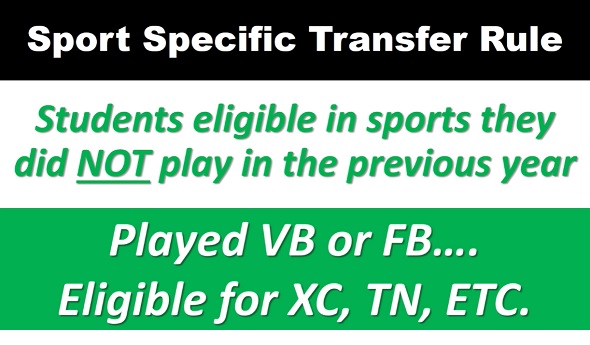
The Council passed a more lenient rule on the one hand and more restrictive on the other. The more lenient aspect is a change that finds a transfer student ELIGIBLE in any sport in which he or she did not participate in a game or a scrimmage in the previous school year.
The more restrictive portion tends to discourage students who change schools for sports reasons. A transfer student who did play a sport in the previous season – and who does not meet one of the 15 Exceptions – is NOT ELIGIBLE in that sport for the next season. If a student changes schools in mid-season, the student would be ineligible for the rest of that season in that sport and the next season for that sport.
Participation under this and other rules means playing in an interscholastic game or scrimmage after starting the 9th grade at any high school. It does not mean practice, but entering an interscholastic game, meet or scrimmage in any way. It also may involve more than one sport, so a three-sport athlete who does not have a residential change and transfers would be ineligible in those sports during the next school year – but eligible for any other sport. It also means a student cut from a team – one who never entered a scrimmage or game – may transfer and play without delay for that new school’s team. It may also mean that a student who meets one of the stated exceptions such as a residential change but enrolls in a school other than her or his school of residence, would have eligibility in sports not played in the previous year.
The new rule will tend to discourage students from changing schools for sports because they would be ineligible in any sport they have played in school the previous season for that sport. It will increase participation for some students who were otherwise not eligible under the current rule.
It is always best to contact school athletic directors who can connect with the MHSAA to verify eligibility prior to enrollment.
If the student’s new school requests in writing, the MHSAA Executive Committee may approve a waiver that reduces the period of ineligibility to 90 scheduled school days at the new school if the change of schools was for compelling reasons demonstrated with outside documentation having nothing to do with sports, curriculum, finances, and school demographics. The Executives Committee also has authority to approve immediate eligibility.