


Stoney Creek Leaders Speak Up to Save Lives
May 26, 2017
By Geoff Kimmerly
Second Half editor
The crowd for Rochester Hills Stoney Creek’s boys basketball game against rival Rochester was as rowdy as could be hoped for most of the evening Feb. 28.
 But it fell silent during halftime as Stoney Creek juniors Nate Davis, Kevin Price and Isabella Ubaydi spoke of how suicide had affected them and their community.
A student had committed suicide every year during their high school careers – including Price’s brother just six months before.
All three are members of the school’s Cougar Athletic Leadership Council, which put on the Suicide Prevention Awareness basketball game not only to raise money for the American Foundation for Suicide Prevention, but also to start the conversation on a sensitive topic that has hit home.
“We wanted to get the word out that it’s OK to talk about these issues – help the topic get out of the dark,” Ubaydi said.
“It was insane. It was awesome. There were so many people. Our student section area where we all sit was filled up to the top row. There were a lot of people from the community who didn’t go to Stoney Creek, or have alumni (associated with the school) or anything like that. But they were at Stoney Creek, and it was great to show people actually care in our community.”
The leadership council is a club made up of Stoney Creek athletes who coordinate special events, including for athletics, with an eye especially on helping the community’s youth, elderly and those with disabilities. Ubaydi, Price and Davis are co-chairs of the CALC’s special events committee.
The tragic circumstances of the last three years led the group to bring suicide prevention to the forefront. While Ubaydi spoke mostly about why the event was held and how donations would be spent, Price and Davis (Price’s best friend) talked about how suicide had affected them personally. “You could hear a pin drop,” Ubaydi said. “After we were done, (the crowd) gave a standing ovation.”
CALC raised nearly $3,500 selling T-shirts that also included free student admission to the game. After Ubaydi, Price and Davis spoke, buckets were passed through the crowd during a “miracle minute” and filled with another $1,200.
All profits from the night, including $500 from concessions, were donated to the American Foundation for Suicide Prevention, and Ubaydi said the $1,000 from the Community Service Award also will be sent to AFSP.
She’s since heard stories from teachers of classmates coming forward to express worries about people in their lives, a sign awareness is paying off. At the same time, Ubaydi and her co-chairs are just as concerned about people who didn’t attend the Suicide Prevention Awareness game and might be experiencing troubles in their lives – but the hope is the event spoke loudly enough to be heard by anyone who needs help.
All three leaders are juniors beginning to contemplate their futures after high school; Ubaydi is leaning toward Roanoke College in Virginia to study political science and minor in theology, while Price is considering Michigan State to study environmental science and Davis is looking at options for pre-law or political science. They hope to host the suicide prevention event again as seniors before they graduate, with future CALC students then carrying on the mission.
“Suicide is an uncomfortable topic to talk about. Since people saw us relating to how it has affected us personally, the community will become comfortable discussing mental illnesses together,” Ubaydi wrote in CALC’s award application.
“I wanted to have this event so people understand that the influence that one person can make may be life-changing. This then causes them to be there for others, see the signs quicker, and save more lives.”
PHOTO: (Top) Cougar Athletic Leadership Council leaders Kevin Price, Isabella Ubaydi and Nate Davis show their shirts from the school’s Suicide Prevention Awareness night. VIDEOS: (Top) State Champs! Network covered the event and interviewed its organizers. (Below) Davis, Ubaydi and Price speak during halftime, also filmed by State Champs! Network.
2017 Community Service Awards
Sunday: Colon "Yard Squad" - Read
Monday: Bailey Brown, Brighton - Read
Tuesday: Justice Ottinger, Newaygo - Read
Thursday: Katie Sesi, Ann Arbor Huron - Read
Friday: Nikki Sorgi, Utica Ford - Read
Friday: Cougar Athletic Leadership Council, Rochester Hills Stoney Creek - Read
Inglis Finds Next Home at MHSAA
December 4, 2013
By Geoff Kimmerly
Second Half editor
The theme chosen by Portage Northern’s student section for its hockey Regional Final in 1989 was “Kings of the Ice,” and as such they wore Burger King crowns as a sign of the royalty their classmates soon would earn.
Just before team captain Cody Inglis accepted the championship trophy, he skated to his friends and was anointed as well as one placed a crown upon his head.
Golden cardboard and all, Inglis received his team’s prize and circled the ice.
Inglis returned home that night eager to discuss the highlights with his dad Bill, a former professional player and one-time coach of the NHL’s Buffalo Sabres. But there was only one thing Bill had to say – and it’s a principle that’s continued to guide Cody throughout his career in high school athletics.
“I was really looking for his input and congratulations, and he looked at me and said very succinctly, ‘There’s a right way and a wrong way to do things. And you chose the wrong way,’” Inglis remembered this week. “At the time, I couldn’t see it with the perspective of a 17-year-old kid. But now I look back on it as the most valuable life lesson I’ve ever gotten.
“I knew he was proud of me. But the lesson he was trying to impart on me was doing things the right way is much more important than winning.”
Inglis has been doing things the right way for two decades while serving first at Suttons Bay and then Traverse City Central High School. He’ll bring a winning list of achievements and wealth of knowledge when he joins the Michigan High School Athletic Association staff as an assistant director in January.
Inglis, 42, has served as athletic director and assistant principal at Traverse City Central since February 2008, taking over after 11 years as athletic director at Suttons Bay. He also has served as secretary for both the Big North and Northwest Conferences and for 13 years as the northern Lower Peninsula representative of 125 athletic directors for the Michigan Interscholastic Athletic Administrators Association.
Inglis will serve as the MHSAA’s director of ice hockey, girls and boys cross country, girls and boys golf, and girls and boys bowling. In addition, he will assist in the direction of girls and boys skiing and girls and boys track and field, and be in charge of the junior high and middle school committee. Inglis also will assist with the administration of the MHSAA’s Coaches Advancement Program and provide his expertise as an instructor.
“We had more than 100 candidates, including a half dozen of the finest ADs in America – not just Michigan. They couldn’t be any better,” MHSAA Executive Director John E. “Jack” Roberts said. “Cody’s selection was based in part on his being just a slightly better fit to the job description we had in mind.
“He’s had to do some tough things as an administrator. But he’s got a personality that causes people to rally around him.”
On the move
Inglis’ dad, Bill, spent 50 years in pro hockey, most of his final 20 as general manager of the Kalamazoo K-Wings, and Cody grew up in lockerrooms around future pros like Ron Hextall, Dirk Graham and Marty Turco. When the Toledo Goaldiggers won the IHL’s Turner Cup when Cody was in sixth grade, he got to carry the cup through downtown. The family moved 17 times, and prior to the stop in Kalamazoo, Cody had never lived anywhere longer than 2½ years.
Inglis graduated from Portage Northern High School in 1989 and went on to Hope College, where he earned a bachelor’s degree in physical education and his teaching certification. He also was the captain of Hope’s 1992 men’s cross country team and captain of the men’s track & field team in both 1992 and 1993, and earned academic All-America honors for cross country.
Given his ties to pro hockey, Inglis might have had an opportunity to follow his dad. But it wasn’t for him. After graduating from Hope, Inglis enrolled at Western Michigan University to study sports management. He went to class for one day and withdrew – his heart just wasn’t into it.
 Instead, Inglis hooked up with his Portage Northern cross country coach Bill Fries and found what he did want to do – coach, and in doing so, teach athletics.
The rest is northern Lower Peninsula history.
Inglis hooked on at Suttons Bay as a 23-year physical education teacher and head cross country and track & field coach, and two years later took over the athletic department.
“I was thrown into the fire right away, but I had a desire to be in sports somehow and coaching was a passion of mine,” Inglis said. “It was kinda sink or swim. I realized the craziness and hecticness of it, but it was something I embraced. I was lucky to have the opportunity to do it at Suttons Bay, to grow there and have people who were willing to let me make some mistakes, learn from my mistakes and become a better administrator.”
Inglis has supervised a group of more than 100 coaches while at Traverse City Central, plus a group of more than 20 teachers and staff as part of his assistant principal duties.
He’s managed more than 100 MHSAA Tournaments, including Ski Finals, Football Semifinals and Hockey Quarterfinals, and a variety of lower tournament levels for hockey, wrestling, track and field, cross country, basketball and golf.
His programs have achieved plentiful success under his leadership. Traverse City Central won the Big North Conference all-sport award every year from 2008-12 and earned six MHSAA Finals team championships during his tenure. The varsity programs have produced 34 academic all-state awards over the past three school years – including 14 in 2012-13 – and 62 percent of the student body was involved in athletics last school year.
While at Suttons Bay, Inglis led an athletic program that won the Northwest Conference sportsmanship trophy nine times and earned two MHSAA Finals championships. He also redeveloped athletic boosters programs, oversaw construction projects and was instrumental in the rewriting of athletic policies at both schools.
He was recognized in the spring with the MHSAA’s Allen W. Bush Award, which recognizes those who serve in high school athletics but do not always receive attention for their contributions.
Mentor to follow
Inglis was instrumental in the creation and later served as an assistant coach for the Traverse City Bay Reps ice hockey team, a co-operative headed by Traverse City St. Francis High School that’s now been in existence 15 seasons. He also was named Division 4 Girls Cross Country Coach of the Year in 2002 by the Michigan Interscholastic Track Coaches Association after leading his team to a runner-up finish at the MHSAA Finals.
Inglis coached a string of girls cross country teams that made the top 10 at MHSAA Finals five straight seasons, plus 25 all-state athletes in cross country and track and field including three individual MHSAA champions.
He has been a member of seven MHSAA sport committees, including for ice hockey. He’s been a frequent presenter at the MIAAA’s annual conferences, covering topics including fundraising, budgeting, organizing successful tournaments, balancing multiple roles and responsibilities, leadership and technology. He’s also taught MIAAA Leadership Training Courses.
Of little surprise, Inglis has been greatly impacted by growing up following his dad. While mother Jeris was the rock of the family, Bill was Cody’s idol and made a significant impact on the manager Inglis has become.
“My dad was so good at the way he treated people. I just saw how he treated them, whether it was the Zamboni drive or an assistant or secretary, he treated them with so much respect,” Inglis said. “That’s the part I’ve really taken from him, how he treated people and the relationships he made. How you treat people in athletics is so key; they’ll treat you the same way back, I’ve found most of the time.”
Inglis received minor degrees at Hope in business administration and communications, and has completed a number of courses toward a master’s in athletic administration from Ohio University.
He is married to Carrie (Ham) Inglis, an MHSAA Finals cross country individual champion for Big Rapids in 1987. They have three sons.
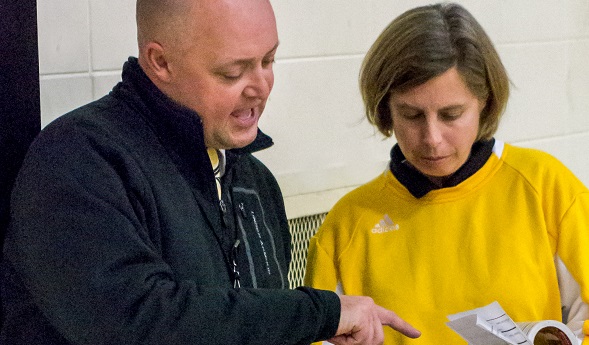
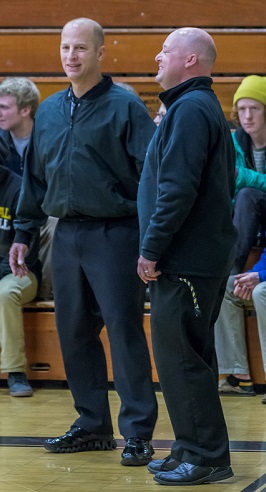
PHOTO: (Top) Traverse City Central athletic director Cody Inglis converses with a member of his staff Tuesday. (Middle) Inglis shares a laugh with an official before Tuesday's girls basketball games. (Photos courtesy of Rick Sack.)