

Stoney Creek Leaders Speak Up to Save Lives
May 26, 2017
By Geoff Kimmerly
Second Half editor
The crowd for Rochester Hills Stoney Creek’s boys basketball game against rival Rochester was as rowdy as could be hoped for most of the evening Feb. 28.
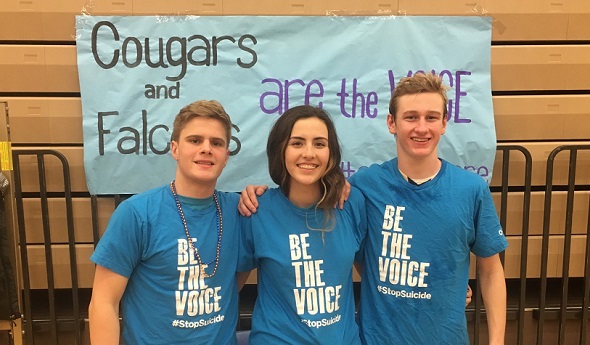
 But it fell silent during halftime as Stoney Creek juniors Nate Davis, Kevin Price and Isabella Ubaydi spoke of how suicide had affected them and their community.
A student had committed suicide every year during their high school careers – including Price’s brother just six months before.
All three are members of the school’s Cougar Athletic Leadership Council, which put on the Suicide Prevention Awareness basketball game not only to raise money for the American Foundation for Suicide Prevention, but also to start the conversation on a sensitive topic that has hit home.
“We wanted to get the word out that it’s OK to talk about these issues – help the topic get out of the dark,” Ubaydi said.
“It was insane. It was awesome. There were so many people. Our student section area where we all sit was filled up to the top row. There were a lot of people from the community who didn’t go to Stoney Creek, or have alumni (associated with the school) or anything like that. But they were at Stoney Creek, and it was great to show people actually care in our community.”
The leadership council is a club made up of Stoney Creek athletes who coordinate special events, including for athletics, with an eye especially on helping the community’s youth, elderly and those with disabilities. Ubaydi, Price and Davis are co-chairs of the CALC’s special events committee.
The tragic circumstances of the last three years led the group to bring suicide prevention to the forefront. While Ubaydi spoke mostly about why the event was held and how donations would be spent, Price and Davis (Price’s best friend) talked about how suicide had affected them personally. “You could hear a pin drop,” Ubaydi said. “After we were done, (the crowd) gave a standing ovation.”
CALC raised nearly $3,500 selling T-shirts that also included free student admission to the game. After Ubaydi, Price and Davis spoke, buckets were passed through the crowd during a “miracle minute” and filled with another $1,200.
All profits from the night, including $500 from concessions, were donated to the American Foundation for Suicide Prevention, and Ubaydi said the $1,000 from the Community Service Award also will be sent to AFSP.
She’s since heard stories from teachers of classmates coming forward to express worries about people in their lives, a sign awareness is paying off. At the same time, Ubaydi and her co-chairs are just as concerned about people who didn’t attend the Suicide Prevention Awareness game and might be experiencing troubles in their lives – but the hope is the event spoke loudly enough to be heard by anyone who needs help.
All three leaders are juniors beginning to contemplate their futures after high school; Ubaydi is leaning toward Roanoke College in Virginia to study political science and minor in theology, while Price is considering Michigan State to study environmental science and Davis is looking at options for pre-law or political science. They hope to host the suicide prevention event again as seniors before they graduate, with future CALC students then carrying on the mission.
“Suicide is an uncomfortable topic to talk about. Since people saw us relating to how it has affected us personally, the community will become comfortable discussing mental illnesses together,” Ubaydi wrote in CALC’s award application.
“I wanted to have this event so people understand that the influence that one person can make may be life-changing. This then causes them to be there for others, see the signs quicker, and save more lives.”
PHOTO: (Top) Cougar Athletic Leadership Council leaders Kevin Price, Isabella Ubaydi and Nate Davis show their shirts from the school’s Suicide Prevention Awareness night. VIDEOS: (Top) State Champs! Network covered the event and interviewed its organizers. (Below) Davis, Ubaydi and Price speak during halftime, also filmed by State Champs! Network.
2017 Community Service Awards
Sunday: Colon "Yard Squad" - Read
Monday: Bailey Brown, Brighton - Read
Tuesday: Justice Ottinger, Newaygo - Read
Thursday: Katie Sesi, Ann Arbor Huron - Read
Friday: Nikki Sorgi, Utica Ford - Read
Friday: Cougar Athletic Leadership Council, Rochester Hills Stoney Creek - Read

MHSAA.TV Joins NFHS Network
September 12, 2013
The Michigan High School Athletic Association is one of 32 members of the National Federation of State High School Associations (NFHS) that has joined the NFHS Network, the new all-digital network devoted to coverage of high school sports and performing arts through the Internet at MHSAA.tv and NFHSnetwork.com.
The NFHS, in association with PlayOn! Sports (PlayOn), announced the official launch of the NFHS Network on Aug. 1. With coverage of boys and girls sports and activities initially in at least 32 states during the 2013-14 school year, the NFHS Network becomes the largest aggregated destination for coverage of high school sports in the country. Through a digital service that is at least partially subscription-based available at MHSAA.tv and NFHSnetwork.com, more students, parents and fans will be able to watch high school sports than ever before.
In addition to the MHSAA, NFHS member associations in the following states have finalized agreements and will be a part of the NFHS Network as the 2013-14 season begins: Alabama, Arizona, Arkansas, Colorado, Connecticut, Delaware, Florida, Georgia, Kentucky, Louisiana, Maine, Massachusetts, Mississippi, Montana, Nebraska, Nevada, New Hampshire, New Mexico, North Dakota, Oregon, Pennsylvania, Rhode Island, South Carolina, Tennessee, Utah, Vermont, Virginia, Washington, West Virginia, Wisconsin and Wyoming.
In addition, member associations in a number of other states are expected to join the NFHS Network soon.
“We believe this is one of the greatest opportunities in the 94-year history of the NFHS as we are able to take advantage of new technology and showcase high school sports and performing arts across the United States,” said Bob Gardner, NFHS executive director. “We are excited to provide viewership opportunities for fans of high school sports that have never existed before. The NFHS Network will help showcase our primary mission of expanding participation and opportunities for involvement in education-based interscholastic sports and performing arts activities.”
“For more than a century, school sports has had the highest profile of all youth sports,” said John E. “Jack” Roberts, MHSAA executive director. “We feature pep assemblies, pep bans, marching bands, cheerleaders, homecoming parades and dances, letter jackets and other traditions, with large crowds of classmates, neighbors and families cheering on students. Ours is a unique brand that stands out among all of youth sports. Done right, this network will solidify interscholastic athletics as the most popular and principled youth sports experience for many more generations.”
Postseason games in all sports sponsored by the MHSAA will be available online on the Network, except for select championship events for which the MHSAA has existing television contracts with other media partners. Viewing opportunities for other NFHS Network events will be posted in the coming months at NFHSnetwork.com.
The NFHS Network will build on the past success of PlayOn’s high-quality coverage of high school sports at the state level. PlayOn currently streams nearly 30,000 events per school year and has worked with 32 state associations and sections in 26 states.
“Teaming up with the NFHS is a natural progression to build a truly national high school sports platform while honoring the local communities that support them,” said David Rudolph, PlayOn! Sports chief executive officer. “Our mission is to serve the current and future generations of student-athletes, support and encourage their participation and make their performances accessible to their friends, family and fans on every media platform they use.”
The NFHS Network is a joint venture between the NFHS and PlayOn! Sports and will be governed and overseen by a combination of NFHS and PlayOn executives. On Aug. 8, Roberts was elected chairman of the five-member NFHS Network board of directors that will be responsible for guiding the Network. “This won’t be easy,” Roberts said, “but nothing really worthwhile ever is.”
“Ultimately, we want to make the NFHS Network the most treasured and trusted source for high school athletics,” Gardner said.