


Use of Participation Fees Falls Slightly
July 29, 2015
By Geoff Kimmerly
Second Half editor
The percentage of Michigan High School Athletic Association high schools that assessed participation fees to help fund interscholastic athletics dropped five percent during the 2014-15 school year to its lowest since 2011-12, according to the most recent survey taken by the MHSAA – although the ratio of schools assessing fees remained above 50 percent of respondents for the fifth straight year.
A total of 522 high schools – or 69 percent of the MHSAA membership – responded to the 2014-15 survey for the highest feedback rate since 2010-11. A total of 269 high schools, or 51.5 percent that took the survey, charged fees this school year, compared to 56.6 percent of schools that responded in 2013-14.
There were 753 senior high schools in the MHSAA membership in 2014-15. This was the 11th survey of schools since the 2003-04 school year, when members reported fees were being charged by 24 percent of schools. The percentage of member schools charging fees crossed 50 percent in 2010-11 and remained at 50.5 percent in 2011-12 before making a nearly five-percent jump three school years ago.
The largest drop of those charging fees in 2014-15 came at Class B schools, with 52 percent reporting fees after 62 percent reported using them in 2013-14. Class A schools saw a seven-percent decrease to 70 percent with fees, and Class D schools saw a four-percent decrease to 35 percent that assessed. Class C schools saw a one-percent increase to 47 percent assessing for participation.
Charging a standardized fee for each team on which a student-athletes participates – regardless of the number of teams – remains the most popular method among schools assessing fees, although that rate fell slightly from 41 percent of schools assessing during 2013-14 to 39 percent this school year. Schools charging a one-time standardized fee per student-athlete also fell, from 33 to 28 percent of schools that assess fees. The survey showed a slight increase in schools assessing fees based on tiers of the number of sports a student-athlete plays (for example, charging a larger fee for the first team and less for additional sports). There also was a slight increase in fees being assessed based on the specific sport being played.
The median fee by schools that charged student-athletes per sport did drop $10 to $75. Other fees remained consistent from the 2013-14 school year: the median one-time student fee at $100, the median annual maximum fee per student at $150 and the median annual maximum family fee at $300.
The survey for 2014-15 and surveys from previous years can be found on the MHSAA Website by clicking here.
The MHSAA is a private, not-for-profit corporation of voluntary membership by more than 1,400 public and private senior high schools and junior high/middle schools which exists to develop common rules for athletic eligibility and competition. No government funds or tax dollars support the MHSAA, which was the first such association nationally to not accept membership dues or tournament entry fees from schools. Member schools which enforce these rules are permitted to participate in MHSAA tournaments, which attract more than 1.4 million spectators each year.
MHSAA Accepting Student Advisory Council Applications for Class of 2028
By
Geoff Kimmerly
MHSAA.com senior editor
April 8, 2026
The Michigan High School Athletic Association is seeking student-athletes to become members of its Student Advisory Council beginning with the 2026-27 school year.
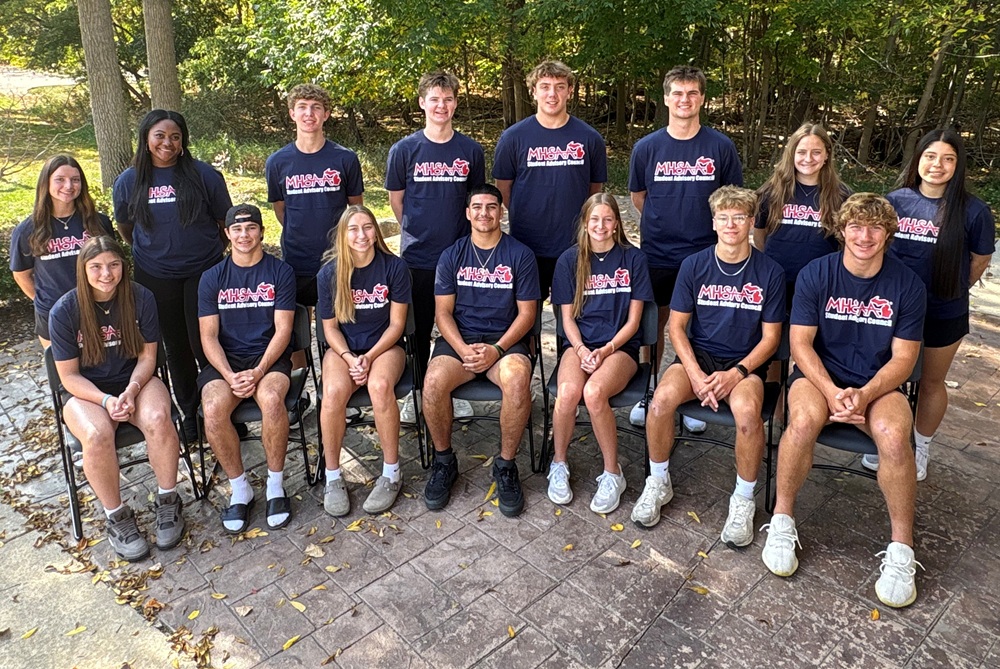
Four boys and four girls from the Class of 2028 will be selected to two-year terms and will meet on matters related to maintaining and promoting a proper perspective and sensible scope for high school sports in Michigan. Eight members from the Class of 2027 already are serving on the Council, while eight members from the Class of 2026 are leaving the Council this spring.
To be eligible for the committee, candidates must be a member of the Class of 2028, complete the official application including answering the three short-answer questions, submit a letter of recommendation from a school administrator, have a cumulative GPA of at least 3.0 (on a 4.0 scale) and be available for all scheduled meetings.
In addition, candidates should show a history of leadership on athletic teams as well as with other extracurricular activities, community service projects, or in the workplace; and show an understanding of the role of school sports and have ideas for promoting a proper perspective for educational athletics.
Applications are due to the MHSAA by 4:30 p.m. on April 20. Applications can be downloaded from the Student Advisory Council page and must be returned via e-mail, fax or any mail delivery service.
The Student Advisory Council meets in person five times each school year, three times via Zoom, and once more for a 24-hour leadership camp. In addition to assisting in the promotion of the educational value of interscholastic athletics, the Council discusses issues dealing with the 4 S’s of educational athletics: scholarship, sportsmanship, safety (including health and nutrition) and the sensible scope of athletic programs. A fifth S – student leadership – is also a common topic. Members contribute to the planning of Sportsmanship Summits and other student leadership events, and assist with medal ceremonies at MHSAA championship events.
Newly-chosen members will join the following from the Class of 2027: Nichole James, Detroit Edison; Mia McGregor, Mio; Camryn Siegers, Holland Christian; Lucy Weber, Fenton; Brody Hammer, Middleville Thornapple Kellogg; Sam Bentley, Ypsilanti Lincoln; Mason Mireles, Hartford; and Joey Smokevitch, Johannesburg-Lewiston.
The eight new members of the Student Advisory Council will be notified by May 1. The 2026-27 in-person meetings at the MHSAA Office in East Lansing are tentatively scheduled for Aug. 23, Oct. 4, Dec. 6, Feb. 7 and April 25, in addition to Zoom meetings Sept. 13, Jan. 10 and March 7. For additional information, contact Andy Frushour at the MHSAA at (517) 332-5046 or [email protected].
PHOTO The 2025-26 MHSAA Student Advisory Council.