


Winter Rules Additions Focus on Safety
December 5, 2013
Rules promoting greater player safety and improved coach-player communication highlight the playing rules changes for the winter sports season now underway at Michigan High School Athletic Association member schools across the state.
The winter sports season involves eight different sports and approximately 70,000 student-athletes. Practices began as early as late October; and tournaments begin in mid-February, running through the end of March. Competition is already underway in Girls Basketball, Bowling in the Upper Peninsula, Girls Competitive Cheer, Girls Gymnastics, Ice Hockey, and Upper Peninsula Swimming & Diving. On Saturday (Dec. 7), competition begins for Bowling and Swimming in the Lower Peninsula, as well as Wrestling. The Boys Basketball season begins on Monday (Dec. 9), and Skiing events may begin on Dec. 14.
Ice Hockey has several rules changes promoting player safety. “Blind-side” hits, checks to an unsuspecting or vulnerable player, can now be penalized; and the rule prohibiting a player form pushing, charging, cross or body-checking an opponent from behind into the boards or goal frame has reinstated the discretion for the official to issue a game disqualification when flagrant. Another safety change stops play when the goalkeeper’s glove is displaced – expanding a rule where the displacement of the keeper’s mask or helmet stops play.
Additionally, an embellishment rule has been added to discourage players from taking dives to draw penalties and exaggerating the severity of the impact of a play in which a penalty is called. Finally, when the attacking team bats the puck directly on goal, it shall result in an immediate whistle and a resulting faceoff at the defensive zone faceoff spot of the offending team.
In Basketball and Wrestling, electronic devices may now be used on the bench or in the corner for coaching purposes – for example, to show plays or keep statistics. Devices may not be used to dispute officials’ calls.
The head coach in Basketball may enter the court without penalty when a fight may break out or has broken out to prevent the situation from escalating. Players and assistant coaches who leave the bench in such situations will continue to be assessed flagrant technical fouls and be disqualified from the contest.
In keeping with rules book language published a few years ago in football, the basketball rules have added a section which limits public address announcers’ action during play. PA announcers, during game action, are limited to announcing who scores baskets and commits fouls. Any other announcements during play, like time remaining, are inappropriate. General announcements during time outs are still allowed.
In Wrestling, forfeits are no longer considered as matches when considering the five-matches-in-one-day limit for competition.
Winter tournaments begin the first full week of February in wrestling. The first MHSAA Finals of the season are the Upper Peninsula Swimming & Diving Finals on February 15, and tournaments conclude with the Boys Basketball Semifinals & Finals, March 21-22.
Applications Available for 2026-27 MHSAA/Farm Bureau Insurance Scholar-Athlete Awards
By
Geoff Kimmerly
MHSAA.com senior editor
October 6, 2026
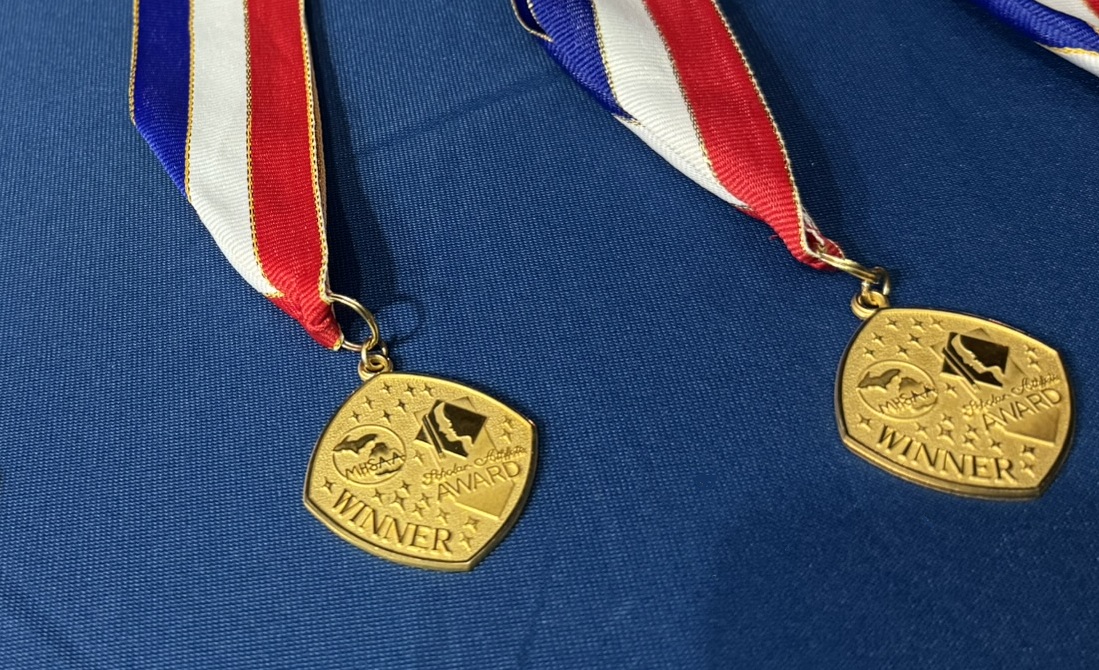
One of the Michigan High School Athletic Association’s most popular programs, the Scholar-Athlete Award, will again with Farm Bureau Insurance present 32 $2,000 scholarships to top student-athletes at member high schools during the 2026-27 school year.

The MHSAA/Farm Bureau Insurance Scholar-Athlete Award highlights the value extracurricular activities play in the total education of high school students, often improving their academic achievements in the process. The Scholar-Athlete Award is in its 38th year. Since the award’s inception in 1988-89, Farm Bureau Insurance has presented more than $1 million in scholarships through this program.
The first 30 scholarships will be presented on a graduated basis across the MHSAA’s traditional class structure. From Class A schools, six boys and six girls will receive scholarships; from Class B schools, four boys and four girls; from Class C schools, three boys and three girls; and from Class D schools, two boys and two girls will be honored. The final two scholarships will be awarded at-large to minority recipients, regardless of school size. The scholarships may be used at the institution of higher learning the recipients attend during the first year at those colleges.
Applications from individual schools will be limited to the number of available scholarships in their enrollment class. Class A schools may submit the names of six boys and six girls, Class B schools may submit four boys and four girls, Class C may submit three boys and three girls and Class D may submit two boys and two girls.
Students applying for Scholar-Athlete Awards must be graduating during the 2026-27 school year, carrying an unrounded 3.5 (on a 4.0 scale) grade-point average and have won a varsity letter in a sport in which the MHSAA sponsors a postseason tournament: baseball, girls and boys basketball, girls and boys bowling, competitive cheer, girls and boys cross country, field hockey, football, girls and boys golf, gymnastics, ice hockey, girls and boys lacrosse, girls and boys skiing, girls and boys soccer, softball, girls and boys swimming & diving, girls and boys tennis, girls and boys track & field, girls and boys volleyball and girls and boys wrestling.
Applicants will be required to show involvement in other school and community activities and submit an essay on the importance of sportsmanship in educational athletics.
Information – including answers to a number of frequently asked questions – and links to the application are available online on the Scholar-Athlete Award page. Applications are available in digital format only and must be submitted online by 4 p.m. Dec. 4.
A committee composed of school administrators from across the state will select finalists and winners in late January, with the winners to be announced throughout February. All applicants, finalists and scholarship recipients will be announced on the MHSAA Website. The 32 scholarship recipients will be recognized during the 2027 MHSAA Boys Basketball Finals at the Breslin Student Events Center in East Lansing.
Farm Bureau Insurance of Michigan was founded in 1949 by Michigan farmers who wanted an insurance company that worked as hard as they did. Those values still guide the company today and are a big reason why it is known as Michigan’s Insurance Company, dedicated to protecting the farms, families, and businesses of this great state. Farm Bureau Insurance agents across Michigan provide a full range of insurance services – life, home, auto, farm, business, retirement, Lake Estate®, and more – protecting more than 660,000 Michigan residents.
The MHSAA is a private, not-for-profit corporation of voluntary membership by more than 1,500 public and private senior high schools and junior high/middle schools which exists to develop common rules for athletic eligibility and competition. No government funds or tax dollars support the MHSAA, which was the first such association nationally to not accept membership dues or tournament entry fees from schools. Member schools which enforce these rules are permitted to participate in MHSAA tournaments, which attract more than 1.4 million spectators each year.