

New Math: Division & Multiplication Problems
July 25, 2017
By Jack Roberts
MHSAA Executive Director
This is the second part in a series on MHSAA tournament classification, past and present, that will be published over the next two weeks. This series originally ran in this spring's edition of MHSAA benchmarks.
High school tournament classifications went viral before there was social media and most of us knew what “viral” meant.
Much as a virus infects computers today or has created epidemics of disease around the world for centuries, high school tournament classification – once introduced – tends to spread uncontrollably. Once started, it tends to keep expanding and rarely contracts.
While we are still some distance from providing every team a trophy as a result of expanding high school tournament classification across the country, there is criticism nevertheless that we are headed in that direction – a philosophy which is supposed to exist only in local youth sports for our youngest children.
Michigan could be blamed for all this. Michigan is generally accepted as the first state to provide different classifications for season-ending tournaments for different sized schools. It started a century ago. Today, every state has various classifications for its tournaments in most if not all sports. And it is a bit ironic that Michigan – creator of the classification chaos – more than most other states has kept the number of tournament classes or divisions under control.
Yes, there is evidence that tournament classifications have expanded over the years in Michigan, especially with the relatively recent introduction of tournaments in football and the late 1990s’ move from classes to divisions in most MHSAA tournaments. But the MHSAA Representative Council has held true to its word when it expanded the playoffs for football from four classes to eight divisions: this is needed because of unique factors of football, factors that exist in no other sport; and all other sports should be capped at a maximum of four classes or divisions.
Kentucky is the preeminent defender of single-class basketball. All of its 276 high schools compete for the single state championship for each gender. In Indiana, there are still open wounds from its move in 1998 from one to four classes for its 400 schools in basketball.
Multi-class tournaments have tended to increase the number of non-public school champions, which some states are trying to lower through enrollment “multipliers,” and also tend to increase the number of repeat champions, which some states are trying to affect with “success factors” which lift smaller schools into classifications for larger schools if they take home too many trophies.
While there is considerable evidence that state tournaments do as much bad as good for educational athletics, state associations persist in providing postseason tournaments because, on balance, the experiences are supposed to be good for student-athletes. And once we reach that conclusion it is just a small leap to believe that if the tournaments are good for a few, they must be better for more – which leads to creating more and more tournament classifications. One becomes two classes, then three, then four and so forth.
While the argument is that more classifications or divisions provides more students with opportunities to compete and win, it is undeniable that the experience changes as the number of tournament classifications expands. It is not possible for state associations to provide the same level of support when tournament classifications expand to multiple venues playing simultaneously. For example, there is less audio and video broadcast potential at each venue, and less media coverage to each venue. Focus is diluted and fans diminished at each championship.
No one can argue reasonably that today's two-day MHSAA Football Finals of eight championship games has the same pizazz as the one-day, four-games event conducted prior to 1990.
In some states the number of divisions has grown so much that it is difficult to see much difference between the many season-ending state championship games and a regular-season event in the same sport.
It is a balancing act. And Michigan has been studying that balance longer than any other state, and charting a steadier course than most.
Addition by Division
The shift to Divisions for MHSAA Tournament play in numerous sports has added up to a greater number of champions for teams and individuals across the state. Following are the sports currently employing a divisional format, and the procedures for determining enrollment and classification.
In 23 statewide or Lower Peninsula tournaments, schools which sponsor the sport are currently divided into nearly equal divisions. They are:
- Baseball - 4 Divisions
- Boys Bowling - 4 Divisions
- Girls Bowling - 4 Divisions
- Girls Competitive Cheer - 4 Divisions
- LP Boys Cross Country - 4 Divisions
- LP Girls Cross Country - 4 Divisions
- LP Boys Golf - 4 Divisions
- LP Girls Golf - 4 Divisions
- Ice Hockey - 3 Divisions
- Boys Lacrosse - 2 Divisions
- Girls Lacrosse - 2 Divisions
- Boys Skiing - 2 Divisions
- Girls Skiing - 2 Divisions
- LP Boys Soccer - 4 Divisions LP
- Girls Soccer - 4 Divisions
- Girls Softball - 4 Divisions
- LP Boys Swimming & Diving - 3 Divisions
- LP Girls Swimming & Diving - 3 Divisions
- LP Boys Tennis - 4 Divisions
- LP Girls Tennis - 4 Divisions
- LP Boys Track & Field - 4 Divisions
- LP Girls Track & Field - 4 Divisions
- Wrestling - 4 Divisions
Lists of schools for each division of these 23 tournaments are posted on MHSAA.com approximately April 1. Listings of schools in Upper Peninsula tournaments for their sports are also posted on MHSAA.com. The lists are based on school memberships and sports sponsorships in effect or anticipated for the following school year, as known to the MHSAA office as of a date in early March.
In football, the 256 schools which qualify for MHSAA 11-player playoffs are placed in eight equal divisions annually on Selection Sunday. Beginning in 2017, the 8-player divisions will be determined in a like manner on Selection Sunday as well, with 32 qualifying schools placed in two divisions.
Schools have the option to play in any higher division in one or more sports for a minimum of two years.
The deadlines for "opt-ups" are as follows:
- Applications for fall sports must be submitted by April 15
- Applications for winter sports must be submitted by Aug. 15
- Applications for spring sports must be submitted by Oct. 15
Subsequent to the date of these postings for these tournaments, no school will have its division raised or lowered by schools opening or closing, schools adding or dropping sports, schools exercising the option to play in a higher division, or approval or dissolution of cooperative programs.
When the same sport is conducted for boys and girls in the same season (e.g., track & field and cross country), the gender that has the most sponsoring schools controls the division breaks for both genders.
Talented Escanaba Pursuing Title Repeat
May 14, 2019
By Dennis Grall
Special for Second Half
ESCANABA – Ever since softball became part of the Escanaba High School athletic program in 1997, it has been among the best and most consistent offerings in the state.
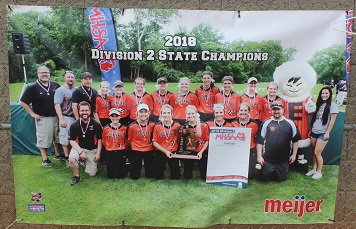
 Last year the Eskymos confirmed their elite prep status by winning the MHSAA Division 2 title, and they again are in the thick of this year's championship picture. Escanaba belted South Haven 5-0 in last season’s Final, after clipping Eaton Rapids 2-0 in the Semifinal two days before.
The Eskymos won their final 13 games last year to finish 31-3. Gabi Salo, then a sophomore, fanned 11 of the title game's opening 13 batters and allowed three hits while punching out 13 batters total. Salo and Escanaba yielded just two runs over seven postseason games. The six EHS seniors on that team compiled a 131-18 record during their four seasons.
Escanaba previously was Division 1 runner-up in 2003 and lost in Division 2 Semifinals in 2016 and 2017.
Salo has helped the Eskymos to a 15-1 record in this weather-marred spring, and Escanaba was ranked No. 1 in the state before losing to Kent State recruit Gabbie Sherman and Division 3 top-rated Millington 3-0 on Friday in Escanaba. Sherman, another of the state's prime pitchers, also throttled Escanaba 2-1 last year.
The Eskymos rebounded from Friday's loss in grand style on a frigid Saturday, whipping Marshfield, Wis., 9-5 and then clipping arch-rival Gladstone 7-0 behind a perfect game by Salo, who whiffed 14 batters.
Gladstone manager John Nevala said "if her control is good and she can get the corner called, she can be called unhittable. We had been hitting the ball pretty good until we faced Gabi."
Salo demonstrated better location and control against Gladstone than the previous night's rare loss. "She is in a class of her own," said Nevala. "She has to be one of the top pitchers in the state. She had very good movement.
"She has excellent speed (around 64-65 mph) and an excellent changeup. She changes speeds so well. She probably has three different speeds. You can't really dig in on one location at the plate."
This season Salo is 10-1 with two saves and sports a dominating 0.02 ERA. She has struck out 136 batters in 69 2/3 innings, but has also issued eight walks and hit four batters during wicked spring conditions the opening month. (NOTE: After a pair of no-hitters Monday and Tuesday against Marquette and Gladstone, respectively, Salo is 12-1 with 161 strikeouts in just under 84 innings pitched.)
A University of Wisconsin recruit since last spring, Salo felt she threw well against Millington and Gladstone, but indicated she was "pretty tight" in the freezing opener. She said her curveball and changeup worked better against Gladstone.
She didn't pay attention to keeping Gladstone off the bases. "I try not to think about those things. I feel like it is a jinx," she said.
 Salo worked hard last year to develop her back-breaking change-up and now terms it her favorite pitch. "It is spot-on," she said. "It throws the hitters off their game. I go out, focus and attack the hitter. I like getting swinging strikes." She is not afraid to use her change on a 3-2 count.
She fires her fastball down-and-in or inside-and-high and loves to get her pitches inside on the batter's fists.
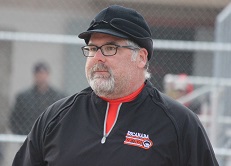
The Escanaba first-year manager is her father, Gary, who was the pitching coach for the Eskymos last year under Jamie Segorski, who resigned as coach just as practice began this spring. Gary and Gabi have been together for several years on different summer travel teams.
He signals the pitches from his dugout perch, using input from his daughter and junior catcher and Ferris State commit Dakota Cloutier, who also handled that spot last season.
Senior right fielder Lexi Chaillier, a three-sport, four-year standout, leads the Eskymos with a .481 batting average and five home runs. Gabi Salo leads with 18 RBI and hits .378, while sophomore first baseman-pitcher Nicole Kamin is hitting .477 with 14 runs driven in. Cloutier is hitting .356 with 12 RBI.
Expect that quartet to lead the way this weekend when the Eskymos play in a highly-competitive 20-team invitational tournament in Ann Arbor. The strong field is what the Eskymos search for in compiling a schedule, with trips into Wisconsin and lower Michigan to find high-quality opponents.
Referring to other top hurlers, along with Millington's circle ace, Gary Salo said "we want to go up against elite pitching if we want to go to the next level." And now, with a state title, he said the Eskymos know "we are going to get everybody's best game."
After Friday's loss and the twin wins Saturday, the Escanaba skipper said "our kids are very resilient. We licked our wounds."
Much of the high school program's success is credit to a tremendous Little League program. Gabi Salo began pitching at age 10 when her youth coach asked if anyone wanted to throw. For many years she has received extensive coaching from Pat Brower in Ann Arbor. "He has developed Gabi into the pitcher she is," said her dad. "It is well worth driving six-and-a-half hours each way."
 Gabi Salo began her travel ball experience with the Escanaba Heartbreakers at age 10, then joined downstate teams, playing with Wixom Finesse the past three summers. The opportunity to play against quality travel teams in addition to high school has been crucial to her development.
Travel ball has taken the Salos to Atlanta, Huntington Beach, Calif. and Boulder, Colo. in addition to such destinations as the Grand Canyon. Gary Salo drives the family RV everywhere, with just father-daughter on most jaunts.
"Softball has given us a summer-long vacation," said Gary Salo.
"Definitely travel ball has helped me see parts of the country I would never get to see," said Gabi, who plans to enter the nursing field at UW and works at Christian Park Nursing in Escanaba. She also bowled for EHS and participates in dance, saying she would skip a softball game but would not skip a dance recital.
"The travel ball and high school competition is pretty equal," she said. "We play the best competition there is in the country."
Escanaba, which also excels in the classroom (a state-best 3.83 GPA), knows a title repeat will be difficult to achieve because teams like Richmond, Muskegon Oakridge, Eaton Rapids, Spring Lake, Detroit Country Day, Freeland and Stevensville Lakeshore are very dangerous.
"It is not a seven-game series. They are seven-inning games," Gary Salo said of the postseason dynamics.
"A lot of teams are playing really, really well," he said. "Any team has the opportunity to get lucky like we did."
 Denny Grall retired in 2012 after 39 years at the Escanaba Daily Press and four at the Green Bay Press-Gazette, plus 15 months for WLST radio in Escanaba; he served as the Daily Press sports editor from 1970-80 and again from 1984-2012 and currently is in a second stint as the interim in that position. Grall was inducted into the Upper Peninsula Sports Hall of Fame in 2002 and serves as its executive secretary. E-mail him at [email protected] with story ideas for the Upper Peninsula.
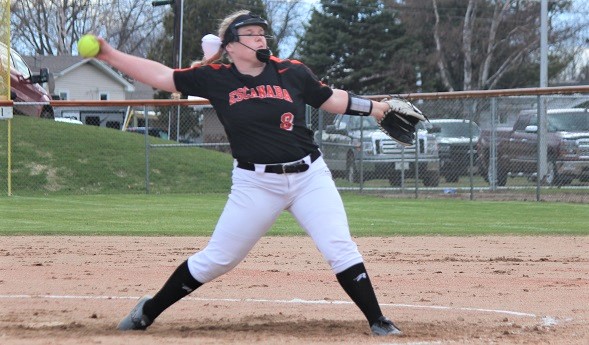
PHOTOS: (Top) Gabi Salo makes her move toward the plate during last weekend’s Escanaba Invitational. (Middle) A championship banner at the Eskymos’ home field celebrates last season’s Division 2 championship. (Below) Gary Salo has taken over the varsity this spring. (Photos by Dennis Grall.)