


New Math: Division & Multiplication Problems
July 25, 2017
By Jack Roberts
MHSAA Executive Director
This is the second part in a series on MHSAA tournament classification, past and present, that will be published over the next two weeks. This series originally ran in this spring's edition of MHSAA benchmarks.
High school tournament classifications went viral before there was social media and most of us knew what “viral” meant.
Much as a virus infects computers today or has created epidemics of disease around the world for centuries, high school tournament classification – once introduced – tends to spread uncontrollably. Once started, it tends to keep expanding and rarely contracts.
While we are still some distance from providing every team a trophy as a result of expanding high school tournament classification across the country, there is criticism nevertheless that we are headed in that direction – a philosophy which is supposed to exist only in local youth sports for our youngest children.
Michigan could be blamed for all this. Michigan is generally accepted as the first state to provide different classifications for season-ending tournaments for different sized schools. It started a century ago. Today, every state has various classifications for its tournaments in most if not all sports. And it is a bit ironic that Michigan – creator of the classification chaos – more than most other states has kept the number of tournament classes or divisions under control.
Yes, there is evidence that tournament classifications have expanded over the years in Michigan, especially with the relatively recent introduction of tournaments in football and the late 1990s’ move from classes to divisions in most MHSAA tournaments. But the MHSAA Representative Council has held true to its word when it expanded the playoffs for football from four classes to eight divisions: this is needed because of unique factors of football, factors that exist in no other sport; and all other sports should be capped at a maximum of four classes or divisions.
Kentucky is the preeminent defender of single-class basketball. All of its 276 high schools compete for the single state championship for each gender. In Indiana, there are still open wounds from its move in 1998 from one to four classes for its 400 schools in basketball.
Multi-class tournaments have tended to increase the number of non-public school champions, which some states are trying to lower through enrollment “multipliers,” and also tend to increase the number of repeat champions, which some states are trying to affect with “success factors” which lift smaller schools into classifications for larger schools if they take home too many trophies.
While there is considerable evidence that state tournaments do as much bad as good for educational athletics, state associations persist in providing postseason tournaments because, on balance, the experiences are supposed to be good for student-athletes. And once we reach that conclusion it is just a small leap to believe that if the tournaments are good for a few, they must be better for more – which leads to creating more and more tournament classifications. One becomes two classes, then three, then four and so forth.
While the argument is that more classifications or divisions provides more students with opportunities to compete and win, it is undeniable that the experience changes as the number of tournament classifications expands. It is not possible for state associations to provide the same level of support when tournament classifications expand to multiple venues playing simultaneously. For example, there is less audio and video broadcast potential at each venue, and less media coverage to each venue. Focus is diluted and fans diminished at each championship.
No one can argue reasonably that today's two-day MHSAA Football Finals of eight championship games has the same pizazz as the one-day, four-games event conducted prior to 1990.
In some states the number of divisions has grown so much that it is difficult to see much difference between the many season-ending state championship games and a regular-season event in the same sport.
It is a balancing act. And Michigan has been studying that balance longer than any other state, and charting a steadier course than most.
Addition by Division
The shift to Divisions for MHSAA Tournament play in numerous sports has added up to a greater number of champions for teams and individuals across the state. Following are the sports currently employing a divisional format, and the procedures for determining enrollment and classification.
In 23 statewide or Lower Peninsula tournaments, schools which sponsor the sport are currently divided into nearly equal divisions. They are:
- Baseball - 4 Divisions
- Boys Bowling - 4 Divisions
- Girls Bowling - 4 Divisions
- Girls Competitive Cheer - 4 Divisions
- LP Boys Cross Country - 4 Divisions
- LP Girls Cross Country - 4 Divisions
- LP Boys Golf - 4 Divisions
- LP Girls Golf - 4 Divisions
- Ice Hockey - 3 Divisions
- Boys Lacrosse - 2 Divisions
- Girls Lacrosse - 2 Divisions
- Boys Skiing - 2 Divisions
- Girls Skiing - 2 Divisions
- LP Boys Soccer - 4 Divisions LP
- Girls Soccer - 4 Divisions
- Girls Softball - 4 Divisions
- LP Boys Swimming & Diving - 3 Divisions
- LP Girls Swimming & Diving - 3 Divisions
- LP Boys Tennis - 4 Divisions
- LP Girls Tennis - 4 Divisions
- LP Boys Track & Field - 4 Divisions
- LP Girls Track & Field - 4 Divisions
- Wrestling - 4 Divisions
Lists of schools for each division of these 23 tournaments are posted on MHSAA.com approximately April 1. Listings of schools in Upper Peninsula tournaments for their sports are also posted on MHSAA.com. The lists are based on school memberships and sports sponsorships in effect or anticipated for the following school year, as known to the MHSAA office as of a date in early March.
In football, the 256 schools which qualify for MHSAA 11-player playoffs are placed in eight equal divisions annually on Selection Sunday. Beginning in 2017, the 8-player divisions will be determined in a like manner on Selection Sunday as well, with 32 qualifying schools placed in two divisions.
Schools have the option to play in any higher division in one or more sports for a minimum of two years.
The deadlines for "opt-ups" are as follows:
- Applications for fall sports must be submitted by April 15
- Applications for winter sports must be submitted by Aug. 15
- Applications for spring sports must be submitted by Oct. 15
Subsequent to the date of these postings for these tournaments, no school will have its division raised or lowered by schools opening or closing, schools adding or dropping sports, schools exercising the option to play in a higher division, or approval or dissolution of cooperative programs.
When the same sport is conducted for boys and girls in the same season (e.g., track & field and cross country), the gender that has the most sponsoring schools controls the division breaks for both genders.
Performance: Anchor Bay's Ally Gaunt
May 3, 2019
 Ally Gaunt
New Baltimore Anchor Bay senior - Soccer
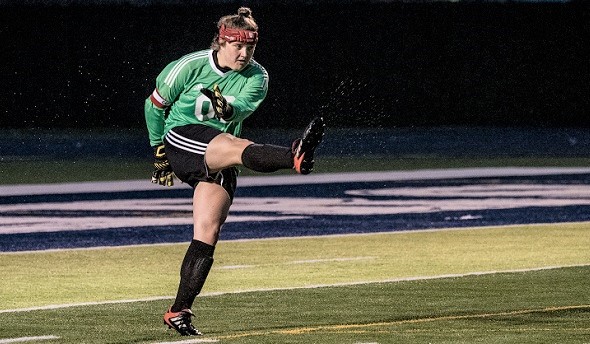
Anchor Bay’s three-year starting goalkeeper continued to build on her substantial legacy last week, tying the school career record with her 32nd shutout against then-No. 3 ranked Utica Eisenhower to earn the Michigan Army National Guard “Performance of the Week.” She became the school’s sole record holder the next game as Anchor Bay shut out Port Huron Northern 5-0 on Friday.
Gaunt tied and broke the record of 2015 graduate Emily Zweng, who went on to Oakland University, and with the 32nd shutout also earned a spot in the MHSAA record book. She’s now up to 29th all-time with 34 career shutouts and has led Anchor Bay to a combined 41-5-10 record over three seasons including 5-1-4 this spring. The Tars also have won two District titles with her guarding the net. In fact, Gaunt has never given up more than two goals in a game at the high school level – and in 13 games, she’s allowed just one – and she has a career goals-against average of 0.52.
 Anchor Bay coach Kevin Grammens considers Gaunt one of the best keepers in Macomb County history, and she earned Division 1 all-state honorable mention as a sophomore and made the second team a year ago. When she’s not playing, she’s still in the game as a youth soccer referee and goalie trainer. Gaunt also played basketball as a freshman and sophomore on sub-varsity teams and carries a 3.7 grade-point average. She’s signed to continue her academic and soccer careers at Saginaw Valley State. A fan of numbers and math, she plans to major in accounting and finance and eventually become a certified public accountant.
Coach Kevin Grammens said: “Ally is usually the first player to arrive at practice and the last to leave. She is a student of the game and true believer in the growth mindset. She soaks in the mental skills training that we teach in our program and intently trains the finer details of her position with her goalkeeper coach, Keith Jarema. She is humble and is first to acknowledge that she cannot set records on her own. We've played tremendous team defense the past three years in front of her and have had and currently have fantastic, selfless players willing to play defense to benefit the team.”
Performance Point: It was a great week. It means a lot, but it’s not everything – to be fair, it’s just a record,” Gaunt said. “The season that we’ve had this year, it’s been a process. And to get that with this team, it means a lot. We graduated our back line – all four of them graduated last year, so we had to rebuild it. We had to start from scratch basically the first day of tryouts, and from then till now it’s grown tremendously. We were ready for battle, and we definitely stepped up. I knew Coach Grammens had a plan, and we had to stick with it. And I trust him, and it worked out.
Success to the successor: “My sophomore and junior year (Zweng) came back for the District games and a few of the other games, and I talked to her. She gave me some pointers, and it was really beneficial just to hear it from another player that set the record here at Anchor Bay, (made the NCAA Tournament) at Oakland.”
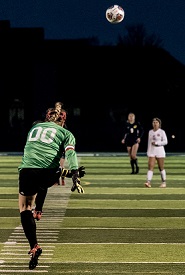 At home in goal: “I love it back there. You can see the entire field. You can see the plays developing before they happen. Just (from) practice, you see it, what we work on, and when it shows in games it shows practice really helps. I can see in goal what we’re trying to do.”
Our time: “My communication is better than it was two years ago. My physical aspects are better than they were two years ago. Every day we’re working on both physical and mental stuff, and it’s very helpful to get something every single day that’s beneficial. Being a senior – there’s six of us, and we all want to do something great here. ‘Leave the jersey in a better place’ is our biggest motto on the team for the seniors, and I truly believe all six of us can do it and are doing it. … Coach Grammens here at Anchor Bay has helped me become the leader I am. We have a binder with a bunch of different articles on how to be mentally strong, and reading those and going through with him helping us individually to become a better person grows our leadership skills as well.”
Problem solver: “I like the structure of (math), knowing there’s not only one way to do a problem to get the correct answer. Within the team, within soccer, you have to be able to see a problem from more than one angle – if there’s two people on the team and something happens, you have to be able to see both angles to be a good leader and try to diffuse the situation. I believe math helps with that because with numbers, you can see it that way.”
- Geoff Kimmerly, Second Half editor
Every week during the 2018-19 school year, Second Half and the Michigan Army National Guard recognizes a “Performance of the Week" from among the MHSAA's 750 member high schools.
The Michigan Army National Guard provides trained and ready forces in support of the National Military Strategy, and responds as needed to state, local, and regional emergencies to ensure peace, order, and public safety. The Guard adds value to our communities through continuous interaction. National Guard soldiers are part of the local community. Guardsmen typically train one weekend per month and two weeks in the summer. This training maintains readiness when needed, be it either to defend our nation's freedom or protect lives and property of Michigan citizens during a local natural disaster.
Past 2018-19 honorees
April 25: Kali Heivilin, Three Rivers softball - Read
March 28: Rickea Jackson, Detroit Edison basketball - Read
March 21: Noah Wiswary, Hudsonville Unity Christian basketball - Read
March 14: Cam Peel, Spring Lake swimming - Read
March 7: Jordan Hamdan, Hudson wrestling - Read
February 28: Kevon Davenport, Detroit Catholic Central wrestling - Read
February 21: Reagan Olli, Gaylord skiing - Read
February 14: Jake Stevenson, Traverse City Bay Reps hockey - Read
February 7: Molly Davis, Midland Dow basketball - Read
January 31: Chris DeRocher, Alpena basketball - Read
January 24: Imari Blond, Flint Kearsley bowling - Read
January 17: William Dunn, Quincy basketball - Read
November 29: Dequan Finn, Detroit Martin Luther King football - Read
November 22: Paige Briggs, Lake Orion volleyball - Read
November 15: Hunter Nowak, Morrice football - Read
November 8: Jon Dougherty, Detroit Country Day soccer - Read
November 1: Jordan Stump, Camden-Frontier volleyball - Read
October 25: Danielle Staskowski, Pontiac Notre Dame Prep golf - Read
October 18: Adam Bruce, Gladstone cross country - Read
October 11: Ericka VanderLende, Rockford cross country - Read
October 4: Kobe Clark, Schoolcraft football - Read
September 27: Jonathan Kliewer, Grand Rapids Forest Hills Northern soccer - Read
September 20: Kiera Lasky, Bronson volleyball - Read
September 13: Judy Rector, Hanover-Horton cross country - Read
PHOTOS: (Top) Anchor Bay goalkeeper Ally Gaunt sends a kick downfield during a game this season. (Middle) Gaunt launches another toward waiting teammates. (Photos courtesy of the Anchor Bay girls soccer program.)