

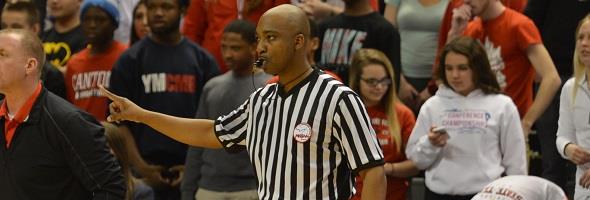
Be the Referee: Block/Charge Calls
February 22, 2018
In this week's edition, assistant director Mark Uyl clears up confusion about the differences between a block and a charge in basketball.
Be The Referee is a series of short messages designed to help educate people on the rules of different sports, to help them better understand the art of officiating, and to recruit officials.
Below is this week's segment – Block/Charge Calls - Listen
Today we’re going to talk about one of the great myths in all of basketball rules – that a defensive player must be completely stationary to take a charging foul against an offensive player either on the drive or on the dribble.
The reality is that a defender only has to obtain what is called a legal guarding position. A legal guarding position is when the defender is facing the offensive player and has essentially beaten him or her to that spot on the floor. Once the defender is in this legal guarding position, the defender can be moving, and can even have one or both feet off the floor at the time that contact occurs.
Past editions
February 15: Dog Days of February - Listen
February 8: National Playing Rules Process - Listen
February 1: Calling Intentional Fouls - Listen
January 25: Points at the Edge of the Mat - Listen
January 18: Behavior Warning - Listen
January 11: Ice Hockey Safe & Sound - Listen
January 4: Why No Shot Clock - Listen
December 21: Coaches Responsible for Equipment - Listen
December 14: Mentoring New Officials - Listen
December 7: Dive on the Floor - Listen
November 30: Wrestling Weight Monitoring - Listen
November 23: Ejections - Listen
November 16: Toughest Call - Listen
November 9: Hurdling - Listen
November 2: The Survey Says - Listen
October 26: Helmet Comes Off - Listen
October 19: Goal Line Rules - Listen
October 12: No 1st-Year Fee - Listen
October 5: Athletic Empty Nesters - Listen
September 28: Misunderstood Football Rules: Kicking - Listen
September 21: Preparation for Officials - Listen
September 14: Always Stay Registered - Listen
September 7: Other Football Rules Changes - Listen
August 31: Pop-Up Onside Kicks - Listen
August 24: Blindside Blocks - Listen

Be the Referee: Animal Interference
By
Paige Winne
MHSAA Marketing & Social Media Coordinator
September 20, 2023
Be The Referee is a series of short messages designed to help educate people on the rules of different sports, to help them better understand the art of officiating, and to recruit officials.
Below is this week's segment – Animal Interference - Listen
In golf – it’s common to hear about birdies, eagles, maybe even an albatross. Or in my case, a snowman. But what if an actual animal interferes with your ball while in play?
There are two kinds of interference.
The first involves a ball still in motion. If you are putting and a squirrel darts out and stops or redirects your putt, you simply get a do-over from the original spot.
Off the green, if a moving ball is stopped or re-directed, you play the ball from where it ultimately stops.
If your ball is stopped and a seagull picks it up and carries it off – you just replace the ball to its original spot and proceed.
It doesn’t happen often, but now you know how to deal with squirrels and seagulls … in addition to birdies and eagles.
Previous Editions
Sept. 13: Feet Rule on Soccer Throw-In - Listen
Sept. 6: Volleyball Jewelry - Listen
Aug. 30: Football Rules Similarities - Listen
Aug. 23: Football Rules Differences - Listen
(PHOTO by Gary Shook.)