

Be the Referee: Correcting a Down
September 10, 2015
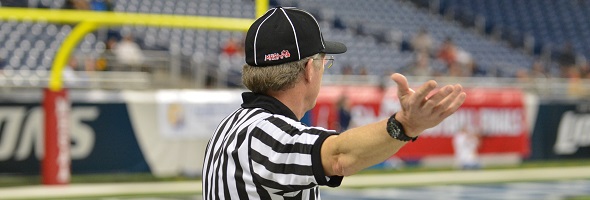
This week, MHSAA assistant director Mark Uyl discusses how officials at the high school level have the authority to correct an error in what down is being played.
Be The Referee is a series of short messages designed to help educate people on the rules of different sports, to help them better understand the art of officiating, and to recruit officials.
Below is this week's segment - Correcting a Down - Listen
For anyone who has followed football for a long time, perhaps the most famous “5th down” game was back in 1990 between Colorado and Missouri.
In that game, the officials mistakenly gave Colorado an extra down while trailing by four points. On the “fifth down” play, Colorado scored a touchdown on the final play of the game to win 33-31.
Under high school rules, the officiating crew has the ability to correct an error of the wrong down as long as it is done before the next snap. For example, if the crew realizes a team has been given an extra down, that play would be nullified and the ball would correctly go over to the other team.
Past editions:
Sept 3: Spearing - Listen
Aug. 27: Missed Field Goal - Listen
Be the Referee: Libero
By
Paige Winne
MHSAA Marketing & Social Media Coordinator
September 17, 2024
Be The Referee is a series of short messages designed to help educate people on the rules of different sports, to help them better understand the art of officiating, and to recruit officials.
Below is this week's segment – Libero - Listen
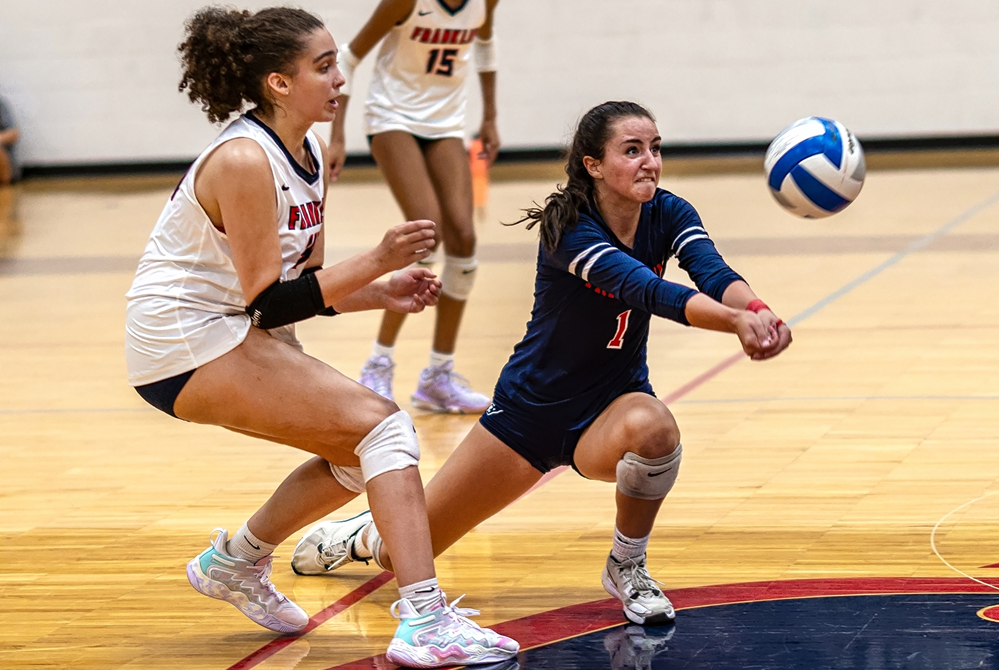
In volleyball, a libero is a defensive player who plays in the back row. It’s a fairly new position, as it was introduced in 1998 – and the libero plays by some unique rules:
► The libero wears a different color jersey from the rest of the team – so they are easily identifiable. Only one libero can be designated for each set of a match.
► The libero can serve, but can't perform an overhead set in front of the attack line, or complete an attack if the ball is above the net.
► The libero is never allowed to rotate to the front line.
► The libero is the first line of defense, often passing to the setter and covering open spaces.
► The libero can be replaced without restriction – but in the event of an injury, can only be replaced by the player the libero originally replaced.
Previous 2024-25 Editions
Sept. 10: Cross Country Uniforms - Listen
Sept. 3: Soccer Handling - Listen
Aug. 24: Football Holding - Listen
PHOTO Livonia Franklin libero Mckenna Moore (1) defends during her team's match against Livonia Churchill this season. (Photo by Douglas Bargerstock.)