


Be the Referee: Pass Interference
September 9, 2014
This week, MHSAA assistant director Mark Uyl explains one of the toughest calls to make on the football field.
"Be the Referee" is designed to help educate people on the rules of different sports, to help them better understand the art of officiating and to recruit officials. The segment can be heard on Mondays, Wednesdays and Fridays during the school year on The Drive With Jack Ebling on WVFN-AM, East Lansing.
Below is this week's segment - Pass Interference - Listen
Today we’re going to talk about one of the most difficult calls for any football official – pass interference. It’s important to know that whenever a forward pass is thrown beyond the line of scrimmage that both players – the offensive receiver as well as the defender – each have an equal right to make a play on the football.
Now, not all contact will automatically result in a pass interference foul. The official must judge if that early contact before the ball arrives has placed one of the two players at a distinct disadvantage. When that contact does create the disadvantage, you have a foul for pass interference. When the contact is minimal and is simply incidental, no foul has occurred.
Past editions
Aug. 25 - Targeting - Listen
Sept. 4 - Concussions - Listen
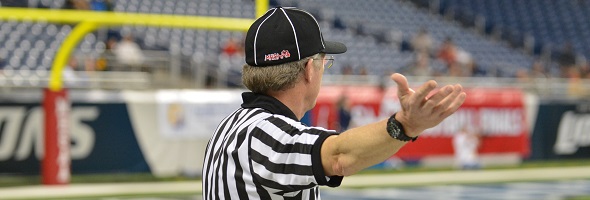
Be the Referee: Intentional Grounding
October 15, 2015
This week, MHSAA assistant director Mark Uyl explains the difference between high school and college/pro rules when it comes to intentional grounding.
Be The Referee is a series of short messages designed to help educate people on the rules of different sports, to help them better understand the art of officiating, and to recruit officials.
Below is this week's segment - Make the Call: Intentional Grounding - Listen
A QB is rolling out wide toward the sideline and is being chased by two large defenders. To avoid a certain sack, the QB throws the ball away deep down the field where no offensive receiver is even in the same zip code of where the ball hits the ground.
What’s the call?
Under high school rules, this is intentional grounding as there always has to be a receiver in the general area of the pass. At the college and pro levels, all the QB has to do is throw the ball beyond the line of scrimmage if he has scrambled outside of the tackle box. When at your next game, know this important difference when it comes to intentional grounding.