


Be the Referee: Punts & Missed FGs
October 18, 2018
This week, MHSAA assistant director Brent Rice explains how high school rules differ from collegiate and professional when it comes to these kick scenarios.
Be The Referee is a series of short messages designed to help educate people on the rules of different sports, to help them better understand the art of officiating, and to recruit officials.
Below is this week's segment – Punts & Missed Field Goals - Listen
One of the differences between high school football rules and rules at the collegiate and professional levels deals with punts and missed field goals.
Essentially, the place kick is treated like a punt as it relates to team possession from the goal line and out of bounds. If either goes out of bounds from inside the field of play, the defensive team takes possession at that spot. If either goes into the end zone, the defensive team may not return the kick.
And a missed field goal in high school that goes into or through the end zone, resulting in a touchback, has the defense taking over, first and 10, at their own 20, regardless of the previous spot.
Past editions
October 11: What Officials Don't Do - Listen
October 4: Always 1st-and-Goal - Listen
September 27: Unique Kickoff Option - Listen
September 20: Uncatchable Pass - Listen
September 13: Soccer Rules Change - Listen
September 6: You Make the Call: Face Guarding - Listen
August 30: 40-Second Play Clock - Listen
August 23: Football Rules Changes - Listen
Be the Referee: Volleyball Unplayable Areas
By
Paige Winne
MHSAA Director of Brand Management
November 14, 2023
Be The Referee is a series of short messages designed to help educate people on the rules of different sports, to help them better understand the art of officiating, and to recruit officials.
Below is this week's segment – Volleyball Unplayable Areas - Listen
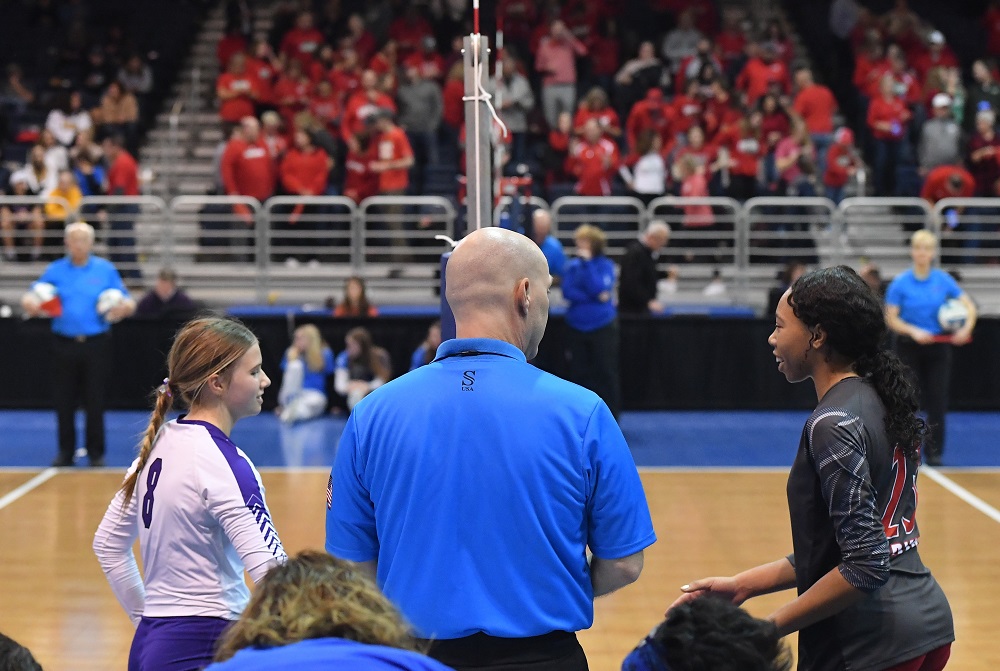
We’re on the volleyball court today when my teammate’s second touch sends the ball towards the bleachers, still on our side of the net. I take off running to attempt to hit it over and jump onto the first row of the stands in order to reach it. I am able to volley the ball over the net, and remarkably it falls to the floor untouched for a point. Or is it?
It is not. The bleachers are not a playable area in volleyball, so my hit wouldn’t count. It would actually be a point for the other team. Despite my best parkour efforts, it’s all for naught.
With player safety in mind, there are other unplayable areas in volleyball including the area behind the benches and the space between the benches and scorer’s table.
Before each match, the officials go over playable and unplayable areas with both coaches.
Previous Editions
Nov. 7: Pass/Kick Off Crossbar - Listen
Oct. 31: Cross Country Interference - Listen
Oct. 24: Soccer Overtime - Listen
Oct. 17: Tennis Spin - Listen
Oct. 10: Blocked Kick - Listen
Oct. 3: Volleyball Double & Lift - Listen
Sept. 26: Registration Process - Listen
Sept. 20: Animal Interference - Listen
Sept. 13: Feet Rule on Soccer Throw-In - Listen
Sept. 6: Volleyball Jewelry - Listen
Aug. 30: Football Rules Similarities - Listen
Aug. 23: Football Rules Differences - Listen