

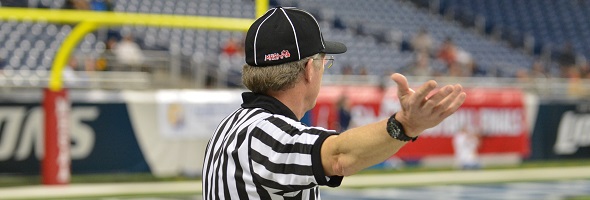
Be the Referee: What Officials Don't Do
October 11, 2018
This week, MHSAA officials coordinator Sam Davis discusses some of the things that do not fall under officials' many game-day responsibilities.
Be The Referee is a series of short messages designed to help educate people on the rules of different sports, to help them better understand the art of officiating, and to recruit officials.
Below is this week's segment – What Officials Don't Do - Listen
Game officials at all levels have a lot of responsibilities. But there are some critical things that take place at local high school games where officials don’t have the authority that some folks think they do.
Let’s start with injuries – specifically concussions. Concussion management starts and ends with the local school. If an official suspects a concussion – or any injury – all he or she can do is notify the coach of the team. The school makes the decision about whether or not a player stays in the game.
We often get calls about whether or not an official is responsible for enforcing MHSAA Handbook rules. Again, it’s up to the school, which agrees to follow and enforce the rules when joining the Association. Even if the official suspects an ineligible player is in the game, it’s not his or her role to enforce that rule. It’s all on the school.
Past editions
October 4: Always 1st-and-Goal - Listen
September 27: Unique Kickoff Option - Listen
September 20: Uncatchable Pass - Listen
September 13: Soccer Rules Change - Listen
September 6: You Make the Call: Face Guarding - Listen
August 30: 40-Second Play Clock - Listen
August 23: Football Rules Changes - Listen

2017-18 Officials Registration Underway
June 22, 2017
By Geoff Kimmerly
Second Half editor
The Michigan High School Athletic Association is accepting registrations by mail and online for game officials for the 2017-18 school year.
The MHSAA annually receives registration by more than 9,500 officials, and had 9,834 during the 2016-17 school year. The highest total of officials registered for basketball, 4,137, with football and baseball both with more than 2,000 registered officials during this past school year.
For all new and returning officials, those who register online again will receive a $5 discount off their processing fees. A $15 fee is charged for each sport in which an official wishes to register, and the online processing fee is $35. Officials submitting registration forms by mail or on a walk-up basis will incur a $40 processing fee. Officials registered in 2016-17 will be assessed a late fee of $30 for registration after July 31. The processing fee includes liability insurance coverage up to $1 million for officials while working contests involving MHSAA schools.
Online registration can be accessed by clicking Officials on the home page of the MHSAA Website. Forms also are available online that can be printed and submitted by traditional mail or hand delivery to the MHSAA Office. More information about officials registration may be obtained by contacting the MHSAA at 1661 Ramblewood Drive, East Lansing, MI, 48823, by phone at (517) 332-5046 or by e-mail at [email protected].
There is an officials' registration test for first-time officials and officials who were not registered during the past school year. The test consists of 45 questions derived from the MHSAA Officials Guidebook, which also is available on the Officials page of the MHSAA Website. Additional 50-question exams must be taken by those registering for football or basketball for the first time or those who were not registered for those sports during the previous school year. Manuals for both sports also are available on the Officials page. New officials and those who didn’t officiate during 2016-17 also must complete the online MHSAA Principles of Officiating course, also available on the MHSAA Website.
The MHSAA is a private, not-for-profit corporation of voluntary membership by more than 1,400 public and private senior high schools and junior high/middle schools which exists to develop common rules for athletic eligibility and competition. No government funds or tax dollars support the MHSAA, which was the first such association nationally to not accept membership dues or tournament entry fees from schools. Member schools which enforce these rules are permitted to participate in MHSAA tournaments, which attract more than 1.4 million spectators each year.