

Become an Official: HS Sports Need You
January 24, 2018
By Bob Gardner, Executive Director of the National Federation of State High School Associations
and Mark Uyl, Assistant Director of the Michigan High School Athletic Association
They don’t make the headlines, their names are not in the box scores and they don’t make the all-star teams. But perhaps the most important individuals in high school sports are the contest officials.
These individuals are so important that, in fact, there would be no organized competitive sports at the high school level without the men and women who officiate these contests every day across the country. Subtract the dedicated men and women who officiate high school sports, and competitive sports would no longer be organized; they would be chaotic.
In some areas of our country, high school officials are retiring faster than new ones are being added. And junior varsity, freshmen and middle school games are being postponed – or even cancelled – because there are not enough men and women to officiate them.
Anyone looking for a unique way to contribute to the local community should consider becoming a registered high school official. For individuals who played sports in high school, officiating is a great way to stay close to the sport after their playing days have ended. Officiating helps people stay in shape, expands their social and professional networks and offers part-time work that is flexible, yet pays. In fact, officiating is a form of community service, but with compensation.
Another benefit of officiating is that individuals become role models so that teenagers in the community can learn the life lessons that high school sports teach. Students learn to respect their opponents and the rules of the game and the importance of practicing good sportsmanship thanks, in part, to those men and women who officiate. And the objectivity and integrity that high school officials display is an example that every young person needs to observe firsthand. In short, communities around the country will be stronger because of the life lessons that high school officials help teach the next generation.
Officiating is a great way to stay connected to sports and to give back to the local high school and community. We need dedicated men and women to become involved so that high school sports can continue to prosper for years to come.
Individuals interested in learning more about becoming a high school official, and even beginning the application process, can do so at www.HighSchoolOfficials.com.
Officials Honored for Service Milestones
By
Geoff Kimmerly
MHSAA.com senior editor
June 25, 2020
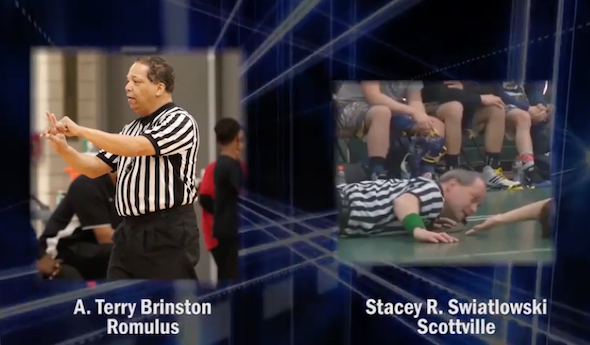
The MHSAA annually honors high school game officials with 20, 30, 40, 45 and 50 years of service at its Officials’ Awards & Alumni Banquet.
However, this spring’s banquet was canceled due to COVID-19. Instead, we present this virtual recognition for 322 officials who celebrated a milestone school year.
Twenty-three officials with 50 years of service are honored below, along with 55 officials with 45 years. A 40-year award has been presented to 55 officials. In addition, 108 officials with 30 years and 181 officials with 20 years of experience are honored.