


MHSA(Q&)A: Midwest League Umpire John Libka
June 22, 2012
By Brian Spencer
Second Half
As a high school junior eight years ago, John Libka began his officiating career as part of the MHSAA Legacy Program.
Now 24, Libka -- who grew up in Mayville and attended school at Juniata Christian in Vassar -- is a baseball umpire in the Class A Midwest League.
The Legacy Program pairs high school seniors and juniors with experienced mentors and allows them to officiate junior high and sub-varsity contests. Libka's mentor was his father, Gary Libka. (Click to read more about the Legacy Program.)
We caught up with John Libka during his summer run through the communities that make up the Midwest League, which in Michigan includes Lansing, Midland and Comstock Park.
Do you think that your experience playing baseball in high school helped you at all during your early and present umpiring career?
Yeah, probably a little bit. I got to see the other side. I received insight on why certain things happen, and how plays and events develop. It also helped me develop the instincts I needed and continue to rely on to be successful.
What was the biggest factor in helping you choose the MHSAA’s Legacy Program over a senior season of baseball (Libka played for his school as a junior)?
I like spending time with my dad, and going to the Legacy Program was a great way to do that. He umpired for 30 years, so he was a good mentor and there was no better option to spend time with him. I also love baseball, so I knew I wanted to stick with baseball in some way.
What was your favorite childhood baseball memory?
I lived for going to Tiger Stadium, and Comerica Park for that matter. The memories at Tiger Stadium were the best. I went to the third-to-last game against the Yankees, I think. It was an awesome experience and a great memory.
What is the most important piece of advice you’ve been given as an umpire?
The most important advice I think I’ve received is probably just to stay even keel. You can’t get too high or too low being an umpire. You have to take every play or every pitch the same, and that is true for all levels, not just in pro ball. You just have to keep a good perspective on everything.
Being on the road a lot, is there any specific restaurant that you look for? What is your favorite food at ____?
We actually try to mix it up a lot. I like to go to Panera. If we could go anywhere, I like going there. The broccoli and cheese bread bowl is usually my favorite. We like to go get the bread bowl for a pregame meal. I also like going to McDonald’s every morning to get an iced coffee. It’s a great way to start the day.
According to an interview conducted with MLive, you worked for Bronner’s this past winter in Frankenmuth. Which do you prefer more, an artificial Christmas tree or a real Christmas tree?
I prefer an artificial Christmas tree. However, after working there you have to have a good eye. The tree has to be just right.
You must catch some flak from coaches and fans; is there any game that sticks out, in which you or your partner received the most verbal abuse?
We actually had a game earlier this year in Fort Wayne where we had three ejections in a postgame incident. We were actually commended for how we handled it. Those are the times when you learn the most.
How do you get through a game where a fan or coach is being unruly?
The best advice is to stay even keel and not to pay attention to a lot of the fans. You handle stuff when you need to, you ignore stuff when you need to. Overall, you just stay objective. If you take the high road most of the time and make the fans or coaches decide their fate, you can’t go wrong.
Do you have any advice for aspiring umpires hoping to make it to the big time?
The best advice I can give is to continue to be a student of the game. It is one of the toughest sports as far as the rules go. Tim Kurkjian once said, “You can go to the ballpark and see something different every day.” When I watch a game on TV, I watch the umpires and not the game. It’s the best way to learn.
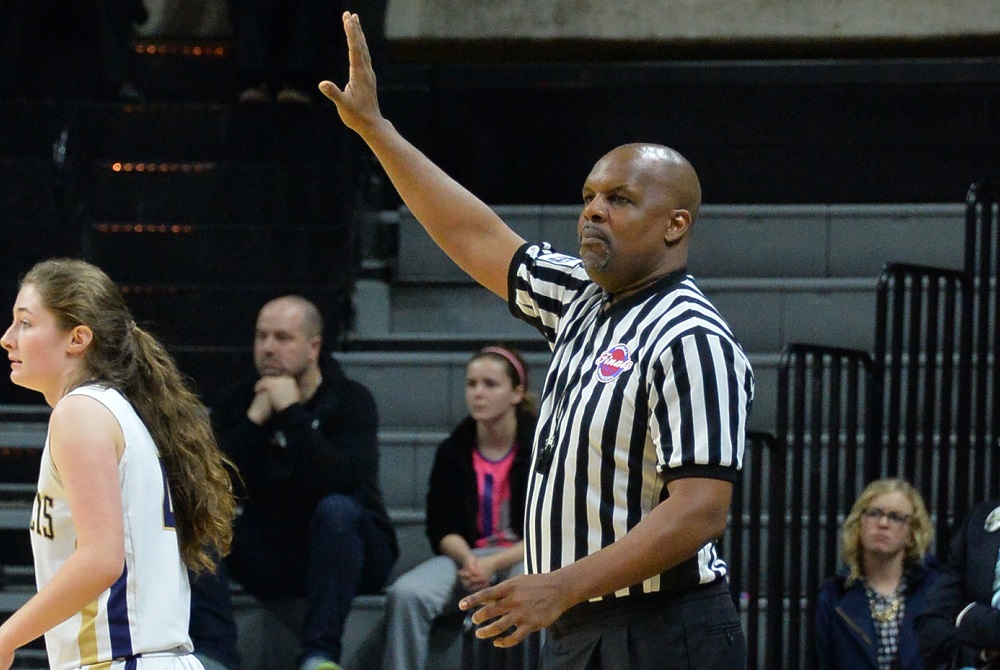
Be the Referee: Basketball Video Review
By
Sam Davis
MHSAA Director of Officials
February 3, 2022
Be The Referee is a series of short messages designed to help educate people on the rules of different sports, to help them better understand the art of officiating, and to recruit officials.
Below is this week's segment – Basketball Video Review - Listen
When watching a college or NBA game, the last two minutes of the game can seem like it takes forever, especially in recent years where more and more judgment calls made by officials are subject to instant replay. At the high school level, video is not used to make a ruling or confirm or overturn a call made during the course of the contest.
The only time video review is used in basketball at the high school level is at the MHSAA Semifinal and Final games. In these games, video review can be used only to determine if a shot was released in time at the end of the fourth quarter or overtime or if that shot was a 2-point or 3-point field goal attempt.
The MHSAA believes that this very limited use of replay in these games at the very end of the tournament series in boys and girls basketball is the right call.
Previous editions
Jan. 27: Wrestling Inspections - Listen
Dec. 16: Ball Over Backboard - Listen
Dec. 9: Winter Officials Mechanics - Listen
Nov. 26: Instant Replay - Listen
Nov. 11: Tourney Selection - Listen
Nov. 4: Receiver Carried Out of End Zone – Listen
Oct. 28: Volleyball Back-Row Block – Listen
Oct. 21: Soccer Disallowed Goal – Listen
Sept 30: Field Goal Falls Short – Listen
Sept. 23: Volleyball Obstruction – Listen
Sept. 16: Catch or No Catch – Listen
Sept. 9: Intentional Grounding – Listen
Sept. 2: Pass Interference – Listen
Aug. 26: Protocols and Mechanics – Listen