


Supporting Sports Officials

February 20, 2015
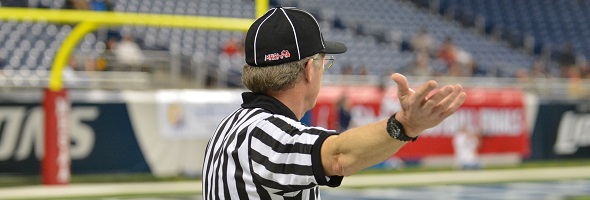
There recently has been some criticism that the MHSAA hasn’t “had the backs” of sports officials regarding a proposal for a new state law.

To make a difference of opinion about legislative strategy the litmus test of MHSAA support for officials is misguided at best and manipulative at worst.

Moreover, from the standpoint of coaches and spectators, the MHSAA is much too ready to support officials, even when officials misapply a game rule or misjudge a contest situation. That we always back officials, even when they are wrong, is a criticism that resonates with the public far more than the recent, rare criticism that we don’t have officials’ backs on a piece of legislation that we believe lacks merit.

Despite the hype and hope, there are two things the proposed legislation will not do: 

First, additional legal sanctions will not dissuade someone who has momentarily lost his or her mind to pause and think, “Oh yeah, If I slug this person, there’s an extra penalty.” There is no evidence that such legislation works as a deterrent to emotional outbursts.

Second, putting such legislation on the books will not improve sportsmanship on the front lines. Such laws are empty words; improving sportsmanship is year-round, grassroots work of real substance.

Because our energies are invested in the ongoing work of improving sportsmanship in interscholastic athletics’ special niche in the world of sports, the MHSAA has been known nationwide for several decades as a high school association with great passion for good sportsmanship and innovative programs to improve sportsmanship.

This week alone we have thousands of students and others voluntarily watching videos promoting school spirit and good sportsmanship as the fourth annual “Battle of the Fans” concludes. This program, born in Michigan, is now spreading to our counterpart organizations across the U.S.

This week, and almost every week, we have staff traveling “anytime, anywhere” to deliver face-to-face education to groups of high school coaches who, more than anyone else, influence the behaviors of both players and spectators.

Through the years, we have promoted sportsmanship with audio and video and print promotions. We’ve conducted statewide, league and local sportsmanship summits as well as team captain and student leadership workshops. We have rewarded good sportsmanship, and penalized bad.

The MHSAA’s Constitution requires every member school to adopt a code of good sportsmanship for its athletes, coaches and spectators, an educational program to promote good sportsmanship, and a system of progressive discipline for failure to behave according to the code of good sportsmanship. A condition of MHSAA membership is to demonstrate that those requirements are being met.

Time and money spent on real solutions, not symbolism, is the MHSAA’s approach to creating and maintaining a higher level of sportsmanship. And it’s the best way for the MHSAA to demonstrate its ongoing support for contest officials.

Investments

July 9, 2014

Bristling from criticism that our associations are money-grabbing exploiters of children, my counterpart from Colorado said, “If we were running our programs just to make money, we would do very many things very differently.” I knew exactly what he meant.

Because we care about the health and welfare of students, because we mean what we say that the athletic program needs to maximize the ways it enhances the school experience while minimizing academic conflicts, and because we try to model our claim that no sport is a minor sport when it comes to its potential to teach young people life lessons, we operate our programs in ways that make promoters, marketers and business entrepreneurs laugh, cry or cringe.

If money were the only object, we would seed teams and select sites to assure the teams that attracted the most spectators had the best chance to advance in our tournaments, regardless of the travel for any team or its fan base. If money were the only object, we would never schedule two tournaments to overlap and compete for public attention, much less tolerate three or four overlapping events. If money were the only object, we would allow signage like NASCAR events and promotions like minor league baseball games.

Those approaches to event sponsorship are not wrong; they’re just not right for us. And we will live with the consequences of our belief system. 

During the 2012-13 school year, 438 of the MHSAA’s 2,097 District, Regional and Final tournaments lost money. Not a single site in golf, skiing or tennis made a single penny. Over 17 percent of all other sites brought in less revenue than the direct expenses incurred at the site. In no sport did every District, Regional and Final site have revenue in excess of direct expenses.

In fact, in only three sports – boys and girls basketball and football – is revenue so much greater than direct expenses overall that it helps to pay for all the other tournaments in which the MHSAA invests.

That’s right: invests. When we present our budget to our board, we talk about the MHSAA’s investment in providing tournament opportunities in all those sports and all those places that cannot sustain the cost of those events on their own.