

Rivaling for a Cause
January 25, 2013
It’s impossible to include all the perspective we gain from every “Battle of the Fans” visit.
But this anecdote, although it didn't make Tuesday’s story about our Frankenmuth trip, tells of another great example for what student cheering sections can accomplish.
Frankenmuth and Millington are heated rivals, to say the least, separated by 13 miles and made more competitive by plenty of championship-deciding matchups over the years.
But for their boys basketball game Jan. 10 at Frankenmuth, student section leaders from both schools almost completely on their own set up the game as a cancer awareness night, complete with Frankenmuth students in black shirts and Millington’s wearing pink.
The idea was the brainchild of a of Frankenmuth section leader, who then received help from a local bank and contacted Millington to get the ball rolling.
Battle of the Fans has shown us the obvious – these student sections need strong leaders – but also the special things they can accomplish with additional initiative.
“Never Forgotten”
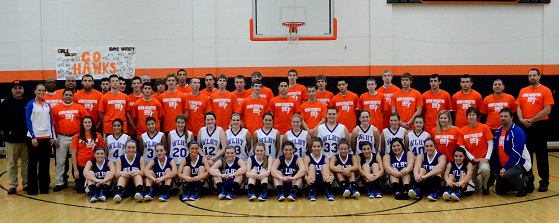 Two more rivals, Fennville and Saugatuck, met late last month for their second “Never Forgotten” boys and girls basketball games with proceeds going to the Wes Leonard Heart Team for the purchase of AEDs.
Players wore jerseys with names on the backs of friends and family members who had died, and those jerseys were then given to family members after the games. Officials Ace Cover, Chris Dennie and Kyle Bowen also donated their game checks to the Heart Team, as did the winner of that night’s 50-50 raffle.
Leonard died from sudden cardiac arrest after making the game-winning shot in a basketball game March 3, 2011. The two schools played their first “Never Forgotten” games last season.
More support for less specialization
I’m asked once a year at least about sport specialization – that is, athletes focusing on just one sport, often from an early age, and if it pays off some way down the road.
Most of my evidence to support my belief in the well-rounded athlete has been anecdotal, based on conversations with people at the high school and college levels over the years. But a British study published this fall in the Journal of Sport Sciences by University of Birmingham researchers provides some interesting empirical findings.
The study of 1,006 people from the United Kingdom showed that those who participated in three sports at ages 11, 13 and 15 were “significantly more likely to compete at a national rather than club standard” between ages 16-18 than those who had practiced only one sport.
In other words, the study found that those who played more sports at earlier ages played at a higher level during their high school-age years, which seems to contradict the one-sport focus philosophy.
Click for more perspective on the study from Chris Kennedy, the Superintendent of Schools in West Vancouver, British Columbia.
PHOTO: The boys and girls teams for Fennville and Saugatuck pose together after their "Never Forgotten" games Dec. 21 at Fennville High. (Photo courtesy of Al LaShell.)
St. Mary's Avenges Regular-Season Sweep to Claim 1st Finals Title Since 2008
March 8, 2025
PLYMOUTH — Orchard Lake St. Mary’s never really went away.
Yes, it had been 17 years since the Eagles won their last MHSAA hockey championship, but they’ve always been a factor.
Whether it was running into Division 1 powers Brighton and Detroit Catholic Central when St. Mary’s played in the biggest-school division in the MHSAA Tournament, losing in overtime twice in Regional Finals or getting shut out in two championship game appearances, and even forfeiting due to COVID policies in 2021, the Eaglets had some great teams come up just short in the postseason.
A program that won three MHSAA Finals in four seasons from 2005-08 finally put it all together again for five tournament games, winning the Division 3 championship with a 3-0 victory over 2024 champion Bloomfield Hills Cranbrook Kingswood on Saturday at USA Hockey Arena.
Winning MHSAA championships is apparently more difficult than St. Mary’s made it look way back when.
 “It’s hard,” said Brian Klanow, who has won 404 games as St. Mary’s coach over 26 seasons. “You’ve got to go through Regionals, and you certainly have to be on your game. Our team is playing its best hockey of the season right now.”
The last time St. Mary’s won a Finals championship was in a game that has now taken on mythical proportions. The Eaglets and Marquette played eight overtimes in the 2008 Division 1 Final tied 1-1 before the game was called and co-champions were declared out of concern for player safety.
So, why was this team the one to end the streak? Certainly, the Eaglets were loaded with talent, as they are most years. But they also had intangibles working in their favor.
“The difference between this year and previous years was we were close this year,” junior co-captain Charlie Roberts said. “Most of these guys have played with each other before. It played a big role. We were like a family out there. You can’t beat that.”
St. Mary’s senior goalie Will Keane has been trying for three seasons to bring a championship back to a school with a strong hockey tradition. He stopped all 26 shots he faced to backstop the victory.
“It’s unbelievable,” Keane said. “I’ve spent now three years here. My first one was a struggle; we didn’t even win a Regional. The guys who were in that room knew it was pretty tough. Last year, we came in and thought we had the team to do it. You don’t get a bounce. You have to get lucky. I don’t think we did last year, but we came back out and knew this year we had the team and we knew we could break that streak. That’s exactly what we did. The result’s unreal, nothing better.”
Keane split the goaltending duties nearly 50/50 throughout the regular season, partially because he missed time in late December with an injury. But St. Mary’s rode him for all five playoff games and he delivered, allowing only four goals for a 0.80 goals-against-average and .968 save percentage.
 “Both of our goaltenders have done a great job this year,” Klanow said. “Mason Shea stepped in when Will was injured. They typically would split. It’s probably close to 50/50, 60/40, but I think it’s important to pick a guy and we needed to ride him.”
Cranbrook Kingswood swept the two-game season series with St. Mary’s, winning 4-3 and 6-2. But the Eaglets locked it down defensively this time and did something they were unable to do in the previous meetings — get an early lead.
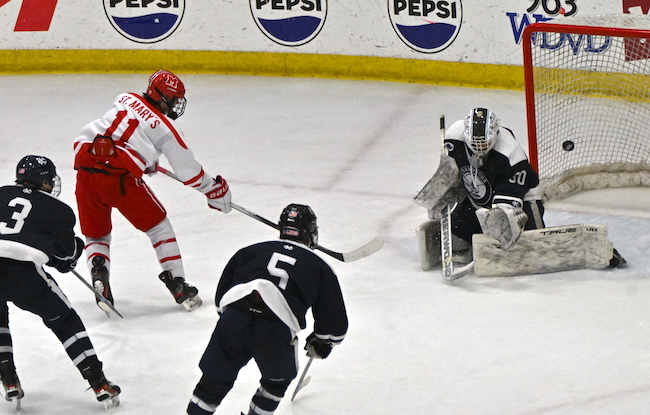
Emmett Pilch scored 5 minutes and 20 seconds into the game. St. Mary’s nursed that one-goal lead for more than 27 minutes until Matthew Mourad gave the Eaglets a 2-0 lead with 1:14 left in the second.
Jacob Fedor scored into an empty net from a faceoff circle in St. Mary’s end with 2:53 remaining to seal the victory and deprive the Cranes of back-to-back titles.
“The leadership was unbelievable this year,” Cranbrook coach John LaFontaine said. “These guys came together really quick. They always wanted to do the extra things to be a team. We didn’t have individuals, we had a bunch of guys who were battling together. They will keep these memories for the rest of their life.”
Senior forward Nick Timko concurred.
“The bond I made with all these guys, it’s going to be life-long,” he said. “It stinks to end it this way, but I’ll forever be thankful for these years I’ve had with them.”
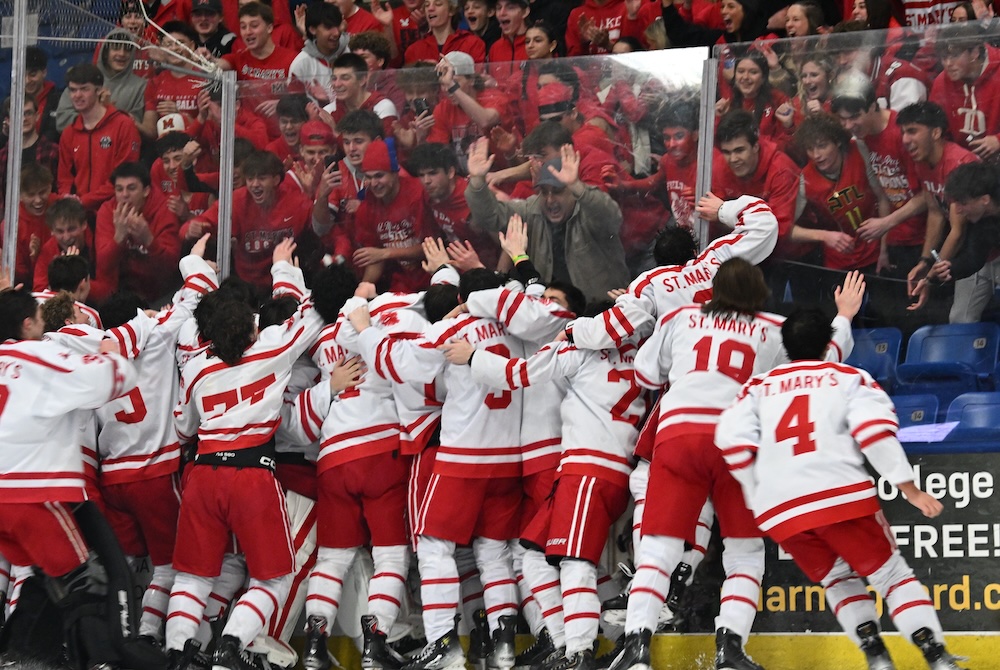
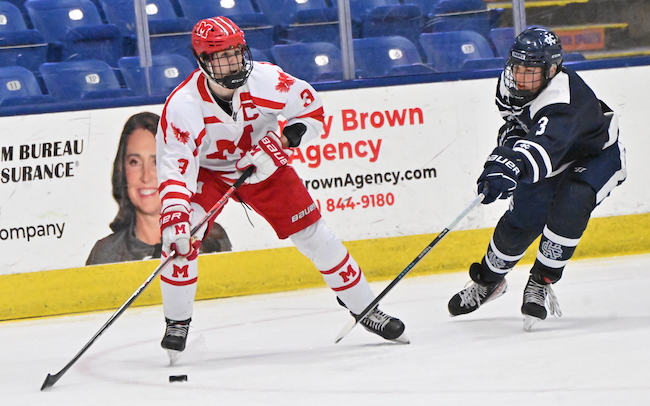
PHOTOS (Top) Orchard Lake St. Mary’s players celebrate their championship win Saturday with the student section and USA Hockey Arena. (Middle) St. Mary’s Charlie Roberts considers his next move with Cranbrook’s David Schmitt defending. (Below) The Eaglets’ Matthew Mourad (11) sends a shot into the net during the second period.