


Rivaling for a Cause
January 25, 2013
It’s impossible to include all the perspective we gain from every “Battle of the Fans” visit.
But this anecdote, although it didn't make Tuesday’s story about our Frankenmuth trip, tells of another great example for what student cheering sections can accomplish.
Frankenmuth and Millington are heated rivals, to say the least, separated by 13 miles and made more competitive by plenty of championship-deciding matchups over the years.
But for their boys basketball game Jan. 10 at Frankenmuth, student section leaders from both schools almost completely on their own set up the game as a cancer awareness night, complete with Frankenmuth students in black shirts and Millington’s wearing pink.
The idea was the brainchild of a of Frankenmuth section leader, who then received help from a local bank and contacted Millington to get the ball rolling.
Battle of the Fans has shown us the obvious – these student sections need strong leaders – but also the special things they can accomplish with additional initiative.
“Never Forgotten”
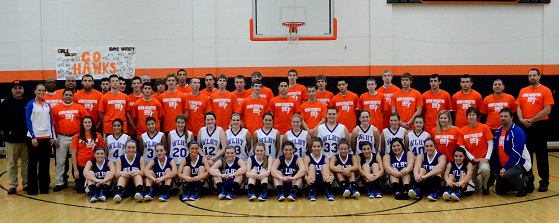 Two more rivals, Fennville and Saugatuck, met late last month for their second “Never Forgotten” boys and girls basketball games with proceeds going to the Wes Leonard Heart Team for the purchase of AEDs.
Players wore jerseys with names on the backs of friends and family members who had died, and those jerseys were then given to family members after the games. Officials Ace Cover, Chris Dennie and Kyle Bowen also donated their game checks to the Heart Team, as did the winner of that night’s 50-50 raffle.
Leonard died from sudden cardiac arrest after making the game-winning shot in a basketball game March 3, 2011. The two schools played their first “Never Forgotten” games last season.
More support for less specialization
I’m asked once a year at least about sport specialization – that is, athletes focusing on just one sport, often from an early age, and if it pays off some way down the road.
Most of my evidence to support my belief in the well-rounded athlete has been anecdotal, based on conversations with people at the high school and college levels over the years. But a British study published this fall in the Journal of Sport Sciences by University of Birmingham researchers provides some interesting empirical findings.
The study of 1,006 people from the United Kingdom showed that those who participated in three sports at ages 11, 13 and 15 were “significantly more likely to compete at a national rather than club standard” between ages 16-18 than those who had practiced only one sport.
In other words, the study found that those who played more sports at earlier ages played at a higher level during their high school-age years, which seems to contradict the one-sport focus philosophy.
Click for more perspective on the study from Chris Kennedy, the Superintendent of Schools in West Vancouver, British Columbia.
PHOTO: The boys and girls teams for Fennville and Saugatuck pose together after their "Never Forgotten" games Dec. 21 at Fennville High. (Photo courtesy of Al LaShell.)
By Near-Slimmest of Margins, Ross Claims Finals Matchup of Blue Water Standouts
By
Jeff Bleiler
Special for MHSAA.com
March 1, 2025
JACKSON – Jason Ross has confidence in his son’s decision-making ability.
But even he had some doubts when Hunter Ross pulled out his third different bowling ball during the two-game championship match of the Division 3 Singles Finals at JAX 60 on Saturday.
The move paid off handsomely for the Almont senior.
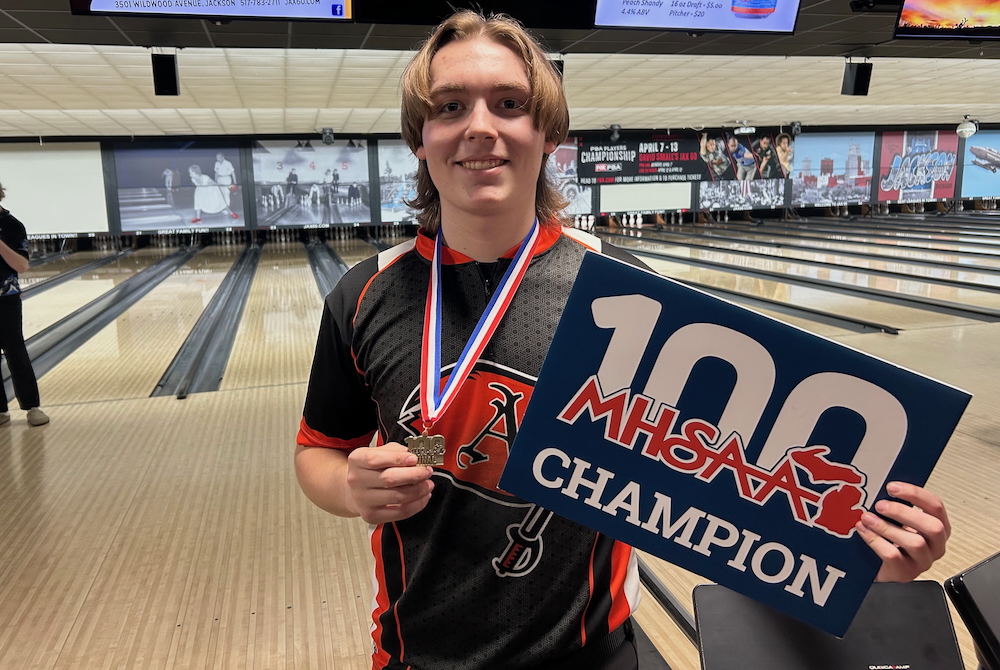
Struggling to find the pocket after an early four-bagger, Hunter Ross changed balls twice in the second game, the second ball delivering two strikes in the 10th frame to squeak out a two-pin victory over good friend and Croswell-Lexington sophomore Joshua Gunderson, 377-375.
“A lot of nerves,” Ross said afterward. “I made it way too close, so did Josh. Josh gave me a couple breaks. I just had to put it together. I don’t know what happened on that first shot in the 10th frame, but I’m thankful for it.”
What happened was the first positive break for either bowler during the two games where strikes were difficult to come by and 10-pins were stubborn. The two bowlers combined for eight 10-pin leaves, with Gunderson missing three and Ross one.
Ross’s miss came in the 10th frame of the first game and left him in a 192-187 hole. That’s when he decided to shelve the urethane ball that had produced four strikes to start the match and nothing close afterward.
“I didn’t feel comfortable on either lane because breakdown was horrendous, but I made do with what I had,” Ross said.
His first reactive ball, the Ion Max, lasted five frames before he turned to the Attention Star for the balance, going spare-spare-strike-spare to set up his 10th frame. After Gunderson converted a 10-pin and struck, Ross needed a double and eight pins to win.
His first ball went light but carried the 2-4-5-8 bucket. He then flushed the second one and got nine on his fill ball for a 190-183 advantage.
“We he got the second one, I knew he had it,” Jason Ross said. “I was on the edge of my seat. I’m just so happy for him. It’s his senior year, and this is what we pictured.”
Just maybe not that many ball changes.
“I was freaking out,” Jason Ross admitted. “But it’s his game, I let him make the call and he made the right choice. I’m confident in him and his abilities, and he earned it.”
Hunter Ross closed his high school career as a Finals champion, a Regional champion two years ago and a two-time singles champion in the Blue Water Athletic Conference.
He could not leave JAX 60 without giving credit to Andy Schnebelt, owner of Andy’s Pro Shop housed in the center. The Rosses made the hour-and-a-half drive from Almont to Jackson every two weeks for about a year for Hunter to learn under Schnebelt’s tutelage.
“I would not have gotten this far without him,” Hunter Ross said. “The dude is a genius. And if anyone has any questions about bowling, they should go to him.”
Ross earned the second seed after the six-game qualifying session with a total of 1,347, just 16 pins shy of Gunderson’s tournament-leading 1,363. Gunderson opened the day with a 289 game a week after winning his Regional with a 1,489 total, with Ross second.
Ross averaged 216 in his first three matches after qualifying, defeating Olivet junior Michael Fitzner 449-337, Hopkins senior Brad Reynolds 409-357, and Gladstone senior Matt Meyer 443-406. During the second game of qualifying, Meyer fired a 299 game.
Gunderson was even hotter entering the championship after averaging 227 for his three matches in defeating Fremont senior Gavin Payne 491-405, junior teammate Carter Ramage 433-372, and Milan senior Max Jenness 438-403.
Despite the loss in the championship — and a runner-up finish the day before in the Team Final — Gunderson was pleased with his showing and that of his team. And proud of Ross.
“I’m happy for my friend. I’m just happy I did better than last year, honestly,” said Gunderson, who lost in the quarterfinals last year to eventual champion Mayson Knop of Frankenmuth. “I feel like we’ll be back next year. We don’t lose anybody for team. We’ll be back, and hopefully I’ll be back for singles.”