


Rivaling for a Cause
January 25, 2013
It’s impossible to include all the perspective we gain from every “Battle of the Fans” visit.
But this anecdote, although it didn't make Tuesday’s story about our Frankenmuth trip, tells of another great example for what student cheering sections can accomplish.
Frankenmuth and Millington are heated rivals, to say the least, separated by 13 miles and made more competitive by plenty of championship-deciding matchups over the years.
But for their boys basketball game Jan. 10 at Frankenmuth, student section leaders from both schools almost completely on their own set up the game as a cancer awareness night, complete with Frankenmuth students in black shirts and Millington’s wearing pink.
The idea was the brainchild of a of Frankenmuth section leader, who then received help from a local bank and contacted Millington to get the ball rolling.
Battle of the Fans has shown us the obvious – these student sections need strong leaders – but also the special things they can accomplish with additional initiative.
“Never Forgotten”
 Two more rivals, Fennville and Saugatuck, met late last month for their second “Never Forgotten” boys and girls basketball games with proceeds going to the Wes Leonard Heart Team for the purchase of AEDs.
Players wore jerseys with names on the backs of friends and family members who had died, and those jerseys were then given to family members after the games. Officials Ace Cover, Chris Dennie and Kyle Bowen also donated their game checks to the Heart Team, as did the winner of that night’s 50-50 raffle.
Leonard died from sudden cardiac arrest after making the game-winning shot in a basketball game March 3, 2011. The two schools played their first “Never Forgotten” games last season.
More support for less specialization
I’m asked once a year at least about sport specialization – that is, athletes focusing on just one sport, often from an early age, and if it pays off some way down the road.
Most of my evidence to support my belief in the well-rounded athlete has been anecdotal, based on conversations with people at the high school and college levels over the years. But a British study published this fall in the Journal of Sport Sciences by University of Birmingham researchers provides some interesting empirical findings.
The study of 1,006 people from the United Kingdom showed that those who participated in three sports at ages 11, 13 and 15 were “significantly more likely to compete at a national rather than club standard” between ages 16-18 than those who had practiced only one sport.
In other words, the study found that those who played more sports at earlier ages played at a higher level during their high school-age years, which seems to contradict the one-sport focus philosophy.
Click for more perspective on the study from Chris Kennedy, the Superintendent of Schools in West Vancouver, British Columbia.
PHOTO: The boys and girls teams for Fennville and Saugatuck pose together after their "Never Forgotten" games Dec. 21 at Fennville High. (Photo courtesy of Al LaShell.)
Dugener Delivering as North Muskegon Enters February Undefeated Again
By
Tom Kendra
Special for MHSAA.com
February 6, 2025
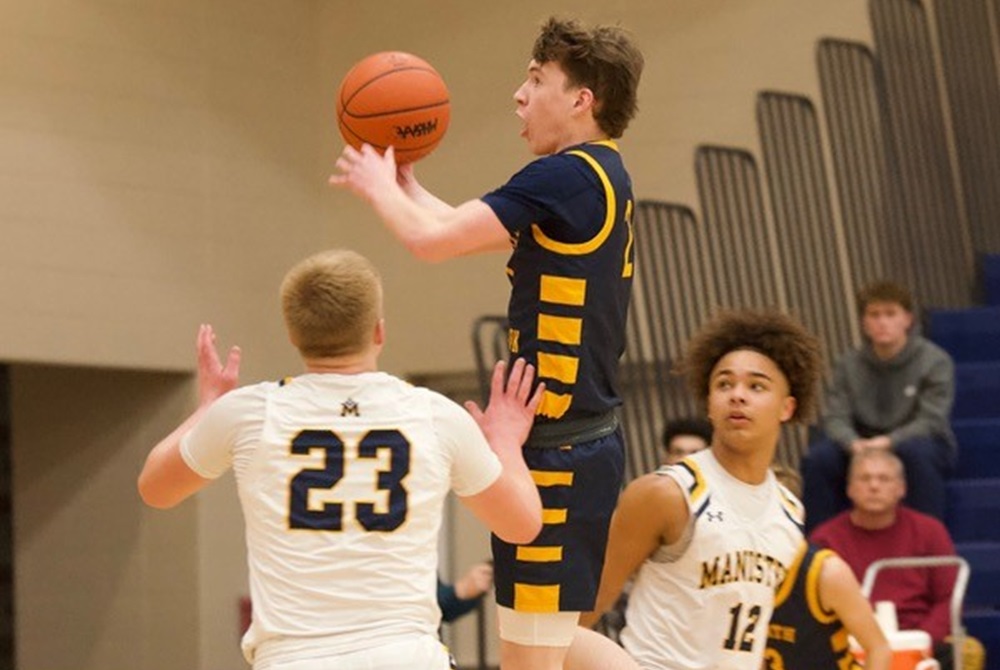
Adam Dugener has certainly emerged as “the dude” for the North Muskegon boys basketball team.
 Chants of “Doog” were raining down from the rafters of North Muskegon’s intimate old gym last week when Dugener drained a school-record nine 3-pointers in a key 65-52 win over West Michigan Conference Rivers rival Mason County Central.
“Shooting is my thing, and sometimes I can get hot,” said Dugener, downplaying his 38-point night in the Norsemen’s win.
“When I’m hot, I feel like I’m going to make everything and that I should keep on shooting.”
That game wasn’t even his biggest scoring night of the season – that being a 39-point performance in a lopsided win over a good Hart team Dec. 20.
Dugener is averaging 23 points per game for the Norsemen, who are 15-0 and ranked No. 9 in the latest Michigan Sports Writers Division 3 poll heading into a pair of big games this weekend at Muskegon Western Michigan Christian on Friday and home Saturday against Grand Rapids Covenant Christian.
“Adam is a legit scorer who demands attention from the defense,” said Chuck Rypstra, who is in his 11th year as NM’s head coach. “He’s in the gym all the time, working at it and trying to get better. Then we have a lot of other pieces around him.”
Dugener is not always on fire, which was the case Wednesday night at Manistee when his shot was slightly off and he managed just 11 points.
The host Mariners made a run at the unbeaten Norse, closing to within eight points midway through the fourth quarter. Dugener, just a junior on a senior-laden team, got his teammates together for a few calming words and keyed a late run to put the game away.
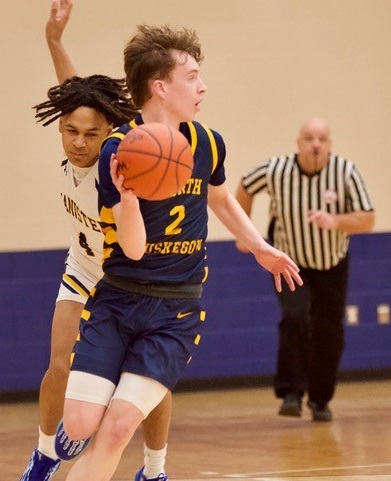
Dugener, who also averages five rebounds, four assists and four steals per game, had a pair of rebounds, a steal and two big assists during that stretch – his most notable play a nifty long outlet pass to Braylen Burrell for a breakaway layup.
“When I’m not having a good shooting night, I try to contribute in other ways,” said Dugener, who is the son of Matt and Susan Dugener. “I’m always looking to get better at distributing and getting the ball to my teammates in the right place.”
 TJ Byard, a 6-foot-1 senior who recently committed to play football at Lawrence Tech as a receiver, is a versatile weapon who averages seven points, six rebounds, three assists and three steals per game. Byard scored a game-high 16 points, with three 3-pointers, in Wednesday’s win at Manistee.
Burrell is the team’s other main 3-point shooting threat, along with Landon Grimm off the bench. Burrell has 36 3-points this season, right behind Dugener’s 39 triples.
Dugener is the only one of the five starters – also including Byard, Burrell, center Chuck Meyers and forward Jaden Villalpando – who wasn’t part of NM’s football team that advanced to the Division 7 Semifinals before losing to eventual champion Millington.
“I think our best is still yet to come, because some of those football guys are still rounding into form,” said Rypstra. “We have a lot of guys that play multiple sports, which is great, because they know how to compete and they know how to win. Now they are getting the basketball reps in.”
That supporting cast is critical if the Norse want to win a fifth-straight District championship and get past their Regional roadblock in March.
North Muskegon, which finished 22-0 during last year’s regular season, has won four consecutive Districts but has not had much success in the Regional round – winning just one Regional game over the past four years, in 2021. Both of the past two years, the Norse lost three-point heartbreakers to Pewamo-Westphalia in the Regional opener.
North Muskegon has established itself as a top-tier defensive team, using their trademark 2-3 zone defense to suffocate and frustrate teams along the way.
Rypstra believes that defensive focus, which relies on taking away fast break and other easy scoring opportunities, will keep his team in every game. The key to taking the next step could be avoiding prolonged dry spells on the offensive end – which is where Dugener comes in.
He’s a self-described gym rat who said he fell in love with the game while playing in his driveway with his two older brothers, Nate and Jared.
“My two older brothers pushed me in those games out in the driveway and they would never let me have anything easy, even though I was smaller than them,” explained Dugener, who hopes to play college basketball and major in something in the science field.
“That really prepared me for tough defenses and pressure situations. I want to be ready for those pressure shots.”
 Tom Kendra worked 23 years at The Muskegon Chronicle, including five as assistant sports editor and the final six as sports editor through 2011. E-mail him at [email protected] with story ideas for Muskegon, Oceana, Mason, Lake, Oceola, Mecosta and Newaygo counties.
PHOTOS (Top) North Muskegon’s Adam Dugener splits a pair of Manistee defenders to get to the basket. (Middle) Dugener (2) considers his options as he reaches midcourt. (Photos courtesy of Susan Dugener.)