


Rivaling for a Cause
January 25, 2013
It’s impossible to include all the perspective we gain from every “Battle of the Fans” visit.
But this anecdote, although it didn't make Tuesday’s story about our Frankenmuth trip, tells of another great example for what student cheering sections can accomplish.
Frankenmuth and Millington are heated rivals, to say the least, separated by 13 miles and made more competitive by plenty of championship-deciding matchups over the years.
But for their boys basketball game Jan. 10 at Frankenmuth, student section leaders from both schools almost completely on their own set up the game as a cancer awareness night, complete with Frankenmuth students in black shirts and Millington’s wearing pink.
The idea was the brainchild of a of Frankenmuth section leader, who then received help from a local bank and contacted Millington to get the ball rolling.
Battle of the Fans has shown us the obvious – these student sections need strong leaders – but also the special things they can accomplish with additional initiative.
“Never Forgotten”
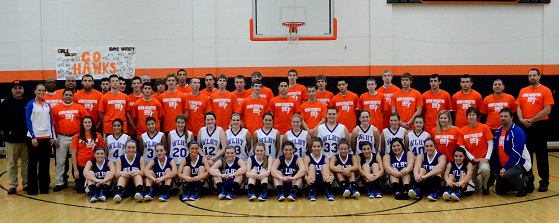 Two more rivals, Fennville and Saugatuck, met late last month for their second “Never Forgotten” boys and girls basketball games with proceeds going to the Wes Leonard Heart Team for the purchase of AEDs.
Players wore jerseys with names on the backs of friends and family members who had died, and those jerseys were then given to family members after the games. Officials Ace Cover, Chris Dennie and Kyle Bowen also donated their game checks to the Heart Team, as did the winner of that night’s 50-50 raffle.
Leonard died from sudden cardiac arrest after making the game-winning shot in a basketball game March 3, 2011. The two schools played their first “Never Forgotten” games last season.
More support for less specialization
I’m asked once a year at least about sport specialization – that is, athletes focusing on just one sport, often from an early age, and if it pays off some way down the road.
Most of my evidence to support my belief in the well-rounded athlete has been anecdotal, based on conversations with people at the high school and college levels over the years. But a British study published this fall in the Journal of Sport Sciences by University of Birmingham researchers provides some interesting empirical findings.
The study of 1,006 people from the United Kingdom showed that those who participated in three sports at ages 11, 13 and 15 were “significantly more likely to compete at a national rather than club standard” between ages 16-18 than those who had practiced only one sport.
In other words, the study found that those who played more sports at earlier ages played at a higher level during their high school-age years, which seems to contradict the one-sport focus philosophy.
Click for more perspective on the study from Chris Kennedy, the Superintendent of Schools in West Vancouver, British Columbia.
PHOTO: The boys and girls teams for Fennville and Saugatuck pose together after their "Never Forgotten" games Dec. 21 at Fennville High. (Photo courtesy of Al LaShell.)

Today in the MHSAA: 8/27/26
By
Geoff Kimmerly
MHSAA.com senior editor
August 27, 2026
1. GIRLS VOLLEYBALL Division 2 No. 2 Kingsley downed Division 4 No. 9 Onekama, Manton and Division 3 honorable mention Traverse City St. Francis – Traverse City Record-Eagle
2. BOYS SOCCER Carson Welker had three goals and two assists in Monroe St. Mary Catholic Central’s 7-3 win over Carleton Airport – Monroe News
3. GIRLS VOLLEYBALL Saginaw Michigan Lutheran Seminary twice came back from one-set deficits to defeat Midland Bullock Creek in five – Midland Daily News
4. CROSS COUNTRY The Harbor Beach girls and Croswell-Lexington boys were victorious at the Cass City Invitational – Huron Daily Tribune
5. BOYS SOCCER Allen Park picked up an important Downriver League road win 3-1 at Trenton – Southgate News-Herald
6. BOYS 1TENNIS St. Joseph – No. 7 in Lower Peninsula Division 3 – earned an important 7-1 Southwestern Michigan Athletic Conference win over Battle Creek Lakeview – St. Joseph Herald-Palladium
7. BOYS SOCCER Manistee scored the game’s lone goal on a penalty kick to get past Benzie Central – Manistee News Advocate
8. GIRLS VOLLEYBALL Brooklyn Columbia Central came back to finish a sweep of Napoleon – Jackson Citizen Patriot
9. GIRLS VOLLEYBALL Division 2 No. 6 Frankenmuth remained undefeated with a shutout of Goodrich – WNEM
10. GIRLS VOLLEYBALL Fulton won its Mid-State Activities Conference opener, sweeping Coleman – Mount Pleasant Morning Sun