


Rivaling for a Cause
January 25, 2013
It’s impossible to include all the perspective we gain from every “Battle of the Fans” visit.
But this anecdote, although it didn't make Tuesday’s story about our Frankenmuth trip, tells of another great example for what student cheering sections can accomplish.
Frankenmuth and Millington are heated rivals, to say the least, separated by 13 miles and made more competitive by plenty of championship-deciding matchups over the years.
But for their boys basketball game Jan. 10 at Frankenmuth, student section leaders from both schools almost completely on their own set up the game as a cancer awareness night, complete with Frankenmuth students in black shirts and Millington’s wearing pink.
The idea was the brainchild of a of Frankenmuth section leader, who then received help from a local bank and contacted Millington to get the ball rolling.
Battle of the Fans has shown us the obvious – these student sections need strong leaders – but also the special things they can accomplish with additional initiative.
“Never Forgotten”
 Two more rivals, Fennville and Saugatuck, met late last month for their second “Never Forgotten” boys and girls basketball games with proceeds going to the Wes Leonard Heart Team for the purchase of AEDs.
Players wore jerseys with names on the backs of friends and family members who had died, and those jerseys were then given to family members after the games. Officials Ace Cover, Chris Dennie and Kyle Bowen also donated their game checks to the Heart Team, as did the winner of that night’s 50-50 raffle.
Leonard died from sudden cardiac arrest after making the game-winning shot in a basketball game March 3, 2011. The two schools played their first “Never Forgotten” games last season.
More support for less specialization
I’m asked once a year at least about sport specialization – that is, athletes focusing on just one sport, often from an early age, and if it pays off some way down the road.
Most of my evidence to support my belief in the well-rounded athlete has been anecdotal, based on conversations with people at the high school and college levels over the years. But a British study published this fall in the Journal of Sport Sciences by University of Birmingham researchers provides some interesting empirical findings.
The study of 1,006 people from the United Kingdom showed that those who participated in three sports at ages 11, 13 and 15 were “significantly more likely to compete at a national rather than club standard” between ages 16-18 than those who had practiced only one sport.
In other words, the study found that those who played more sports at earlier ages played at a higher level during their high school-age years, which seems to contradict the one-sport focus philosophy.
Click for more perspective on the study from Chris Kennedy, the Superintendent of Schools in West Vancouver, British Columbia.
PHOTO: The boys and girls teams for Fennville and Saugatuck pose together after their "Never Forgotten" games Dec. 21 at Fennville High. (Photo courtesy of Al LaShell.)
1st & Goal: 2026 Week 6 Review
By
Geoff Kimmerly
MHSAA.com senior editor
October 5, 2026
The races are on for 90 leagues featuring Michigan high school football teams this fall.
 A few championships have been decided, and several more are in the process. Those races and how they stack up heading into these final weeks are easily the theme as we look back on Week 6 below.
Bay & Thumb
HEADLINER Sanford Meridian 42, Harrison 14 The Mustangs (6-0) clinched a share of the Jack Pine Conference Division 2 title and can make the championship outright this week against Beaverton. While the offense was mighty, the defense arguably was more impressive – Harrison (5-1) entered the game averaging 44.8 points per. Click for more from the Midland Daily News.
Watch list Port Huron 29, Macomb L’Anse Creuse North 14 Port Huron (6-0) clinched its first league title since 2023, claiming a share of the Macomb Area Conference Blue championship with a chance to finish the league schedule perfect this week against Warren Cousino. The Red Hawks have doubled up every league opponent so far, with LCN (4-2) providing the toughest challenge.
On the move Unionville-Sebewaing 30, Ubly 16 The Patriots (4-2) made the playoff last season for the first time this decade, and a year later have clinched a share of the Big Thumb Conference Black title with their two losses by a combined eight points. Holly 30, Flushing 29 Holly (4-2) can’t win the Flint Metro League Stripes title but with this result took Flushing (3-3) out of the race as well. Midland Dow 52, Traverse City West 24 The Chargers (4-2) kept pace one game behind Saginaw Valley League North leader Mount Pleasant and put West (3-3) in the same spot by dealing the Titans their first league defeat.
Greater Detroit
HEADLINER Detroit Catholic Central 31, Toledo Central Catholic (OH) 12 The Catholic High School League Central race still includes four teams with three league games (or two for two teams) to play, but it may realistically be down to just two contenders after the Shamrocks (6-0) handed TCC (5-2) its first league defeat. Next up for DCC is Orchard Lake St. Mary’s, the only other Central team without a league loss. Click for more from the Detroit Free Press.
Watch list Dearborn Fordson 14, Northville 10 Fordson (5-1) will be Northville’s biggest fan this week as the Tractors’ Kensington Lakes Activities Association Black title hopes now rest with the Mustangs (5-1), who play leader Belleville next. A five-point Week 3 loss to the Tigers has been Fordson’s only setback, with this win over Northville interestingly its fourth by seven points or fewer.
On the move Grosse Pointe South 28, Macomb Dakota 21 GPS (5-1) will need some help to finish next weekend with a share of the MAC Red title, but the Blue Devils are up to No. 7 in Division 2 playoff-point average with this win over Division 1 Dakota (3-3). Oxford 15, Rochester Adams 14 The Wildcats (5-1) avenged last season’s 27-point loss to Adams (3-3) to move up to a tie for No. 6 in Division 1 playoff-point average. Monroe Jefferson 36, New Boston Huron 21 Jefferson (5-0) paced a step closer to facing Monroe St. Mary Catholic Central in a winner-take-all Huron League decider in Week 8, while sending New Boston Huron (4-2) into a tie for third.
Mid-Michigan
HEADLINER Pewamo-Westphalia 34, Fowler 28 (2OT) It probably didn’t seem possible to exceed expectations in this rivalry matchup, and yet this game arguably did so as P-W prevailed for its first back-to-back wins over Fowler since 2020 and 2021. The Pirates (6-0) clinched at least a share of the league championship with the Eagles (5-1) now rooting for Saranac this week to give them a chance of still claiming a share. Click for more from WLNS.
Watch list Howell 28, Hartland 27 (OT) The Highlanders (6-0) held on to send Hartland (4-2) a game back in the KLAA Gold and set up a potential title decider this week against Brighton.
On the move Brighton 28, Dearborn 27 The Bulldogs (4-2) similarly had to survive a close one to make this week’s matchup with Howell mean even more. Dearborn fell to 3-3 with a second single-digit loss over the last three weeks. New Lothrop 49, Ovid-Elsie 14 The Hornets (5-1) kept pace in the Mid-Michigan Activities Conference, a game behind leader Montrose, while making a title pursuit much tougher for the Marauders (3-3) as they prepare to face Montrose this week. Okemos 37, Holt 20 At 4-2, Okemos has as many wins this fall as the last six years combined and sits No. 30 in Division 1 playoff-point average.
Northern Lower Peninsula
HEADLINER Petoskey 42, Gaylord 21 The Northmen (4-2) control their destiny in the Big North Conference, with this win over the Blue Devils (3-3) leaving open an opportunity to face Marquette in Week 8 for a share of the league title – or more, if Marquette slips up this week against Gaylord. Cadillac also remains in the mix, tied with Petoskey for second place. Click for more from the Petoskey News-Review.
Watch list Maple City Glen Lake 34, Oscoda 14 With three league games to go, three teams are chasing leader East Jordan in the Northern Michigan Football Conference – and Glen Lake (4-2) is one of those three teams 4-1 in league play thanks to this key victory over Oscoda (3-3).
On the move Traverse City St. Francis 49, Pontiac Notre Dame Prep 28 The Gladiators (4-2) quietly have strung together three straight wins after a tough season start. After facing similarly tough competition, Notre Dame Prep (2-4) is hanging on to the No. 31 spot in the Division 5 playoff-point rankings. Elk Rapids 26, Boyne City 6 The Elks (4-2) avenged a 36-0 loss last season to the Ramblers (3-3) with their first win over them since 2011. Harbor Springs 18, Lakeview 13 The Rams (5-1) are now a win away from their most since 2019, and Lakeview (3-3) is enjoying the same scenario despite this defeat.
Southeast & Border
HEADLINER Hudson 38, Clinton 30 Four teams are back in the hunt in the Lenawee County Athletic Association after Hudson handed Clinton its first defeat in both league play and overall. Ida stands alone atop the standings at 5-0, but Hudson, Clinton and Adrian Madison are all 4-1 – with Hudson playing Ida in Week 8 and Clinton getting Ida this week followed by Madison on Oct. 16. Click for more from the Adrian Daily Telegram.
Watch list Temperance Bedford 38, Dexter 35 Bedford made the District Finals last season while finishing 5-6 overall, and the Kicking Mules (6-0) already have surpassed that win total as they prepare for a potential Week 8 winner-take-all against Saline in the Southeastern Conference Red.
On the move Manchester 80, Leslie 35 This battle for first in the Cascades Conference North turned high scoring and then some, with the end result Manchester (5-1) gaining an opportunity to earn a share of the league title this week as Leslie (4-2) already had done so. Adrian 15, Tecumseh 14 Adrian (5-1) needs help to have a chance at a share of the SEC White championship, but the Maples continued to improve their playoff position jumping up to No. 14 in Division 4 while sending Tecumseh to No. 22. Springport 61, Reading 8 Springport (5-1) took the last step to set up this week’s matchup of Big 8 Conference leaders with Union City.
Southwest Corridor
HEADLINER Decatur 34, Galesburg-Augusta 7 The Raiders (6-0) clinched a share of a second-straight Southwest 10 Conference championship with another dominating victory and have given up only 28 points total over their last five. Galesburg-Augusta (5-1) will be hoping for some help from Hartford in Decatur’s league finale in Week 8. Click for more from the Kalamazoo Gazette.
Watch list Berrien Springs 29, Dowagiac 28 Berrien Springs (6-0) clinched a share of a fourth-straight Lakeland Conference title but needed its closest league win in decades to do so. Dowagiac (3-3) lost by 21 and 14 in its two meetings with the Shamrocks last season, but made this one much closer.
On the move Kalamazoo United 7, Schoolcraft 0 The Titans (6-0) strengthened their hold significantly on first place in the Southwestern Athletic Conference and lead two others by a game with three to play – all against teams 2-4 or 1-5. Battle Creek Harper Creek 38, Coldwater 19 The Beavers (5-1) kept pace just behind Marshall in the Interstate 8 Athletic Conference and surely will root for Coldwater (4-2) against the Redhawks in Week 8. Battle Creek Central 36, Kalamazoo Central 23 The Bearcats (3-3) broke a three-game losing streak as they pursue a first playoff appearance since 2022, and this win jumped them 15 spots in the Division 3 playoff-point average rankings to No. 32.
Upper Peninsula
HEADLINER Bark River-Harris 46, L’Anse 18 The Broncos (5-1) bounced back from their lone loss to move within one more win of clinching a share of a repeat Western Peninsula Athletic Conference Iron title. Bark River-Harris can make that happen this week against Hancock, which has only one defeat in league play. L’Anse (3-3) is just outside the top 32 on the Division 8 playoff-points average list but has opportunities to gain big points the rest of the way facing Iron Mountain, Hancock and Calumet.
Watch list Marquette 34, Alpena 21 Marquette (4-2) entered this season a combined 14-4 in Big North Conference play over its three seasons in the league. But its increased that to 18-4 this fall as it attempts to close in on a first league title in the BNC after two second places and a third.
On the move Kingsford 35, Hancock 6 The Flivvers (6-0) edged another win closer to setting up a winner-take-all again in the West PAC Copper against Menominee. Calumet 34, Houghton 13 The Copper Kings (4-2) bounced back from consecutive losses to those Copper contenders and sit No. 14 in Division 6 playoff-point average. Negaunee 36, Ishpeming Westwood 14 The Miners (4-2) rank No. 18 in Division 5 playoff-point average as they prepare to host undefeated Menominee with a chance to shake up those league standings.
West Michigan
HEADLINER Muskegon Mona Shores 29, Byron Center 28 The margin was slim but the result massive in the Ottawa-Kent Conference Green as Mona Shores (5-1) sits alone atop the standings after breaking a two-game losing streak against the Bulldogs (4-2). The Sailors can clinch a share of the league title this week against Muskegon High. Click for more from the Local Sports Journal.
Watch list Hopkins 42, Belding 22 The Vikings (6-0) also sit alone atop the O-K Silver standings after handing Belding (5-1) its lone defeat and breaking a four-game losing streak against the Black Knights. The victory also gave Hopkins one more than all of last season.
On the move Grand Rapids Catholic Central 27, Middleville Thornapple Kellogg 7 The Cougars (5-1) took over first place alone in the O-K Black, handing MTK (5-1) its lone loss with an impressive defensive showing. East Kentwood 31, Rockford 10 The Falcons (6-0) did their part to set up this week’s O-K Red showdown with also-undefeated co-leader Caledonia, also sending Rockford to 3-3. Zeeland West 48, Zeeland East 14 The Dux (5-1) ran their winning streak in this neighborly rivalry to 11, bouncing back nicely from a Week 5 defeat.
8-Player
HEADLINER Portland St. Patrick 28, Pickford 18 These two remain on track to potentially finish their seasons at the Superior Dome, as St. Patrick (6-0) moved up two spots to sit tied for No. 3 in Division 2 playoff-point average and Pickford (5-1) fell just one position after entering the weekend No. 1 in Division 1. The Shamrocks led 7-6 at halftime before pulling away. Click for more from the Cheboygan Daily Tribune.
Watch list Crystal Falls Forest Park 34, Norway 26 The Trojans (5-1) dwell alone in second place in the Great Lakes Eight Conference West with a Week 9 date with leader Lake Linden-Hubbell gaining more and more steam.
On the move Climax-Scotts 56, Marcellus 52 This was another high-profile cross-division battle as Climax-Scotts moved up to No. 6 in Division 1 playoff-points average and Marcellus fell to No. 10 in Division 2. Bridgman 58, St. Joseph Our Lady of the Lake Catholic 20 The Bees (5-1) bounced back from a Week 5 defeat to hand Our Lady (4-2) this one before Our Lady attempts to finish off a league title run this week. Merrill 30, Breckenridge 14 Despite a notable defensive effort by the Huskies (3-3), high-scoring Merrill powered through to set up this week’s winner-take-all matchup with Blanchard Montabella in the Mid-State Activities Conference Blue.
MHSAA.com's weekly “1st & Goal” previews and reviews are powered by MI Student Aid, a division within the Department of Lifelong Education, Advancement, and Potential (MiLEAP). MI Student Aid encourages students to pursue postsecondary education by providing access to student financial resources and information. MI Student Aid administers the state’s scholarship and grant programs that help make college Accessible, Affordable and Attainable for you. Click to connect with MI Student Aid and find more information on Facebook and Twitter @mistudentaid.
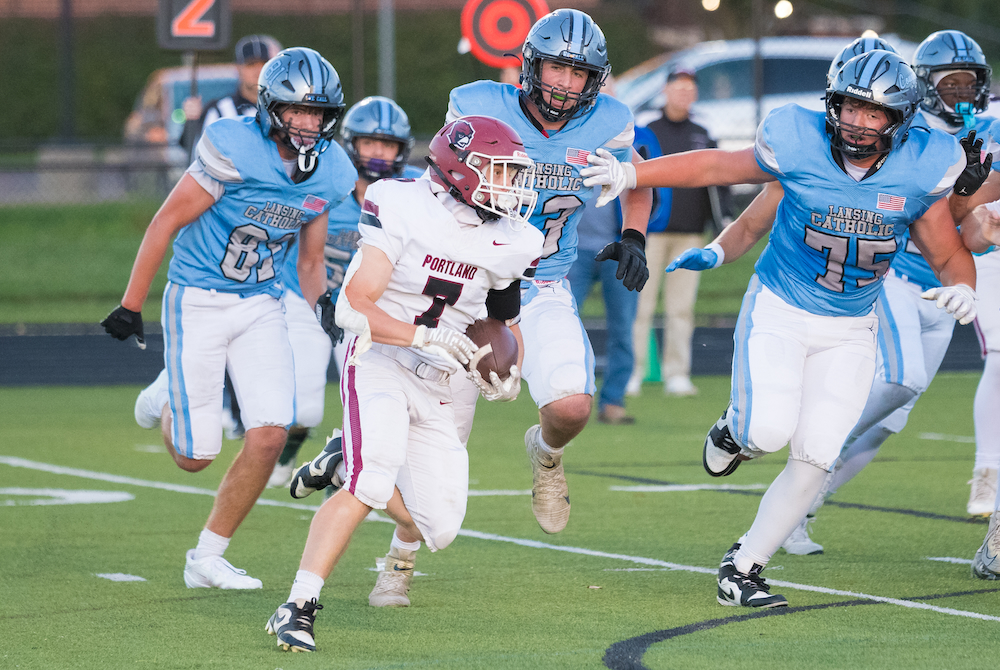
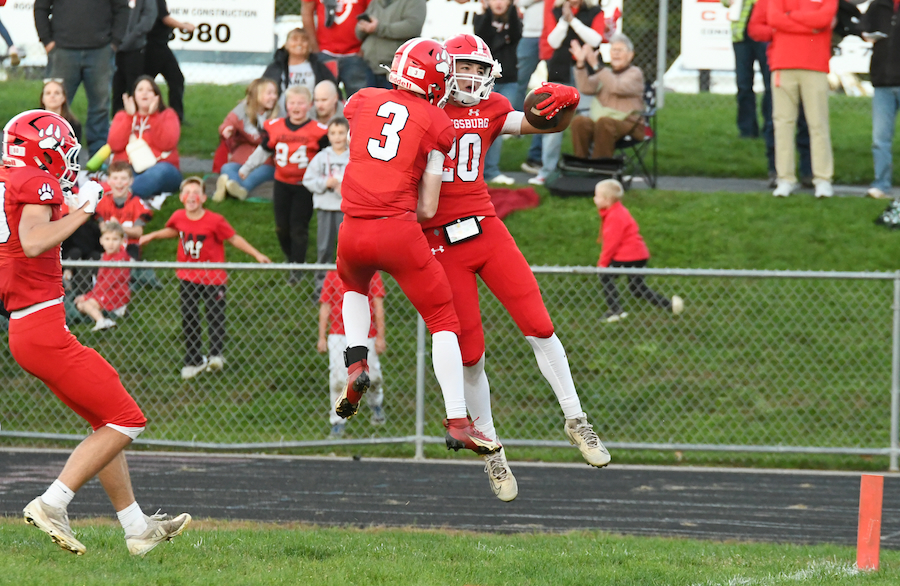
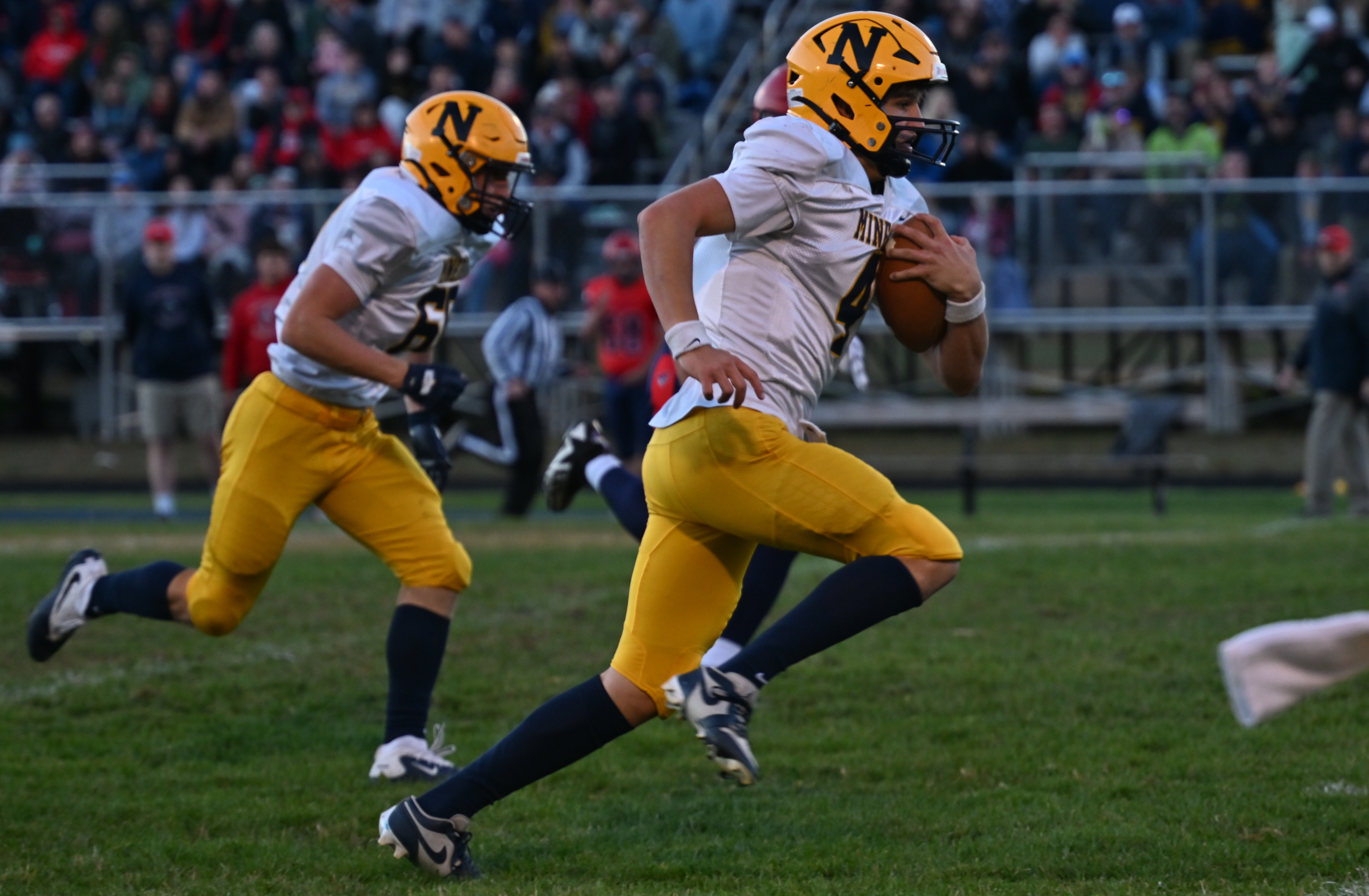
PHOTOS (Top) Portland’s Carson Spenski (7) turns a corner with several Lansing Catholic players in pursuit during a 49-14 Raiders win. (Middle) Laingsburg players celebrate a touchdown during a 44-0 shut out of Bath. (Below) Negaunee's Kyle Waterman keeps the ball and carries it to within a few yards of the end zone. (Portland/Lansing Catholic photo by TCP Photography. Laingsburg photo by John Johnson. Negaunee photo by Cara Kamps.)