


Rivaling for a Cause
January 25, 2013
It’s impossible to include all the perspective we gain from every “Battle of the Fans” visit.
But this anecdote, although it didn't make Tuesday’s story about our Frankenmuth trip, tells of another great example for what student cheering sections can accomplish.
Frankenmuth and Millington are heated rivals, to say the least, separated by 13 miles and made more competitive by plenty of championship-deciding matchups over the years.
But for their boys basketball game Jan. 10 at Frankenmuth, student section leaders from both schools almost completely on their own set up the game as a cancer awareness night, complete with Frankenmuth students in black shirts and Millington’s wearing pink.
The idea was the brainchild of a of Frankenmuth section leader, who then received help from a local bank and contacted Millington to get the ball rolling.
Battle of the Fans has shown us the obvious – these student sections need strong leaders – but also the special things they can accomplish with additional initiative.
“Never Forgotten”
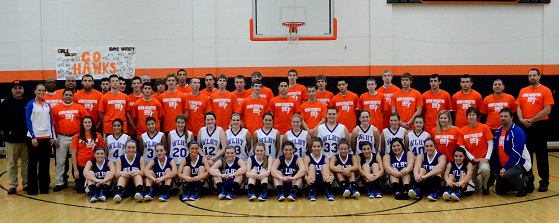 Two more rivals, Fennville and Saugatuck, met late last month for their second “Never Forgotten” boys and girls basketball games with proceeds going to the Wes Leonard Heart Team for the purchase of AEDs.
Players wore jerseys with names on the backs of friends and family members who had died, and those jerseys were then given to family members after the games. Officials Ace Cover, Chris Dennie and Kyle Bowen also donated their game checks to the Heart Team, as did the winner of that night’s 50-50 raffle.
Leonard died from sudden cardiac arrest after making the game-winning shot in a basketball game March 3, 2011. The two schools played their first “Never Forgotten” games last season.
More support for less specialization
I’m asked once a year at least about sport specialization – that is, athletes focusing on just one sport, often from an early age, and if it pays off some way down the road.
Most of my evidence to support my belief in the well-rounded athlete has been anecdotal, based on conversations with people at the high school and college levels over the years. But a British study published this fall in the Journal of Sport Sciences by University of Birmingham researchers provides some interesting empirical findings.
The study of 1,006 people from the United Kingdom showed that those who participated in three sports at ages 11, 13 and 15 were “significantly more likely to compete at a national rather than club standard” between ages 16-18 than those who had practiced only one sport.
In other words, the study found that those who played more sports at earlier ages played at a higher level during their high school-age years, which seems to contradict the one-sport focus philosophy.
Click for more perspective on the study from Chris Kennedy, the Superintendent of Schools in West Vancouver, British Columbia.
PHOTO: The boys and girls teams for Fennville and Saugatuck pose together after their "Never Forgotten" games Dec. 21 at Fennville High. (Photo courtesy of Al LaShell.)
Dawson, Nieuwenhuis Claim 4th Individual Titles, Romeo Wins Girls Team Final
By
Scott DeCamp
Special for MHSAA.com
March 8, 2026
DETROIT – Madison Nieuwenhuis has big plans in her future as it relates to wrestling, including competing in the World Team Trials and heading to the University of Iowa.
First, the Plainwell senior was looking to etch her name into the MHSAA record book Saturday at the Girls Wrestling Finals at Ford Field.
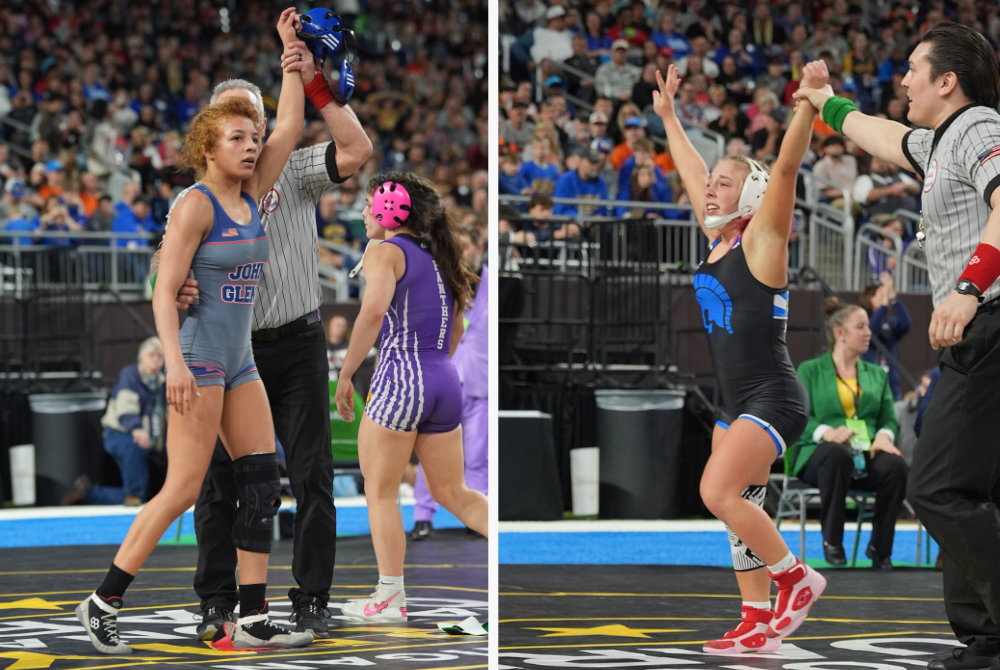
Nieuwenhuis became the second girls wrestler in MHSAA history to win four individual championships as she pinned Howell freshman Olive DiMassa in the 105-pound bout in 1:34.
Two matches later, Westland John Glenn senior Nakayla Dawson joined that select company with her fourth-straight title on a technical fall (5:30, 17-1) at 115 pounds against Frankfort senior Isabella Crompton.
Last year, Fowlerville’s Margaret Buurma became the first girl to capture four MHSAA Individual Finals titles.
“I’m super excited,” Nieuwenhuis said. “I’ve had this goal for, I don’t even know how long it is, and it’s finally come true. I’ve worked so hard, and I’m so happy right now.”
Said Dawson: “It is very satisfying because at the beginning of the season I wasn’t doing my best when I first got my (knee) injury. People thought I was going to lose states – they (weren’t) going to take the title from me.”
For the second time, the MHSAA recognized a girls team champion based upon individual points and places scored by each school.
Romeo was the team champion with 80 points, pushed by Oxford at 78.5. Plainwell was third (64), followed by Yale (55.5), Lowell (53.5), and Allen Park (47) among the top six.
“It was a really close race. Hats off to Oxford – they wrestled really well this weekend and I’m glad our girls could pull it off,” said Romeo coach Stephen Manuel, whose daughters Belicia and Kaili won individual titles in consecutive matches at 155 and 170, respectively. “We were behind going into the finals and we had to score 12 points, so they had to bonus and they did.”
100
Champion: Lillee Denson, St. Clair Shores Lakeview, Sr. (22-1)
Technical Fall (5:16) 22-6, over McKenzie Mantei, Dundee, Soph. (31-4)
Wrestling was a gradual progression for Denson, who didn’t begin the sport until her sophomore season.
“I started my sophomore year, and I didn’t even make it to state,” said Denson, who is a Northern Michigan University commit. “My second year, I just had to change my mindset and I ended up getting runner-up last year, so just short of state champion. And this year, I won it all because of my support system.”
Denson lost at last year’s Finals at 105 against Lowell’s Tatianna Castillo, who won the title at 110 on Saturday.
105
Champion: Madison Nieuwenhuis, Plainwell, Sr. (28-0)
Fall, 1:34, over Olive DiMassa, Howell, Fr. (40-2)
It was an emotional end to Nieuwenhuis’ high school career, as she sprinted toward the Division 2 boys mat immediately following her victory over DiMassa. She was a nervous wreck watching sophomore brother Dylan Nieuwenhuis win at 113 pounds.
First, she had to take care of her business, which she did with no problem.
“I’m super pleased with my performance. … I’ve got a lot bigger things coming, so I’m glad I got to check this part and pull it off,” Nieuwenhuis said.
“I wouldn’t be able to do it without the Plainwell community. There’s no one better than the Plainwell community. My parents have stuck by me and my brother. They’re there every single step of the way. They’ve done so much for us. I wouldn’t be able to do it without them.”
110
Champion: Tatianna Castillo, Lowell, Soph. (34-1)
Fall, 5:10, over Rylee Nidiffer, Riverview Gabriel Richard, Fr. (32-4)
Castillo collected a second-straight title, this one at 110 after winning 105 in 2025.
The Lowell boys team won its 13th-straight Division 2 team title last weekend, and the Red Arrows have had numerous wrestlers bring home individual championships.
Castillo is hoping that the Lowell girls can establish a rich wrestling history of their own. They’re off to a good start.
“I think we kind of trained to live up to the boys’ expectations, even though we’re our own kind of section,” she said. “I think it’s so, like, amazing to bring the girls something bigger into Lowell. Lowell isn’t really known for the girls (program), but being a state champ and helping other girls come, I just feel like it’s so amazing to be able to be a part of that.”
115
Champion: Nakayla Dawson, Westland John Glenn, Sr. (15-0)
Technical Fall (5:30), 17-1, over Isabella Crompton, Frankfort, Sr. (48-2)
It wasn’t the easiest of seasons for Dawson, despite her perfect record, as she was hampered by a knee injury to start.
Dawson remained inspired, however, to the point where she said she’d like to coach wrestling some day and teach others what she’s learned.
Dawson said she is considering Indian Hills Community College in Iowa for her next wrestling stop.
“It means a lot because just from me winning my first state title and everything like that, more girls have moved into wrestling, especially at my school and everything,” she said. “They wanted to learn, wanted to wrestle, because of me.”
120
Champion: Cheyenne Frank, Oxford, Sr. (39-0)
Technical Fall (4:40) 16-1, over Alexander Stiltner, Battle Creek Harper Creek, Sr. (40-2)
Frank capped her perfect senior season with a dominant win and a second-straight title. If that weren’t enough, she did backflips on the mat immediately following – just because.
“I just felt like kind of doing that. I just felt loose, you know,” Frank said with a big smile.
Frank was a Finals runner-up as a sophomore and placed fifth as a freshman as a four-time all-stater.
“This means a lot to my community, my team, like all my great coaches,” Frank said. “I’m just glad I got to do this, this last year with them and be surrounded by people I love and care about.”
125
Champion: Adriana Murray, Yale, Soph. (39-3)
Fall, 1:57, over Haley Stenz, Alpena, Soph. (32-2)
If you saw Murray’s vertical leap when she jumped into her coach’s arms after winning her first Finals title, then you may not believe she is coming off significant surgery during her freshman year.
Murray was at a loss for words Saturday, expressing gratefulness to be able to return to the mat.
“I got injured last year. I had surgery on both of my legs on my birthday, and it was supposed to be my last year (wrestling),” Murray said. “I won’t lie, it was miserable. I can’t sit here and tell you all the perfect stuff and that it was great and it’s easy to work through because it’s not. I couldn’t walk for nine months. I had to miss a little bit of school. I wasn’t walking. I wasn’t moving.”
130
Champion: Kassie Sapp, Whitehall, Soph. (39-1)
Decision, 6-4, over Cecilia Williams, Mason, Sr. (21-1)
When Sapp was trailing Williams 4-3 late in their match Saturday, she couldn’t help but think of her 4-3 loss to Grand Haven’s Gracey Barry in last year’s 115-pound title bout.
Even though Williams entered as a favorite, seeking her third Finals title after winning 125 last year and 120 in 2023, Sapp was determined to flip the script. She did so with a takedown during the final seconds.
“I mean, I just dug in, I really did. I don’t even know,” Sapp said. “I just found it within myself and I was like, ‘I’m not going to lose. I’m not going to do what I did last year.’ I was like, ‘I’m not going to lose 4-3 again. There’s no way.’”
135
Champion: Angellaya Burden, Mio, Jr. (28-0)
Fall, 3:33, over Paisley DeNault, Clarkston, Sr. (22-1)
After winning her second-straight championship, Burden admitted she’s not always fond of practices. She finished fourth in the state as a freshman, so somebody must be doing something right.
“I have to thank my coaches, even though sometimes I don’t like them,” Burden quipped and then laughed. “Definitely my teammates, too – even though I feel like quitting, they keep pushing me.
“I definitely struggle a little bit wrestling at practice, but I know at the end of the day it’s making me better – even when I’m wrestling my brothers,” she said, turning and looking toward her coach with a raised eyebrow.
140
Champion: Alexis Lazar, Brighton, Sr. (27-0)
Fall, 1:44, over Kylee Mollow, Olivet, Jr. (44-5)
Lazar has been wrestling for six years. She’s in her first year attending public school after previously being homeschooled.
In her first season competing in an MHSAA sport, she moved to the head of her class.
She kept her cool.
“I didn’t get in my head. I had fun the whole time. I just went out there and did what I had to do,” said Lazar, a Grand Valley State University commit.
145
Champion: MacKenna Webster, Three Rivers, Sr. (42-1)
Fall, 6:00, over Brynna Alwell, Allen Park, Sr. (31-5)
Winning her first Finals title was a big deal for Webster, after she lost in a championship match last year and finished sixth as a sophomore. But being a positive role model may rank higher on her list.
“Honestly, it’s everything. I’m always (trying to set an example) for the girls after me, to be able to leave my mark for those girls,” Webster said. “I just feel so completed. The girls after me, my little girls … they’re why I do it. They’re always pushing me all the way. I’m so glad that I could do it for them.”
Webster plans to attend Davenport University.
155
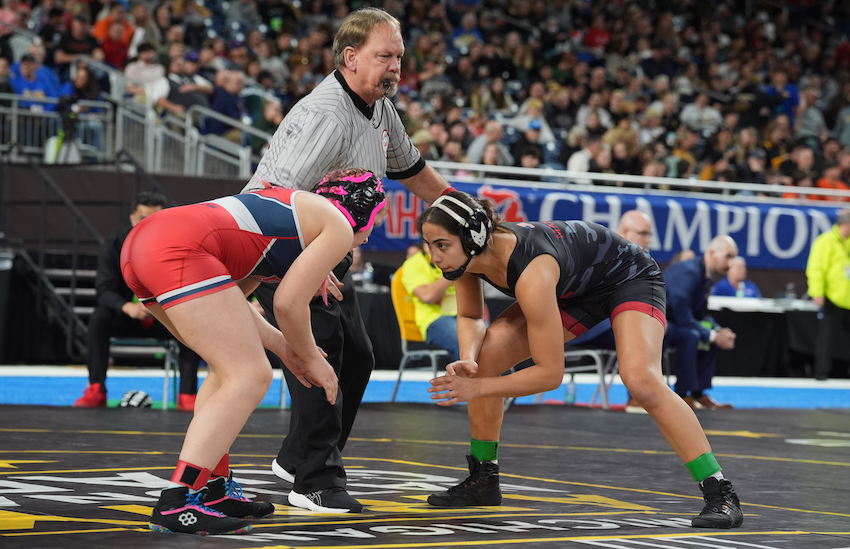
Champion: Belicia Manuel, Romeo, Sr. (50-0)
Fall, 1:03, over Aaliyah Langell, Big Rapids, Fr. (27-2)
Manuel seized her second title, adding to the one she captured at 140 as a sophomore. She finished runner-up at 145 last year when she lost to four-time champ Margaret Buurma of Fowlerville.
Watching sister Kaili win a championship at 170 immediately after she clinched hers, Belicia was very satisfied with the way her high school career wrapped up.
“It was really nice. It was really fun, especially winning it my last year together (with her sister),” Manuel said.
She plans to attend Northern Michigan University, where she is looking to wrestle.
170
Champion: Kaili Manuel, Romeo, Jr. (48-1)
Technical Fall (2:30) 23-7, over Adelaide Holderman, Middleville Thornapple Kellogg, Jr. (25-3)
Moments after big sister Belicia won her second title, Kaili followed suit with another of her own. This was her third championship, as Kaili won at 155 last year and 145 two years ago.
Belicia’s match was so quick, Kaili pretty much missed it.
“Honestly, I looked at the beginning, I did like a lap and then I looked back and it was over. I was like …,” she paused, then gestured with applause to acknowledge her sister for a job well done.
When Kailia was asked if she and Belicia tangle at home, she came back with an amusing reply.
“It’s mainly my other sisters that fight,” she said. “I’m more of, like, a talker and not a fighter.”
190
Champion: Olivia Kemp, Carleton Airport, Jr. (25-1)
Decision, 4-2, over Kanata Richardson, Bloomfield Hills, Sr. (30-3)
Richardson was seeking a second-straight title, but Kemp had other plans – even if it looked bleak for her during a large portion of the match.
It was such an emotional finish for Kemp, she still had tears in her eyes several minutes after her match ended.
“I just looked over, saw my coaches – I thought of all the hard work I put in through the season, knowing I couldn’t beat her the last time I had a bum shoulder,” said Kemp, who placed fifth last year. “This time, I’m all healed up and ready to go. There’s no excuses.”
235
Champion: Halle Spears, Midland, Sr. (33-0)
Fall, 1:42, over AnnMarie Green, Clare, Sr. (27-2)
Spears finished runner-up at 190 last season, so all she had on her mind this year was to win the prize.
“It’s so great. I’ve waited so long for this. It feels really good to come back and get what I wanted last year,” Spears said.
A Grand Valley State University commit, she was overcome with emotion when she thought about her brother being in her corner at the Finals. Their celebratory embrace was accompanied by tears of joy.
“Have fun and do what you know,” she said. “I think when you’re wrestling, you should just always do what you know and wrestle how you know you have to wrestle.”
PHOTOS (Top) Westland John Glenn's Nakayla Dawson, left, and Plainwell's Madison Nieuwenhuis have their hands raised in victory after earning their fourth MHSAA Finals championships Saturday at Ford Field. (Middle) Romeo's Belicia Manuel, right, and Big Rapids' Aaliyah Langell prepare to face off. (Click for more from High School Sports Scene.)