

Rivaling for a Cause
January 25, 2013
It’s impossible to include all the perspective we gain from every “Battle of the Fans” visit.
But this anecdote, although it didn't make Tuesday’s story about our Frankenmuth trip, tells of another great example for what student cheering sections can accomplish.
Frankenmuth and Millington are heated rivals, to say the least, separated by 13 miles and made more competitive by plenty of championship-deciding matchups over the years.
But for their boys basketball game Jan. 10 at Frankenmuth, student section leaders from both schools almost completely on their own set up the game as a cancer awareness night, complete with Frankenmuth students in black shirts and Millington’s wearing pink.
The idea was the brainchild of a of Frankenmuth section leader, who then received help from a local bank and contacted Millington to get the ball rolling.
Battle of the Fans has shown us the obvious – these student sections need strong leaders – but also the special things they can accomplish with additional initiative.
“Never Forgotten”
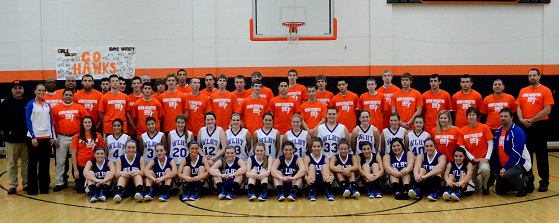 Two more rivals, Fennville and Saugatuck, met late last month for their second “Never Forgotten” boys and girls basketball games with proceeds going to the Wes Leonard Heart Team for the purchase of AEDs.
Players wore jerseys with names on the backs of friends and family members who had died, and those jerseys were then given to family members after the games. Officials Ace Cover, Chris Dennie and Kyle Bowen also donated their game checks to the Heart Team, as did the winner of that night’s 50-50 raffle.
Leonard died from sudden cardiac arrest after making the game-winning shot in a basketball game March 3, 2011. The two schools played their first “Never Forgotten” games last season.
More support for less specialization
I’m asked once a year at least about sport specialization – that is, athletes focusing on just one sport, often from an early age, and if it pays off some way down the road.
Most of my evidence to support my belief in the well-rounded athlete has been anecdotal, based on conversations with people at the high school and college levels over the years. But a British study published this fall in the Journal of Sport Sciences by University of Birmingham researchers provides some interesting empirical findings.
The study of 1,006 people from the United Kingdom showed that those who participated in three sports at ages 11, 13 and 15 were “significantly more likely to compete at a national rather than club standard” between ages 16-18 than those who had practiced only one sport.
In other words, the study found that those who played more sports at earlier ages played at a higher level during their high school-age years, which seems to contradict the one-sport focus philosophy.
Click for more perspective on the study from Chris Kennedy, the Superintendent of Schools in West Vancouver, British Columbia.
PHOTO: The boys and girls teams for Fennville and Saugatuck pose together after their "Never Forgotten" games Dec. 21 at Fennville High. (Photo courtesy of Al LaShell.)
Breslin Bound: 2025-26 Boys Report Post-Break
By
Geoff Kimmerly
MHSAA.com senior editor
January 5, 2026
Holiday break is showcase season for several basketball teams all over the state, and there’s plenty to catch up on as "Breslin Bound” returns for the start of calendar year 2026.

While championship hopefuls will continue to play in special events (mostly on Saturdays) over the next many weeks as well, there were 58 tournaments and one-or-several-day showcases over the last two weeks featuring Michigan boys hoops teams.
“Breslin Bound” is powered by MI Student Aid and based on results and schedules posted for each school at MHSAA.com.
Week in Review
The countdown of last week’s five most intriguing results:
1. Rockford 81, Bloomfield Hills Brother Rice 78 (2 OT) The Rams won a classic at the D Zone Showcase and remain undefeated at 8-0 while the loss was the second over three games for Brother Rice (7-3).
2. Auburn Hills Avondale 50, Grand Blanc 49 In another D Zone Showcase nail-biter, Avondale (8-1) bounced back from losing to Freeland two days before to hand Grand Blanc (8-1) its only defeat this season.
3. Grand Haven 77, Freeland 74 (OT) Grand Haven (8-1) handed Freeland (7-1) its lone defeat, during the Cornerstone University Holiday Showcase.
4. Clinton Township Chippewa Valley 69, Detroit Cass Tech 67 Chippewa Valley (7-1) has been consistently successful over several seasons, but defeating Cass Tech (5-3) at the D Zone Showcase certainly earned additional attention.
5. East Lansing 62, Bloomfield Hills Brother Rice 41 The reigning Division 1 champion Trojans (8-0) have had a few close calls this winter but impressed against one of their most highly-regarded foes.
Watch List
With an eye toward March, here are two teams in each division making sparks:
DIVISION 1
Grand Blanc (8-1) The Bobcats have won at least a District title every season this decade, and appear on the right track for another run with their only loss by a point to Avondale (see above). Grand Blanc also has navigated a one-point overtime victory over Hamtramck and three-point win over Saginaw United, and perhaps most impressively downed Clarkston 54-47 at its home Charlie Carmody Classic to begin this month. Friday’s game at Grand Haven (8-1) will be another that could shake up rankings.
Ypsilanti Lincoln (8-1) The Railsplitters have continued to roll after finishing last season 16-10 but with six wins over their last seven games including a District title clincher. After finishing fourth in the Southeastern Conference Red last winter, Lincoln is the early leader in the SEC White. Its lone loss was during the first week of December to Wayne Memorial, and the Railsplitters have four wins by one or two points.
DIVISION 2
Benton Harbor (10-0) The Tigers are among five teams statewide that have reached double-digit wins, with six of those first 10 coming during showcase games including by two over Detroit Douglass and three in overtime over Berrien Springs. Benton Harbor has several more matchups of note coming up; circle Jan. 13 at Niles Brandywine, Jan. 17 against Detroit Catholic Central at Westland John Glenn’s Rocket Classic and Feb. 7 against Warren Lincoln at Grand Rapids Community College’s 2K26 Showcase.
Grand Rapids South Christian (7-1) The Sailors are coming off a 20-5 season that included sharing the Ottawa-Kent Conference Gold title and winning their District despite opening 1-3. They’re off to a much faster start this winter, already avenging last-winter losses to Grand Rapids Christian and Grand Rapids Catholic Central – the latter which ended South Christian’s 2024-25 season. The Sailors shared last year’s league title with Grand Rapids Northview and will see the Wildcats for the first time Friday.
DIVISION 3
Beal City (7-0) The Aggies opened the new year with wins over Mason County Central and Vestaburg to win the Reed City Holiday Tournament, and total five of their seven victories have come over teams currently with winning records. Beal City handed Highland Conference rival McBain its only loss and sits tied atop the league standings with LeRoy Pine River, with their first matchup slated for Jan. 20. Beal City finished second in the league to McBain last season and ended their tournament run with a Regional Final loss to the Ramblers.
Menominee (7-1) The Maroons began this season with a defeat against Division 2 contender Freeland at Petoskey’s Sean Pollion Invitational, but haven’t lost again – a substantial bounce-back from last year’s 2-4 start on the way to a 13-12 finish. The difference in part has been wins over Negaunee, Crystal Falls Forest Park and Green Bay West (Wis.) – after losses to those opponents during last winter’s start – and it’s important to note as well that all seven wins this season have come by at least 23 points.
DIVISION 4
Dollar Bay (6-1) Although the Blue Bolts are coming off a loss to Division 1 Marquette last week, a 49-45 overtime win over Forest Park has highlighted this early run and avenged an 18-point loss to the Trojans a year ago. Dollar Bay went on last season to share the Copper Mountain Conference title and win its District, and the Blue Bolts will see the other two co-champions Wakefield-Marenisco and Ewen-Trout Creek this month, as well as Bessemer – which ended Dollar Bay’s 2024-25 season in a Regional Semifinal.
Pickford (7-0) The Panthers just missed out on a trip to Breslin last season, falling to Forest Park by two points in their Quarterfinal while finishing 23-3 overall. They’ve already avenged last year’s regular-season loss to Harbor Springs as they opened this winter with six wins by at least 18 points before handing Harbor Springs Harbor Light Christian its only loss, 59-54 last week. Undefeated Cheboygan on Jan. 17 could present another intriguing challenge.
Can’t-Miss Contests
Be on the lookout for results of these games coming up:
Wednesday – Fowler (7-0) at Pewamo-Westphalia (5-1) – The only loss between these Central Michigan Athletic Conference rivals this winter was P-W’s by two points to Division 1 Grandville.
Friday – Detroit Loyola (8-0) at Dearborn Divine Child (8-2) – The Catholic High School League AA kicks off its second half with a rematch of a season-opening 62-56 win by league leader Loyola.
Friday – Frankenmuth (7-0) at Freeland (7-1) – These two are both undefeated in early Tri-Valley Conference Red play, with the only loss between them Freeland’s to Grand Haven noted above.
Saturday – Wayne Memorial (4-0) vs. Muskegon (4-0) at East Kentwood – These are two of 10 remaining undefeated Division 1 teams, and they face off at 4:45 p.m. in the Gottagetit Classic.
Saturday – Rockford (8-0) vs. East Lansing (8-0) at East Kentwood – These are two more of the Division 1 unbeatens, and they play in the 8:15 p.m. slot at East Kentwood.
MHSAA.com's weekly “Breslin Bound” reports are powered by MI Student Aid, a division within the Department of Lifelong Education, Advancement, and Potential (MiLEAP). MI Student Aid encourages students to pursue postsecondary education by providing access to student financial resources and information. MI Student Aid administers the state’s scholarship and grant programs that help make college Accessible, Affordable and Attainable for you. Click to connect with MI Student Aid and find more information on Facebook and X @mistudentaid.
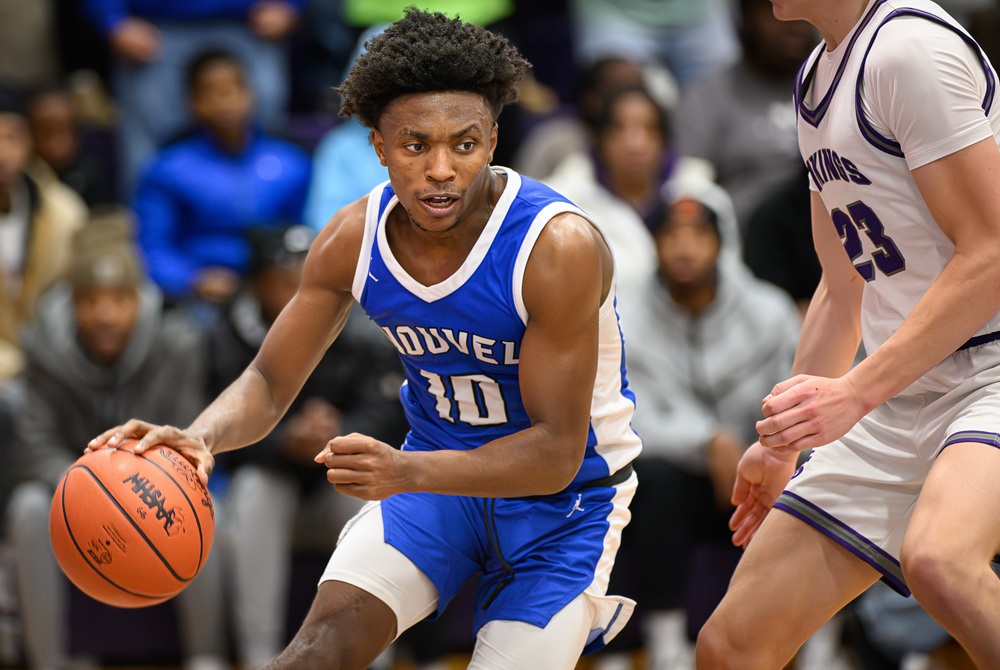
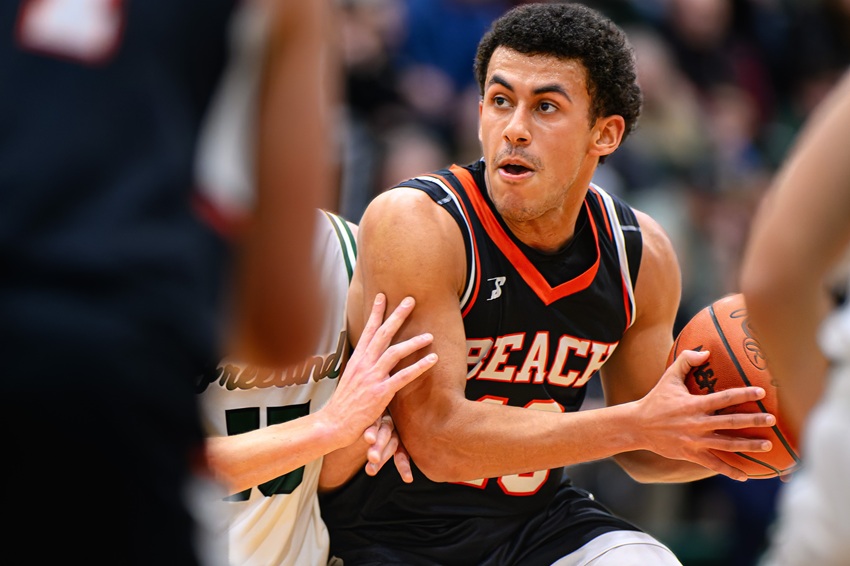
PHOTOS (Top) Saginaw Nouvel Catholic Central senior Rahmaan Kelley Jr. drives to the basket during the third quarter for two of his team-leading 20 points in the Panthers’ 44-35 victory over Saginaw Swan Valley on Dec. 17. (Middle) Harbor Beach guard Benson Harper works his way through the paint toward a second-quarter basket in his team’s Jan. 2 game against Freeland. (Photos by Kolleth Photo.)