


Rivaling for a Cause
January 25, 2013
It’s impossible to include all the perspective we gain from every “Battle of the Fans” visit.
But this anecdote, although it didn't make Tuesday’s story about our Frankenmuth trip, tells of another great example for what student cheering sections can accomplish.
Frankenmuth and Millington are heated rivals, to say the least, separated by 13 miles and made more competitive by plenty of championship-deciding matchups over the years.
But for their boys basketball game Jan. 10 at Frankenmuth, student section leaders from both schools almost completely on their own set up the game as a cancer awareness night, complete with Frankenmuth students in black shirts and Millington’s wearing pink.
The idea was the brainchild of a of Frankenmuth section leader, who then received help from a local bank and contacted Millington to get the ball rolling.
Battle of the Fans has shown us the obvious – these student sections need strong leaders – but also the special things they can accomplish with additional initiative.
“Never Forgotten”
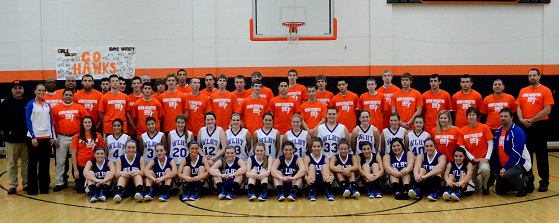 Two more rivals, Fennville and Saugatuck, met late last month for their second “Never Forgotten” boys and girls basketball games with proceeds going to the Wes Leonard Heart Team for the purchase of AEDs.
Players wore jerseys with names on the backs of friends and family members who had died, and those jerseys were then given to family members after the games. Officials Ace Cover, Chris Dennie and Kyle Bowen also donated their game checks to the Heart Team, as did the winner of that night’s 50-50 raffle.
Leonard died from sudden cardiac arrest after making the game-winning shot in a basketball game March 3, 2011. The two schools played their first “Never Forgotten” games last season.
More support for less specialization
I’m asked once a year at least about sport specialization – that is, athletes focusing on just one sport, often from an early age, and if it pays off some way down the road.
Most of my evidence to support my belief in the well-rounded athlete has been anecdotal, based on conversations with people at the high school and college levels over the years. But a British study published this fall in the Journal of Sport Sciences by University of Birmingham researchers provides some interesting empirical findings.
The study of 1,006 people from the United Kingdom showed that those who participated in three sports at ages 11, 13 and 15 were “significantly more likely to compete at a national rather than club standard” between ages 16-18 than those who had practiced only one sport.
In other words, the study found that those who played more sports at earlier ages played at a higher level during their high school-age years, which seems to contradict the one-sport focus philosophy.
Click for more perspective on the study from Chris Kennedy, the Superintendent of Schools in West Vancouver, British Columbia.
PHOTO: The boys and girls teams for Fennville and Saugatuck pose together after their "Never Forgotten" games Dec. 21 at Fennville High. (Photo courtesy of Al LaShell.)
Bolstered by Bonnema, Kalamazoo Christian Adds 2nd Win of 4-Year Finals Run
By
Paul Costanzo
Special for MHSAA.com
June 14, 2025
EAST LANSING – Kalamazoo Christian girls soccer coach Jay Allen was asking a lot of senior midfielder Jordyn Bonnema during Saturday’s Division 4 Final at Michigan State University.
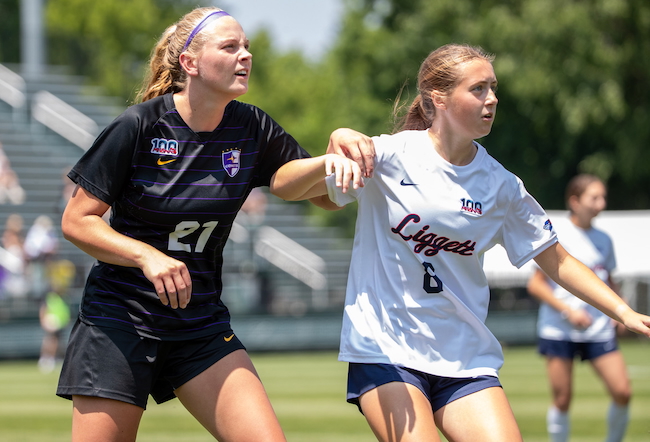
Bonnema was tasked with tracking Grosse Pointe Woods University Liggett’s Kerith Short around the field, and making sure the Knights’ leading scorer didn’t get free.
Just as Allen expected, Bonnema did her part, and then some.
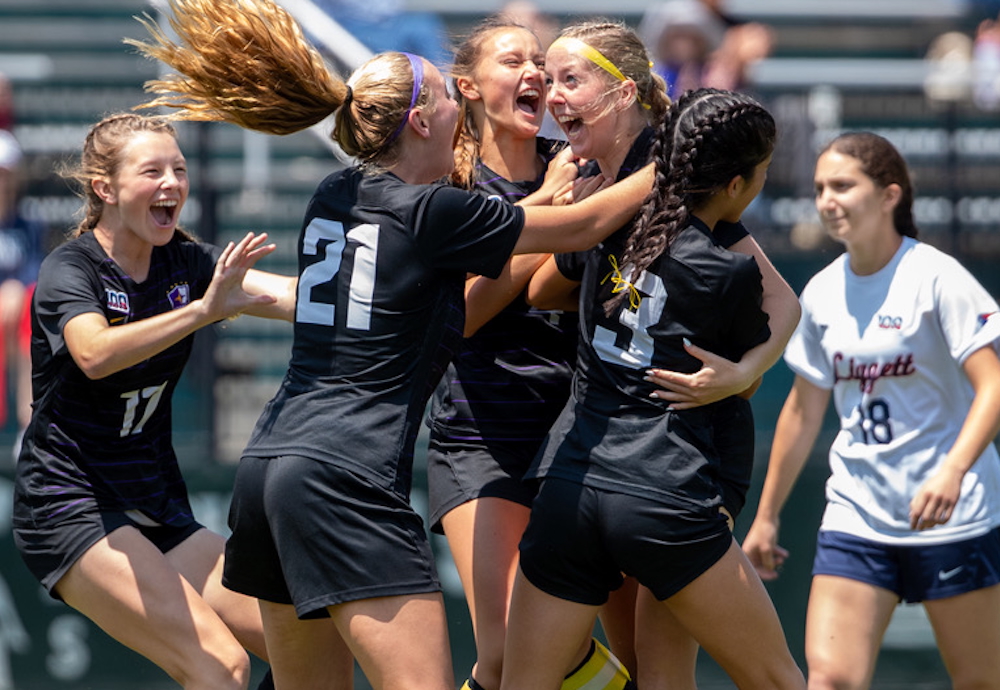
The Kalamazoo Christian senior scored a pair of goals and made life difficult for Short in the Comets’ 4-1 victory at DeMartin Stadium.
“She’s just a pure athlete,” Allen said. “She was bound and determined to win. It’s not just in soccer – it’s golf, it’s in basketball, it’s in the classroom, she’s a 3.9 student. The kid doesn’t know a loss. She’s driven.”
The title was the sixth in program history for the Comets, and second in three years. They were making their fourth-straight Finals appearance, having lost in a shootout a year ago against Jackson Lumen Christi.
For Bonnema, who had played in all four of those Finals, walking away as runner-up again was not an option.
“This is my last time in the black and gold, or purple and gold, and it’s bittersweet, but I just wanted to give it my all,” she said. “This has been such a long ride. Soccer was my first sport, I picked it up when I was 3 years old. To be here, stepping on the field for maybe the last time in my life, there can be no regrets. So I was just coming into the game with that mentality, that this might be the last time I’m ever going to lace up the cleats, so making sure I left nothing behind and leave it all on the field. I’m just super grateful for the opportunity to play for such an amazing program and with my best friends.”
Bonnema scored the second and third goals for Kalamazoo Christian, twice giving her team a two-goal lead in the second half. Izzy Suloff and Laila Rashid also scored, while Avery Lambarth had two assists and Rachel Miller had one.
 Kalamazoo Christian keeper Kailey Triemstra had nine saves. Most came on shots from outside the box, as the Comets defense, led by Maysen Steensma, did a good job of limiting opportunities for the Knights.
“I give them a lot of credit; they were defensively really solid,” Liggett coach David Dwaihy said. “They were really organized. They’d bend, but they didn’t break. They did all the things championship teams do defensively, and their goalie was there for them when they needed. Full credit to them, they deserve that. I thought that we did give them a good game, though, and I thought we represented ourselves really well and played with a style we can feel really good about.”
Short did score the lone goal for Liggett, bending in an Olimpico off a corner kick, after she had created the best scoring chance of the afternoon for her team, cutting inside on a defender and getting off a shot that deflected wide.
It was clear, though, each time she touched the ball that the Comets were determined to not give her any space to work.
“Our gameplan was Jordyn Bonnema,” Allen said. “Jordyn Bonnema was told you just can’t let her beat us. Jordyn just shadowed her, made sure she didn’t get clean looks, and that’s where we were at. We also fall back on Maysen Steensma, who is a solid brick wall back there, and kind of organized things. It was just a group effort.”
Kalamazoo Christian, which arrived late to the 2024 Final after its bus broke down, got off to a quick start Saturday, scoring within the first three minutes. Suloff collected the ball near the top of the box, created space to her right and fired a shot over the head of Liggett keeper Aline Rahaim, who had six saves on the day.
The second half opened much the same, as Bonnema scored less than three minutes in, charging into the box and getting on the end of a cross from Lambarth, making it 2-0.
While that looked to have killed momentum Liggett had been building through the end of the first half, the Knights found their answer five minutes later with Short’s goal.
“I think in the first half it helped us; in a weird way, I think it kind of woke us up,” Dwaihy said. “While playing from behind, we were a little more relaxed, and that ‘Let’s play to win’ vibe, as opposed to playing not to lose. It really favored us for the rest of the half. The next 37 minutes, we worked our way into the game and got some chances, but more importantly, we held a lot of the possession. That was key, because as we started to lose that in the second half, tired legs started to set in and the game got away from us.”
Bonnema made it a two-goal game again, scoring with a header off Miller’s corner with 10:14 to play.
“It’s for sure a little more reassuring, but we’re still back on defense and for sure not ready (to celebrate) until the clock hits zero,” Bonnema said. “It was nice to have a little bit of a gap, though, for sure.”
When Rashid followed up Lambarth’s shot and made it 4-1 with 7:05 to go, however, the die was cast, and it was clear the Comets would be lifting the trophy.
“This senior class has been here four times, so to end their senior year like this is special for them,” Allen said. “They are just such a hard-working group, and with all the hard work they put in, we were knocking off teams we shouldn’t have been and we got here. This week, and the last two days of practice, you could tell they wanted it, and we didn’t quit for 80 minutes.”
PHOTOS (Top) Kalamazoo Christian players celebrate during their Division 4 championship win Saturday at DeMartin Stadium. (Middle) The Comets’ Jordyn Bonnema (21) marks University Liggett’s Aubrey Hermann. (Photos by Adam Sheehan/Hockey Weekly Action Photos.)