

Special Year Thanks to No Specialization
August 7, 2015
By Geoff Kimmerly
Second Half editor
As we embark on another sports-filled school year Monday, we can look to a recent Monroe St. Mary Catholic Central grad for the value of a school year filled with sports.
As specialization at the highs school level continues to be debated, Bryce Windham will start his college baseball career this fall at Division I Old Dominion University – after playing baseball but also football and basketball for the Falcons.
 The MHSAA has long advocated athletes taking on as many sports as they have interest instead of focusing on just one in pursuit of a college scholarship – a position that’s received plenty of public backing of late, be it from stars of the U.S. women’s soccer team after their World Cup championship run or former Lansing Waverly multi-sport athlete John Smoltz during his enshrinement in the Major League Baseball Hall of Fame.
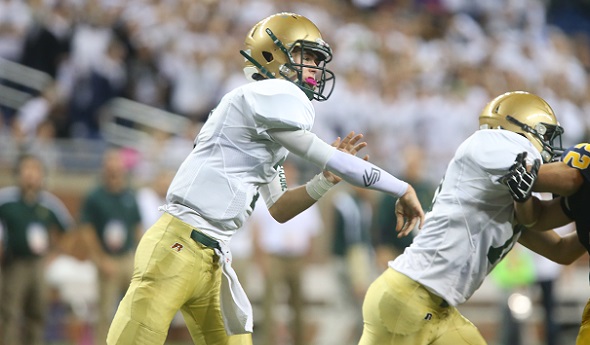
Enter Windham – who easily could’ve been excused for focusing on baseball, or even basketball as his dad is the St. Mary’s varsity boys coach. Instead, Bryce quarterbacked the football team to last season’s Division 6 championship – breaking Ithaca’s national-best 69-game winning streak in the Final – before being named Class C Player of the Year by The Associated Press in basketball and earning a Most Valuable Player honor at the baseball state coaches association all-star game at Comerica Park this spring.
All three of Windham's teams reached at least the MHSAA Quarterfinals.
“His participation in football and basketball helped land a Division 1 baseball scholarship to Old Dominion. They were able to see his athleticism in basketball and toughness in football, and ODU’s coach loved it,” dad and hoops coach Randy Windham said.
“He probably would’ve given up football, and that ended up his greatest memory by winning a state championship.”
Click to read about Windham’s multitude of accomplishments as reported last month by the Monroe Evening News.
Honors Abound
National coaching honors were bestowed on a trio of Michigan coaches over the summer:
- Retired Trenton ice hockey coach Mike Turner – the winningest hockey coach in MHSAA history with a record of 629-126-52 from 1974-81 and then 1995-2014 – was named National Coach of the Year in Special Sports by the National High School Athletic Coaches Association. His teams won 11 MHSAA titles and finished runner-up four times. “I was there when the MHSAA added hockey as one of their sanctioned sports and crowned their first MHSAA state championships in 1975. At that time there were 60-70 high school teams participating, and now there are 170,” Turner said. “It has been great to be a part of the advancements made in the sport of high school hockey, with more teams participating, more player development, and more opportunities that exist for players after high school.”
- Traverse City Central boys track and field and cross country coach John Lober won his second national coaching honor of the 2014-15 school year, named the NHSACA Coach of the Year for track and field to go with a previous honor earned in January from the National Federation of State High School Associations. He has coached the Traverse City Central boys track and field team since 1977 and also the boys cross country team since 1989. His 1992 track team won the Class A championship, and he has coached 17 individual MHSAA Finals champions. He was inducted into the Michigan Interscholastic Track Coaches Association Hall of Fame in 2006.
- Ann Arbor Pioneer assistant girls swimming and diving coach Liz Hill was named the Assistant Coach of the Year for all girls sports by the NHSACA. Hill, a former All-American at the University of Michigan and standout sprinter at Pioneer, began assisting her husband Denny Hill in 1983 before becoming his fulltime assistant a few seasons later. Together they’ve led the Pioneers girls to 15 MHSAA team titles, the last two as co-head coaches.
Michigan Mourns
Fremont and the high school athletic community statewide mourned the death July 21 of longtime coach Rich Tompkins, who led Fremont’s boys cross country teams to six MHSAA cross country championships including three and a runner-up finish during his last decade of coaching before retiring in 1997.
The Muskegon Chronicle reported that his boys and girls cross country teams and boys track and field team combined for 45 league championships, with his boys cross country team winning 116 straight duals from 1977-88. Tompkins was executive director of the Michigan High School Coaches Association for more than a decade and served on its board for more than two decades.
Click to read more from the Chronicle on Tompkins’ legacy.
Officials in the News
The Monroe County Officials Association took to the county fair to encourage passers-by to “Be the Referee” – and received 47 sign-ups from people interested in the avocation. Visitors to an MCOA booth at the fair were told in some detail what is involved with being an MHSAA official, and those who then signed up to find out more about officiating football, basketball, baseball or softball (sports the MCOA trains for and schedules) will be invited to an orientation session where they will become eligible for one of 20 complimentary registration fees for this school year.
 The West Michigan Officials Association marked a decade of support at the start of this summer for the Visually Impaired Sports and Activity Day, sponsored by the Helen DeVos Children’s Foundation. The WMOA has contributed nearly $18,000 to the event over the last 10 years as well as taking part in the event, which includes a number of sports and other activities.
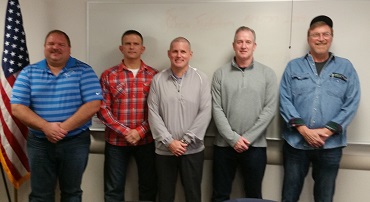
The Saginaw Athletic Officials Association sent along this photo of five members who worked 2013-14 MHSAA Finals, from left: Mark Jarlock (baseball), Tom Behmlander (softball), Scott Helmka (football), Dale Brown (softball and football) and Mark Schoenow (football). The Baseball Final was Jarlock’s first; the other officials had worked Finals in the past.
PHOTO: (Top) Monroe St. Mary quarterback Bryce Windham unloads a pass during last season's Division 6 Final win over Ithaca at Ford Field.
By Near-Slimmest of Margins, Ross Claims Finals Matchup of Blue Water Standouts
By
Jeff Bleiler
Special for MHSAA.com
March 1, 2025
JACKSON – Jason Ross has confidence in his son’s decision-making ability.
But even he had some doubts when Hunter Ross pulled out his third different bowling ball during the two-game championship match of the Division 3 Singles Finals at JAX 60 on Saturday.
The move paid off handsomely for the Almont senior.
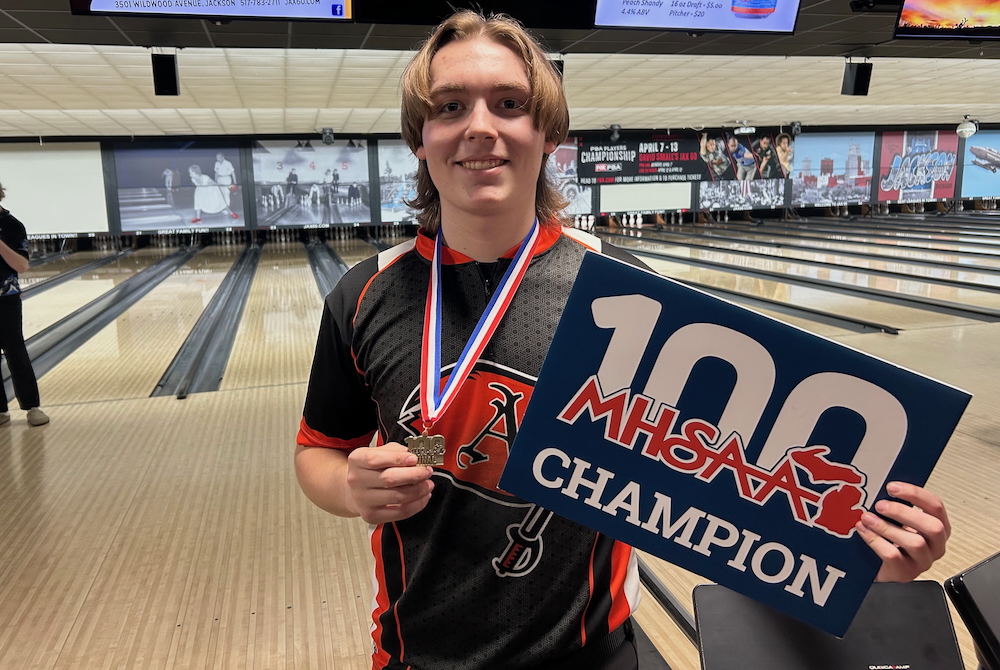
Struggling to find the pocket after an early four-bagger, Hunter Ross changed balls twice in the second game, the second ball delivering two strikes in the 10th frame to squeak out a two-pin victory over good friend and Croswell-Lexington sophomore Joshua Gunderson, 377-375.
“A lot of nerves,” Ross said afterward. “I made it way too close, so did Josh. Josh gave me a couple breaks. I just had to put it together. I don’t know what happened on that first shot in the 10th frame, but I’m thankful for it.”
What happened was the first positive break for either bowler during the two games where strikes were difficult to come by and 10-pins were stubborn. The two bowlers combined for eight 10-pin leaves, with Gunderson missing three and Ross one.
Ross’s miss came in the 10th frame of the first game and left him in a 192-187 hole. That’s when he decided to shelve the urethane ball that had produced four strikes to start the match and nothing close afterward.
“I didn’t feel comfortable on either lane because breakdown was horrendous, but I made do with what I had,” Ross said.
His first reactive ball, the Ion Max, lasted five frames before he turned to the Attention Star for the balance, going spare-spare-strike-spare to set up his 10th frame. After Gunderson converted a 10-pin and struck, Ross needed a double and eight pins to win.
His first ball went light but carried the 2-4-5-8 bucket. He then flushed the second one and got nine on his fill ball for a 190-183 advantage.
“We he got the second one, I knew he had it,” Jason Ross said. “I was on the edge of my seat. I’m just so happy for him. It’s his senior year, and this is what we pictured.”
Just maybe not that many ball changes.
“I was freaking out,” Jason Ross admitted. “But it’s his game, I let him make the call and he made the right choice. I’m confident in him and his abilities, and he earned it.”
Hunter Ross closed his high school career as a Finals champion, a Regional champion two years ago and a two-time singles champion in the Blue Water Athletic Conference.
He could not leave JAX 60 without giving credit to Andy Schnebelt, owner of Andy’s Pro Shop housed in the center. The Rosses made the hour-and-a-half drive from Almont to Jackson every two weeks for about a year for Hunter to learn under Schnebelt’s tutelage.
“I would not have gotten this far without him,” Hunter Ross said. “The dude is a genius. And if anyone has any questions about bowling, they should go to him.”
Ross earned the second seed after the six-game qualifying session with a total of 1,347, just 16 pins shy of Gunderson’s tournament-leading 1,363. Gunderson opened the day with a 289 game a week after winning his Regional with a 1,489 total, with Ross second.
Ross averaged 216 in his first three matches after qualifying, defeating Olivet junior Michael Fitzner 449-337, Hopkins senior Brad Reynolds 409-357, and Gladstone senior Matt Meyer 443-406. During the second game of qualifying, Meyer fired a 299 game.
Gunderson was even hotter entering the championship after averaging 227 for his three matches in defeating Fremont senior Gavin Payne 491-405, junior teammate Carter Ramage 433-372, and Milan senior Max Jenness 438-403.
Despite the loss in the championship — and a runner-up finish the day before in the Team Final — Gunderson was pleased with his showing and that of his team. And proud of Ross.
“I’m happy for my friend. I’m just happy I did better than last year, honestly,” said Gunderson, who lost in the quarterfinals last year to eventual champion Mayson Knop of Frankenmuth. “I feel like we’ll be back next year. We don’t lose anybody for team. We’ll be back, and hopefully I’ll be back for singles.”