

An errant drive, but a right-on response
May 16, 2012
By Geoff Kimmerly
Second Half editor
Junior Garcia was minding his own round last week when, seemingly out of the sky, he was nailed in the hand by an opponent's golf ball.
It clearly hurt -- so much so, he had to quit his round before finishing. He could've responded in a number of ways. Many of us wouldn't have responded so well.
Instead of finding the player who had hit him -- and letting him have it back -- Garcia, a Shelby senior, did seek out Montague junior Nate VanGeison, to make sure VanGeison was OK and to let him know that these mistakes are part of the game. He was equally, if not more concerned with VanGeison's well-being than his own.
It's something we all should keep in mind the next time an errant shot comes at us like a comet from above.
"It was so touching. It's hard to really put it into words unless you were there," Montague golf coach Tom Kearney said. "He was just so sincere."
Shelby and Montague were playing in a West Michigan Conference jamboree at Oceana Golf Course. VanGeison pulled a drive so far left that it left his fairway and flew over an adjacent green that Garcia's group was approaching.
Garcia's hand began to swell up immediately. He'd leave to get it X-rayed before the teams finished play that day. But not before he asked Kearney to check on VanGeison and make sure his opponent knew there were no hard feelings. And not before following up that request by asking Kearney to then drive him back onto the course himself to pass on a few words of encouragement.
VanGeison had asked to leave the course as well so he could check on Garcia. The two instead met in the middle.
"Nate apologized to him, and Junior said, 'It's OK. I know it was an accident,' and they hugged," Kearney said. "Just before we left (to go back inside), Junior said, 'Nate, don't worry about me. I want you to shoot a good round for me.'"
And VanGeison did, firing a 94 to finish second for Montague in that round.
Garcia went so far as to ask his mother if he could stop by Montague the next day, just to check on VanGeison one more time. Both returned to the course Tuesday.
"I really thought it was a wonderful example of sportsmanship," Kearney said.
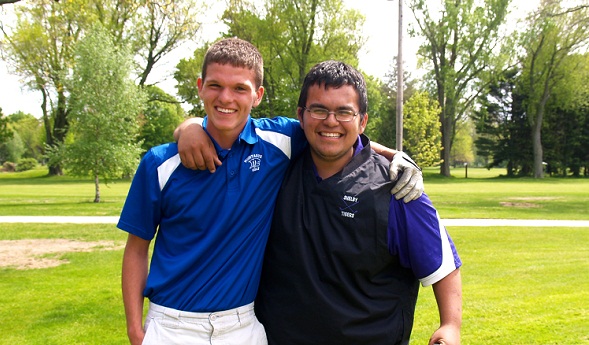
PHOTO: Nate VanGeison (left) of Montague and Shelby's Junior Garcia returned to the golf course Tuesday, in great spirits after last week's jamboree ended for Garcia after his hand was bruised by a VanGeison drive. (Photo courtesy of Tom Kearney.)
Reaching the Sportsmanship Summit
January 7, 2013
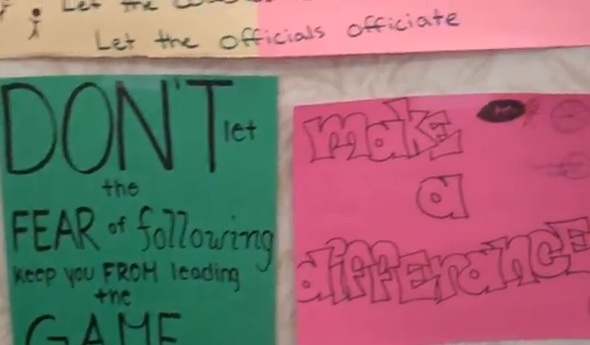
Didn't make it to one of the MHSAA's Sportsmanship Summits this fall? Check out this video review of what you missed, including a preview of this winter's Battle of the Fans II competition.
The MHSAA conducted student summits in Lansing, Warren, Gaylord and Kalamazoo. With assistance from its Student Advisory Council, MHSAA staff and administrators from all over the state explained how students can set the tone of good sportsmanship – and then presented effective ways of doing so, including taking part in the Battle of the Fans.
The deadline for student-submitted #BOTF applications is Saturday. Click for more information on the contest.