


5 Concussion Myths Debunked
February 28, 2020

Awareness about the dangers of concussions is at an all-time high. In response, athletic organizations — from Pop Warner football (a nonprofit program for kids 5 to 16) to USA Hockey — have safe-play protocols in place. But misconceptions about injury — prevention, management and return to play — are still all too common.
"It's great that parents, coaches and athletes are focused on the potential for concussions, but they also need to be aware of the complexities involved in evaluating, diagnosing and managing concussion," says Jeffrey Kutcher, M.D., a sports neurologist who treats athletes at the Henry Ford Kutcher Clinic for Concussion and Sports Neurology.
The best way to get the knowledge you need? Learn how to separate fact from fiction.
Separating Concussion Fact From Fiction
Here’s the truth behind five common concussion myths:
Myth #1: Concussions are only caused by blows to the head.
Concussions happen in response to force. While they often result from a blow to the head, they can also occur after a hit to the neck, shoulders or anywhere else on the body. To cause brain injury, the force of the impact only needs to cause the head to move rapidly back and forth (think whiplash from a car crash or a spill down the stairs).
Myth #2: Concussions always involve a loss of consciousness.
A very small percentage of all concussions, 10 percent or less, result in a loss of consciousness. For the remaining injuries, parents, coaches and medical providers should watch for additional symptoms such as:
· Confusion
· Balance problems
· Slurred speech
· Physical complaints including headache, nausea and vomiting.
Myth #3: You should keep a person awake overnight after a concussion has occurred.
It's important to observe and interact with a recently concussed person for the first few hours to recognize the potential signs of a more serious injury. However, if they are interacting normally after four hours, it’s okay to let them sleep. If you have any doubts or questions, always err on the side of caution and seek medical attention.
Myth #4: After a concussion, kids should avoid digital media until they feel better.
Unless digital activities or screen time significantly worsen symptoms, there's no reason to avoid them. "You shouldn't force people who have suffered a concussion to rest too much — or deprive them of sensory input — if they are comfortable engaging in activity," Dr. Kutcher says. What’s more, taking away activities that bring a person joy or keep them socially connected could end up prolonging their recovery by creating additional symptoms.
Myth #5: All physical activity should be avoided after a concussion.
It’s important to rest for the first two to three days after a concussion. However, you need to be careful not to rest too much or avoid all activity for too long.
Engaging in physical, mental and social activities can be beneficial. But knowing how much to do and when to take it easy can be difficult. If you have any questions, consult a sports neurologist for specific recommendations.
Ground Rules for Concussion Prevention and Management
When it comes to preventing concussion, common sense offers the greatest impact, Dr. Kutcher notes. He recommends starting with these four tenets:
- Whenever possible, limit the amount of contact in practices and games.
- Wear proper fitting and certified helmets or other head protection whenever appropriate.
- Spread contact drills out over time as much as possible.
- Practice good technique and play by the rules.
Athletes — especially those who play contact sports — should undergo an annual neurological evaluation that includes a comprehensive, focused neurological history and examination. This information provides a critical point of reference for medical professionals.
Knowing the truth about concussions — including what to watch for and what to do if one occurs — is really the best game plan.
Dr. Jeffrey Kutcher is a sports neurologist at the Henry Ford Concussion and Sports Neurology Clinic and the global director of the Kutcher Clinic.
Want to learn more? Henry Ford Health System sports medicine experts are treating the whole athlete, in a whole new way. From nutrition to neurology, and from injury prevention to treatment of sports-related conditions, they can give your athlete a unique game plan.
Visit henryford.com/sports or call (313) 972-4216 for an appointment within 24 business hours.
Lifelong Hawkeye: Joostberns Continues Legacy of Service in Hamilton
By
Zach Harig
Hamilton Community Schools
September 19, 2025
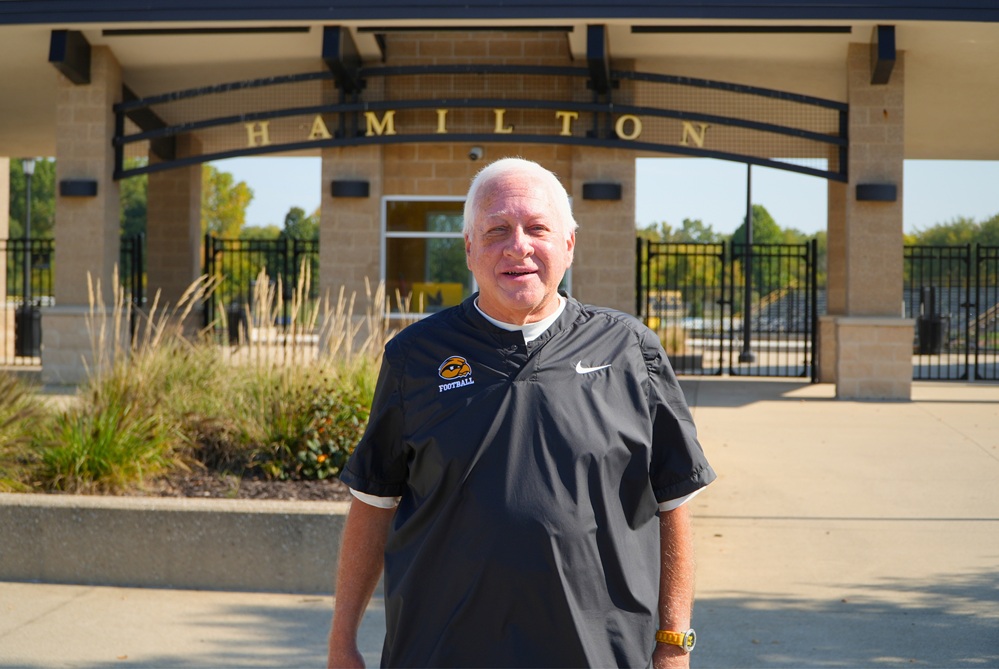
For nearly half a century, the voice behind Friday night football games in Hamilton has belonged to one man: Loren Joostberns.
A 1970 graduate of Hamilton High School, Joostberns has worn many hats in his hometown – teacher, coach, announcer, scorekeeper, school board member – but all of them share a common thread: a deep commitment to giving back to the community that raised him.
“This is my 45th year of announcing football games for Hamilton,” Joostberns said proudly, his voice carrying the same warmth that has welcomed fans to Hawkeye Stadium for decades. “I’ve done some volleyball, a lot of wrestling, occasionally some basketball, but mostly the scorebook in basketball for 44 years, and I do announce baseball in the spring now, which has been fun.”
With so much experience and history from the community, Joostberns is regularly asked to serve as the voice of many school district and community videos. His voice is arguably the most recognizable in town. From morning coffee at the round table at the local restaurant in town, to school board meetings, to microphones all around the district, Joostberns is seen and heard no matter where he goes around Hamilton.
Building a life in Hamilton
Not many can claim that they have been involved in a school district before it was even a school district.
However, Joostberns can make that claim as he was in kindergarten in 1957-58, with Hamilton becoming its own school district on June 23, 1958. He then continued in the school district as a student through graduation.
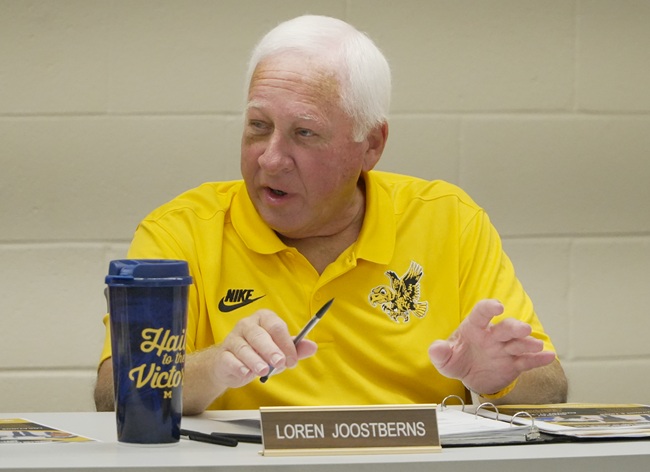 After graduating from Hamilton and then Hope College, Joostberns returned to the district as a teacher. He taught for 30 years, then continued his connection to the classroom as a substitute teacher for another nine. Today, he remains an active part of Hamilton Community Schools as Board of Education secretary, now in his 13th year of service.
Through it all, he has found joy in staying close to athletics. Since announcing his first football game in 1981, he’s become a fixture at sporting events year-round. His passion is not about statistics or wins and losses – it’s about making sure young athletes have the best possible experiences.
“I think one thing is, what can you do to contribute to kids having good experiences?” he said. “That’s one thing I always keep in the back of my mind. You want to do what you can to help kids have positive experiences, and if that contributes in a small way, then it’s worth it.”
Of course, Joostberns admits there’s a little fun in the job, too. “You’re in the center of the action. I’ve got the best seat in the house for football, and for basketball you’re at center court. You get to know the officials, get to know people from other schools, and it’s a good way to be involved.”
Memories from the press box
The Hamilton facilities Joostberns works in today look nothing like what he started with in the early 1980s. He chuckled as he recalled the first press box from which he worked.
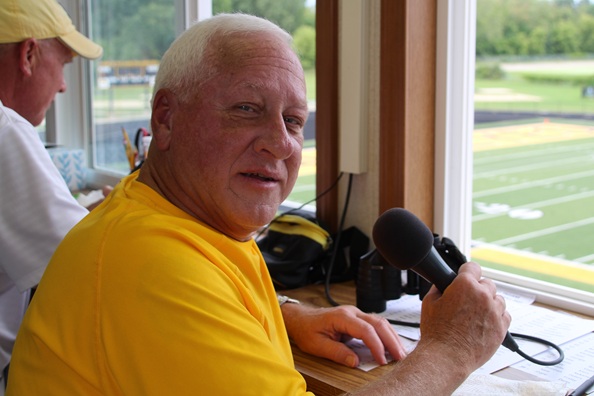
“In football, if you would have seen what we had in Hamilton back in 1981 and 1982 compared to what we have now in terms of facilities, it’s incredible,” he said. “The press box was a little green building basically on stilts that swayed with heavy winds, and it held six people – two coaches from each team on either side and an announcer and timer in the middle. You were elbow to elbow and you felt in a precarious position because you didn’t know if the press box was going to stand up or not.”
 That humble start makes him especially proud to see how the district has grown its athletic facilities and opportunities for students.
While Joostberns has devoted his life to Hamilton, he also holds a special passion for the University of Michigan. He has been a season ticket holder for 51 years, attending countless games at “The Big House” in Ann Arbor. The dual loyalties complement one another: Hamilton football on Fridays and Michigan football on Saturdays.
But no matter how big the stage gets, his heart always comes back to Hamilton. “At Hamilton, we have always prided ourselves in trying our best to do the best we can for kids, to do things the right way,” Joostberns said. “That’s why I’ve stayed involved for so long.”
Lasting Legacy
Few communities can point to someone who has continuously served across so many different roles for more than four decades.
Joostberns’ contributions can’t be measured in titles or statistics, but rather in the memories he has helped shape – whether it’s an athlete hearing his name announced before a big play, a student remembering him as a teacher, or a fellow community member working alongside him on the school board. Numerous times a year, veteran opposing coaches greet Joostberns before the game to say hi because he is such a staple of the community and school district. His warm and friendly demeanor is appreciated by all, both on the home and opposing sidelines.
Hamilton’s athletic director and coaches often describe him as the kind of person every school hopes to have: reliable, passionate, and selfless. He doesn’t do it for recognition, but for the chance to leave things a little better than he found them.
For Joostberns, the motivation is simple: “It’s about helping kids, and being part of something bigger than yourself.”
And for Hamilton, the community is grateful that one of its own has been willing to give back for so many years. As recognition for his countless years of service in and out of the classroom, “Mr. Hamilton” was honored with the high school basketball court being renamed the Loren Joostberns Court in 2021.
From the rickety old press box of 1981 to the modern facilities of today, from chalkboards in the classroom to discussions in the boardroom, Joostberns has remained a steady, positive presence. His story is a reminder of how one person’s steady commitment over a lifetime can shape a school and community for generations.
Not all lessons or legacies are cemented in the classrooms or fields, but some are passed on from behind the mic and echoed over the airwaves for all to hear and cherish.
PHOTOS (Top) Hamilton’s Loren Joostberns poses for a photo in front of the high school stadium this fall. (Middle) Joostberns has served the district in several roles over the years, including as a member of the school board. (Below) Joostberns takes a moment for a photo while behind the microphone. (Photos courtesy of Hamilton Community Schools.)