


7 Sleeping Tips for Student-Athletes
November 5, 2019

Henry Ford Health System
Many athletes seem to believe time spent not training is time wasted. But, on the contrary.
The time athletes spend resting and sleeping is actually just as important. Take the world’s best female skier, Mikaela Shiffrin, for example. Shiffrin reportedly not only sleeps nine hours each night, but naps at least an hour every day.
So, what does sleeping have to do with her success? When asleep, the body not only has time to recover, but the information that was taken in during the day goes from short-term memory and becomes long term.
“Being an elite athlete is a 24-hour profession, and sleep and recovery are integral to optimal performance,” says Meeta Singh, M.D., a sleep medicine specialist at Henry Ford Health System.
Here are seven tips to help your student athlete catch some Zzzs during the season:
1. Limit caffeine. Caffeine is a popular ingredient in many pre-workout drinks, and many athletes choose to use it for an energy boost. However, having caffeine late in the day may make falling asleep and staying asleep difficult. But, everyone reacts differently to caffeine, so athletes should try logging their intake to determine what time to stop consuming and how much is okay to consume.
2. Maintain a regular sleep schedule. The body has an internal clock that’s largely affected by environment. Going to bed and waking up at approximately the same time each day can add a natural rhythm to the body’s internal clock, which can cause people to feel more awake during the day and fall asleep easily at night.
3. Workout early. Often times, working out later in the day gives people a burst of energy that can keep them up late into the night. For example, exercising after 9 p.m. can boost body temperature, making sleep difficult. However, research shows morning workouts can help achieve deeper sleep, and working out in the afternoon can help reduce insomnia.
4. Unplug. Nothing can keep one up at night like a buzzing smartphone. Additionally, the blue light a phone emits may slow the production of melatonin, making sleep difficult. Advise your children to leave electronics out of reach while they’re sleeping. And as an added bonus: If their phone is their alarm, it will force them out of bed in the mornings.
5. Use essential oils. Essential oils have seen growing popularity in recent years, and this is in part because scent helps trigger memory. Oils can be diffused, rubbed on temples or drops can be spread on pillows. Popular oils for promoting sleep are lavender, valerian root and roman chamomile.
6. Focus on breathing. Focusing on breath can help steady heart rate and relax the body. A popular breathing technique is the 4-7-8 exercise, in which one inhales through the nose for four seconds, holds their breath for seven, and exhales for eight.
7. Keep it dark, cool and quiet. Having the right environment is an important part of falling asleep … and staying asleep.
Ultimately, when it comes to enhancing athletic performance, getting proper sleep, resting and recovering can be just as important as training or hitting the gym.
“Since sleep can modulate reaction time and accuracy, it’s important to ensure an athlete gets his or her Zzzs,” Dr. Singh says.
See also: Is Your Teen Sleep Deprived?
Want to learn more? Henry Ford Health System sports medicine experts are treating the whole athlete, in a whole new way. From nutrition to neurology, and from injury prevention to treatment of sports-related conditions, they can give your athlete a unique game plan.
Visit henryford.com/sports or call (313) 972-4216 for an appointment within 24 business hours.
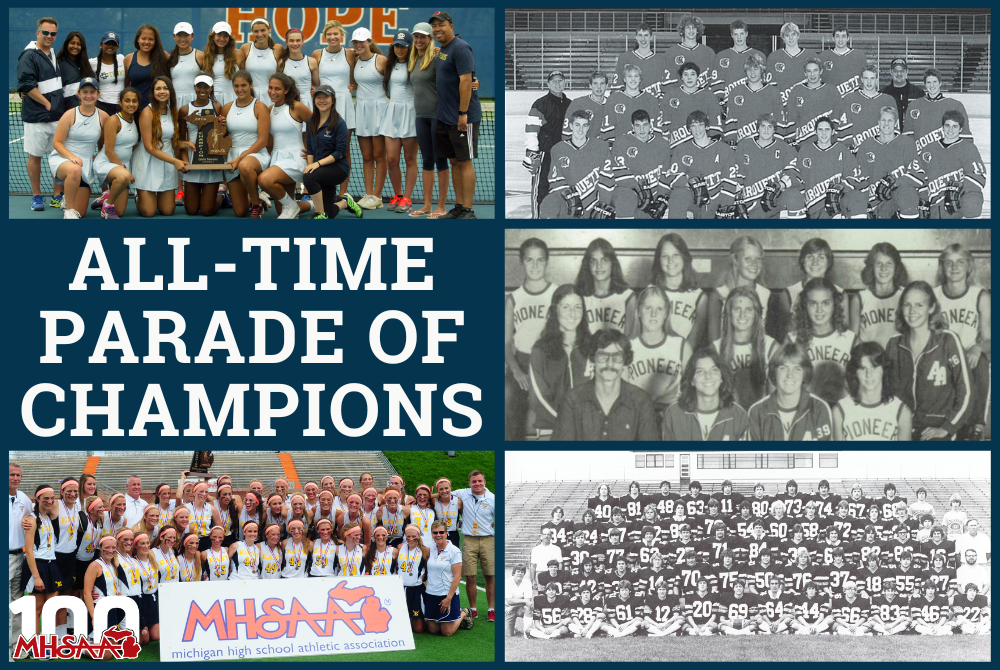
Century of School Sports: All-Time 'Parade of Champions'
By
Geoff Kimmerly
MHSAA.com senior editor
June 25, 2025
As we do every June, we will complete 2024-25 this week by publishing our “Parade of Champions” – a listing of every team to win an MHSAA Finals championship trophy this school year.
Recognizing about 130 champions annually – give or take a few if there were shared titles along the way during that past fall, winter and spring – it’s always an impressive list. So we’re plenty stoked – maybe even 100 times more – to present as our second-to-last “Century of School Sports” feature a few findings from our work-in-progress all-time “Parade of Champions.”
Eventually, the data we’ve collected will be provided on the MHSAA website as a searchable data base – there’s more work to come, and I’ll explain some of that below. But for today, here are some of the first facts that jump off the pages from this massive collection.
Starting with the biggest: Since its first titles were awarded to finish the Winter 1924-25 season, the MHSAA has recognized 6,876 teams for winning Finals championships.
Five schools have won at least 100 Finals titles, and 17 schools have won 50 or more. Marquette leads the list with 295, followed by East Grand Rapids (145), Escanaba (134), Ann Arbor Pioneer (122) and Detroit Country Day (107).
For several reasons, it’s difficult to compare championship totals among Upper Peninsula and Lower Peninsula schools as apples to apples – chiefly, schools in both peninsulas compete against each other in postseason competition in only 16 of 28 MHSAA-sponsored sports, and a handful of those 16 have little or no representation from the U.P. despite being statewide tournaments.
That said, here’s a look at some expanded school Finals title rankings, but by peninsula, going deeper on Lower Peninsula schools ranked because the majority of Michigan’s high schools are below Mackinac Bridge:
Lower Peninsula: 1. East Grand Rapids (145), 2. Ann Arbor Pioneer (122), 3. Detroit Country Day (107), 4. Bloomfield Hills Cranbrook Kingswood 88, 5. Detroit Catholic Central (74), 6. Bloomfield Hills Brother Rice (69), 7. Grosse Pointe Woods University Liggett (64), 8. Jackson Lumen Christi (55), 9. Petoskey (46), 10. Traverse City Central (45).
11. Okemos (44), 12. Detroit St. Martin dePorres (41), 13. East Lansing (39), 14. Rockford (37), T-15. Ann Arbor Greenhills (35), T-15. Birmingham Seaholm (35), 17. Flint Powers Catholic (33), T-18. Bloomfield Hills Marian (32), T-18. Kalamazoo Central (32), 20. Grand Rapids Forest Hills Northern (31).
Upper Peninsula: 1. Marquette (295), 2. Escanaba (134), 3. Iron Mountain (78), 4. Menominee (66), 5. Ishpeming Westwood (65), T-6. Ishpeming (64), T-6. Pickford (64), T-8. Negaunee (50), T-8. Ontonagon (50), 10. Houghton (49).
A few more interesting notes:
• Note Detroit dePorres at No. 12 among Lower Peninsula schools; dePorres closed in 2005. Flint Northern ranks 21st among Lower Peninsula schools with 30 championships despite closing in 2013. The former Ypsilanti High School, which consolidated with Willow Run in 2013 to form Ypsilanti Community, also is high on the list with 24 titles.
• Larger schools generally play more sports, and hence have more opportunities to win Finals titles. But Lower Peninsula small schools fell just outside those listed above, including Battle Creek St. Philip and Fowler – both with 29 championships – and Flint Beecher, Kalamazoo Hackett Catholic Prep and Pewamo-Westphalia with 26 apiece.
• We don’t have an easy way – yet – to figure out which schools have won at least once in the most sports. But among the top five, East Grand Rapids and Marquette both have won titles in 18 sports, Country Day has won in 17, Ann Arbor Pioneer in 15 and Escanaba in 13. Pioneer’s 15 include boys gymnastics, which was sponsored by the MHSAA from 1925-31 and 1961-81.
• Detroit Catholic Central has the most championships among all-boys schools, among 11 sports. Bloomfield Hills Marian ranks highest among all-girls schools, with its titles covering seven sports.
As noted, this remains a work in progress, as we’re continuing to research several school closings, consolidations or other name changes over the last 100 years and how those might affect our championship totals. We also need to continue figuring in how to list championships won by cooperative programs and if those are credited to primary schools or as standalone programs.
In the meantime, we’ll continue to update the data with championships won each season, including in our new sports of girls field hockey and boys volleyball debuting in 2025-26. Once the data is fully edited and complete, we’ll add this substantial source to our growing collection of historical information available for all to enjoy.
Previous "Century of School Sports" Spotlights
June 17: Top Performers Tell Us What High School Sports Mean to Them - Read
June 10: 'The Mitten' Becomes Sought-After Symbol of MHSAA Greatness - Read
June 3: MHSAA's Move to TV, Now Internet, 60 Years Old & Growing - Read
May 27: Upper Peninsula Helps Make Michigan's School Sports Story Unique - Read
May 20: From Nearly A to Z, Schools Repped by 221 Nicknames - Read
May 13: These Record-Setters were Nearly Impossible to Defeat - Read
May 6: 200+ Representatives Fill All-Time Council Roster - Read
April 29: MHSAA Programs Prioritize Health & Safety - Read
April 23: Patches Signify Registered Officials' Role in MHSAA Story - Read
April 16: Student Advisory Council Gives Voice to Athletes - Read
April 9: State's Storytellers Share Spring Memories - Read
April 2: Sharp Leadership Synonymous with MHSAA Success - Read
March 25: Athletic Directors Indispensable to Mission of School Sports - Read
March 18: 2025 Finals Begin Next Half-Century of Girls Hoops Championships - Read
March 11: Boys Basketball's Best 1st to Earn MHSAA Finals Titles - Read
March 5: Everything We Do Begins with Participation - Read
Feb. 25: Slogans & Logos Remain Unforgettable Parts of MHSAA History - Read
Feb. 19: MHSAA Tickets Continue to Provide Fan-Friendly Value - Read
Feb. 11: We Recognize Those Who Make Our Games Go - Read
Feb. 4: WISL Conference Continues to Inspire Aspiring Leaders - Read
Jan. 28: Michigan's National Impact Begins at NFHS' Start - Read
Jan. 21: Awards Celebrate Well-Rounded Educational Experience - Read
Jan. 14: Predecessors Laid Foundation for MHSAA's Formation - Read
Jan. 9: MHSAA Blazes Trail Into Cyberspace - Read
Dec. 31: State's Storytellers Share Winter Memories - Read
Dec. 17: MHSAA Over Time - Read
Dec. 10: On This Day, December 13, We Will Celebrate - Read
Dec. 3: MHSAA Work Guided by Representative Council - Read
Nov. 26: Finals Provide Future Pros Early Ford Field Glory - Read
Nov. 19: Connection at Heart of Coaches Advancement Program - Read
Nov. 12: Good Sports are Winners Then, Now & Always - Read
Nov. 5: MHSAA's Home Sweet Home - Read
Oct. 29: MHSAA Summits Draw Thousands to Promote Sportsmanship - Read
Oct. 23: Cross Country Finals Among MHSAA's Longest Running - Read
Oct. 15: State's Storytellers Share Fall Memories - Read
Oct. 8: Guided by 4 S's of Educational Athletics - Read
Oct. 1: Michigan Sends 10 to National Hall of Fame - Read
Sept. 25: MHSAA Record Books Filled with 1000s of Achievements - Read
Sept. 18: Why Does the MHSAA Have These Rules? - Read
Sept. 10: Special Medals, Patches to Commemorate Special Year - Read
Sept. 4: Fall to Finish with 50th Football Championships - Read
Aug. 28: Let the Celebration Begin - Read
PHOTOS These are all past MHSAA Finals champions, clockwise from top left: The 2016 Detroit Country Day girls tennis team, 2004 Marquette ice hockey team, 1978 Ann Arbor Pioneer girls cross country team, 1981 Escanaba football team and 2013 East Grand Rapids girls lacrosse team.