

Acupuncture Can Enhance Performance
January 5, 2021

Henry Ford Health System
In the ancient Chinese medicine of acupuncture, thin needles are gently inserted into specific areas of the body, stimulating blood flow to speed the recovery of certain ailments.
It can be used as a treatment for everything from headaches and unbalanced hormones to joint pain and weakened immune systems. Acupuncture is also popular among athletes, as many of them incorporate it into their wellness regimens to stay in peak physical condition.
“Back in the day, athletes ate steak, smoked cigars and drank whiskey during the week and then played football on Sunday,” says Thomas Betts, a sports medicine acupuncturist with Henry Ford Health System. “But today, to improve their performance, athletes are attacking the body from every angle possible with diet, lifestyle and exercise. NBA players, for example, have talked about how acupuncture keeps them feeling their best.”
But you don’t have to be an NBA star to reap the benefits of acupuncture. Whether you’re a professional or student athlete, or you exercise and play sports for fun or to challenge yourself, here are ways acupuncture can boost your game:
- Acupuncture can help you recover more quickly from an injury. “If a muscle is torn, acupuncture won’t put it back together, but for sprains and strains, muscle soreness and tendonitis, acupuncture can decrease inflammation and speed the healing process,” says Betts.
- Acupuncture can reduce the need for “rest days.” If you just had an intense workout and your muscles are sore, getting acupuncture afterward can loosen the muscles and decrease soreness so you don’t have to take a day off to recuperate before training again.
- Acupuncture can improve flexibility, decrease muscle tension and increase muscle activation. “This is done with motor point acupuncture,” says Betts. “The motor point is where the brain attaches to the muscle via the motor nerve. By using needles to stimulate a motor point, it is like rebooting a phone or computer that isn’t working well: Motor point acupuncture is autoregulating, in that it can deactivate a tight muscle or reactivate an inhibited or weak muscle.”
- Acupuncture can provide immediate pain relief. “Some studies show that acupuncture can provide as much as, if not more pain relief than medication,” Betts says. “It differs for everyone, and it depends on what is being treated, but some people say they feel a difference right after a session, and others say they feel better about 20 to 30 minutes later.” Pain relief can last from a few hours to a few days.
- Acupuncture can help prevent injury. Because acupuncture can reactivate weak muscles and decrease muscle tension, it can also be used as a preventative measure against injury, Betts says. But you should always still stretch before and after exercising!
Learn more about acupuncture and other integrative medicine services at Henry Ford. To make an appointment, you can request one online or by calling 1-833-246-4347.
Thomas Betts, DOAM, RAc, is a certified sports acupuncturist with Henry Ford Health System. He sees patients at the Henry Ford Center for Athletic Medicine in Detroit.
Lifelong Hawkeye: Joostberns Continues Legacy of Service in Hamilton
By
Zach Harig
Hamilton Community Schools
September 19, 2025
For nearly half a century, the voice behind Friday night football games in Hamilton has belonged to one man: Loren Joostberns.
A 1970 graduate of Hamilton High School, Joostberns has worn many hats in his hometown – teacher, coach, announcer, scorekeeper, school board member – but all of them share a common thread: a deep commitment to giving back to the community that raised him.
“This is my 45th year of announcing football games for Hamilton,” Joostberns said proudly, his voice carrying the same warmth that has welcomed fans to Hawkeye Stadium for decades. “I’ve done some volleyball, a lot of wrestling, occasionally some basketball, but mostly the scorebook in basketball for 44 years, and I do announce baseball in the spring now, which has been fun.”
With so much experience and history from the community, Joostberns is regularly asked to serve as the voice of many school district and community videos. His voice is arguably the most recognizable in town. From morning coffee at the round table at the local restaurant in town, to school board meetings, to microphones all around the district, Joostberns is seen and heard no matter where he goes around Hamilton.
Building a life in Hamilton
Not many can claim that they have been involved in a school district before it was even a school district.
However, Joostberns can make that claim as he was in kindergarten in 1957-58, with Hamilton becoming its own school district on June 23, 1958. He then continued in the school district as a student through graduation.
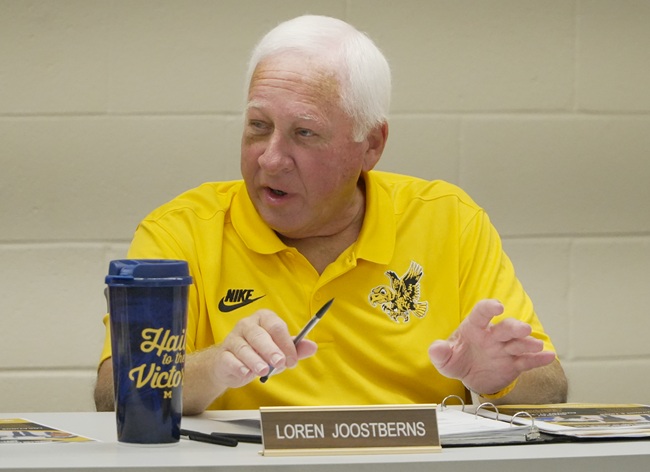 After graduating from Hamilton and then Hope College, Joostberns returned to the district as a teacher. He taught for 30 years, then continued his connection to the classroom as a substitute teacher for another nine. Today, he remains an active part of Hamilton Community Schools as Board of Education secretary, now in his 13th year of service.
Through it all, he has found joy in staying close to athletics. Since announcing his first football game in 1981, he’s become a fixture at sporting events year-round. His passion is not about statistics or wins and losses – it’s about making sure young athletes have the best possible experiences.
“I think one thing is, what can you do to contribute to kids having good experiences?” he said. “That’s one thing I always keep in the back of my mind. You want to do what you can to help kids have positive experiences, and if that contributes in a small way, then it’s worth it.”
Of course, Joostberns admits there’s a little fun in the job, too. “You’re in the center of the action. I’ve got the best seat in the house for football, and for basketball you’re at center court. You get to know the officials, get to know people from other schools, and it’s a good way to be involved.”
Memories from the press box
The Hamilton facilities Joostberns works in today look nothing like what he started with in the early 1980s. He chuckled as he recalled the first press box from which he worked.
“In football, if you would have seen what we had in Hamilton back in 1981 and 1982 compared to what we have now in terms of facilities, it’s incredible,” he said. “The press box was a little green building basically on stilts that swayed with heavy winds, and it held six people – two coaches from each team on either side and an announcer and timer in the middle. You were elbow to elbow and you felt in a precarious position because you didn’t know if the press box was going to stand up or not.”
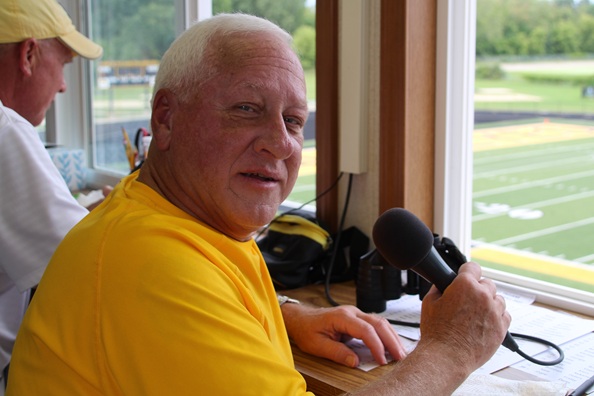 That humble start makes him especially proud to see how the district has grown its athletic facilities and opportunities for students.
While Joostberns has devoted his life to Hamilton, he also holds a special passion for the University of Michigan. He has been a season ticket holder for 51 years, attending countless games at “The Big House” in Ann Arbor. The dual loyalties complement one another: Hamilton football on Fridays and Michigan football on Saturdays.
But no matter how big the stage gets, his heart always comes back to Hamilton. “At Hamilton, we have always prided ourselves in trying our best to do the best we can for kids, to do things the right way,” Joostberns said. “That’s why I’ve stayed involved for so long.”
Lasting Legacy
Few communities can point to someone who has continuously served across so many different roles for more than four decades.
Joostberns’ contributions can’t be measured in titles or statistics, but rather in the memories he has helped shape – whether it’s an athlete hearing his name announced before a big play, a student remembering him as a teacher, or a fellow community member working alongside him on the school board. Numerous times a year, veteran opposing coaches greet Joostberns before the game to say hi because he is such a staple of the community and school district. His warm and friendly demeanor is appreciated by all, both on the home and opposing sidelines.
Hamilton’s athletic director and coaches often describe him as the kind of person every school hopes to have: reliable, passionate, and selfless. He doesn’t do it for recognition, but for the chance to leave things a little better than he found them.
For Joostberns, the motivation is simple: “It’s about helping kids, and being part of something bigger than yourself.”
And for Hamilton, the community is grateful that one of its own has been willing to give back for so many years. As recognition for his countless years of service in and out of the classroom, “Mr. Hamilton” was honored with the high school basketball court being renamed the Loren Joostberns Court in 2021.
From the rickety old press box of 1981 to the modern facilities of today, from chalkboards in the classroom to discussions in the boardroom, Joostberns has remained a steady, positive presence. His story is a reminder of how one person’s steady commitment over a lifetime can shape a school and community for generations.
Not all lessons or legacies are cemented in the classrooms or fields, but some are passed on from behind the mic and echoed over the airwaves for all to hear and cherish.
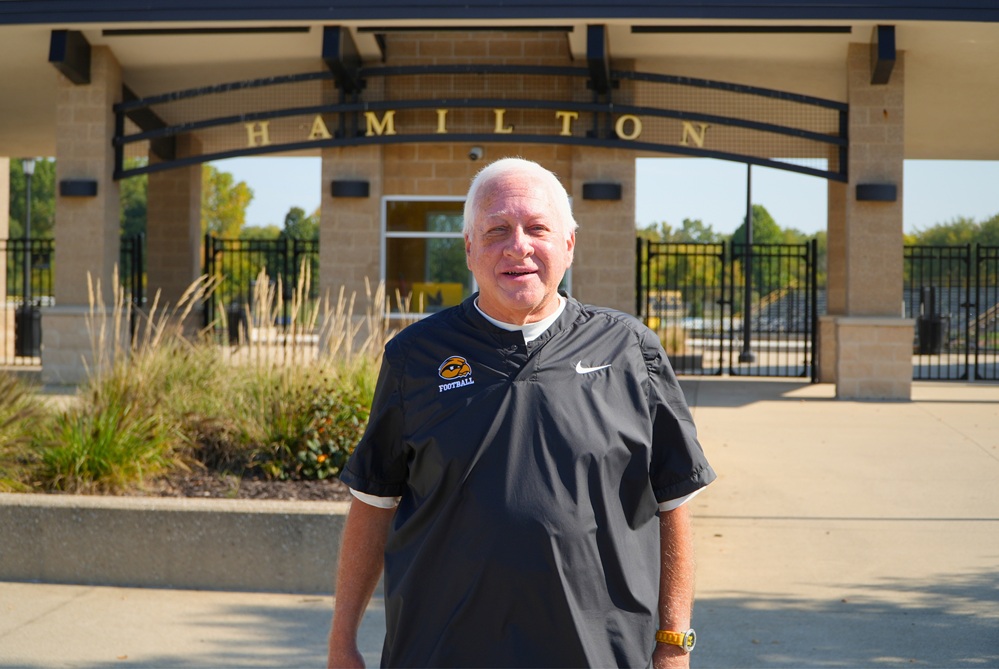
PHOTOS (Top) Hamilton’s Loren Joostberns poses for a photo in front of the high school stadium this fall. (Middle) Joostberns has served the district in several roles over the years, including as a member of the school board. (Below) Joostberns takes a moment for a photo while behind the microphone. (Photos courtesy of Hamilton Community Schools.)