

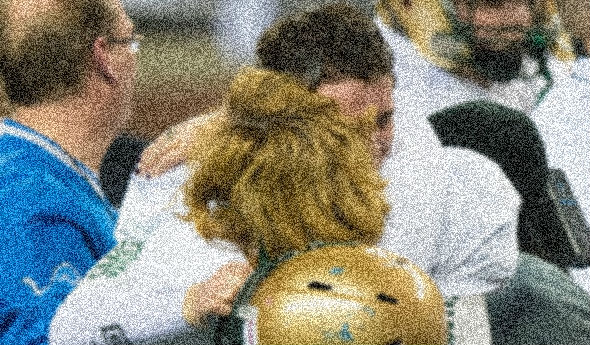
After the Game: What do you say?
April 20, 2017
 By Kevin Wolma
Hudsonville Athletic Director
“I love to watch you play.” Those are the six words a son or daughter wants to hear from his or her parents after a game.
What if your child does not play? What do you say then? Parents can’t say, “I love to watch you play” when your child does not play, nor can they say other post-competition statements like:
“Did you fight like a dog?”
“Did you have fun?”
It is hard to fight like a dog when not given the opportunity, and we all know players have more fun when they play in the game. When you google the phrase, “what to say after a game,” there are all sorts of articles written with some of them backed by research. However, when you google the phrase – “what to say when your kid does not play” – very little comes out of that search.
Why?
This is a hard and very sensitive area for most parents to come up with the right thing to say.
Before we talk about what to say in this situation, it may be more important to discuss what not to say after a game where your child does not play. Some of the comments all parents should avoid are:
“Why have you not played in the last three games? Your coach must not like you for some reason.”
“Your coach is clueless; he has no idea what he is doing.”
“You are way better than Johnny! I can’t believe he is playing more minutes than you.”
“Did you see how many mistakes Suzie made? I know if you were given the opportunity you would not make those same mistakes.”
Parents will often say these things because they are frustrated, and parents think they are comforting their child by giving them an excuse. What these comments actually do is create a divisive culture within a team. After hearing these negative comments over and over again, the athlete will eventually believe it only to see his or her attitude and effort become negatively affected over time. That athlete turns into a selfish teammate.
Now let’s put yourself in the situation where your child comes home after a game after not playing. What do you say?
The first thing you could do is talk about the game itself. Recount certain plays and make note of individuals who played well for both teams. This initial conversation takes the uncomfortable nature of the situation and sets the stage to talk about how athletes feel about not getting into the game.
There may be times when your child will not want to talk about it because he or she is upset, angry or even embarrassed. These moments of silence give the parents an opportunity to talk about the importance of being a good teammate and how an athlete can have a major impact on the team no matter what role is played. They can teach how to be the first person off the bench to congratulate or give a word of encouragement to teammates. Parents also can point out that the harder athletes work in practice, the better it is going to make the team.
In other words, we have the responsibility as parents to teach our kids the significance of living life pointed out no matter the circumstance. Living pointed out simply means to put others before yourself in everything you do. Finding ways to make the people around you the best they can be. No complaining. No excuses.
Andrew DeWitt played two years of Varsity basketball for me at Hudsonville, and he rarely had the opportunity to play. Unfortunately for him, he was a good player on two really good teams with lots of talent. He understood his role and treated practices like games – playing as hard as he could.
He would elevate the intensity of practice every day. On game nights, he was our biggest cheerleader. His impact went way beyond scoring points or getting rebounds.
Andrew’s parents were great teachers as they guided him through those tough times where it would have been easy to make an excuse or complain. Instead, they taught Andrew he could always have an influence on other people’s lives despite the role he played. What a great lesson that Andrew can carry with him for the rest of his life.
At the end of the day, one thing every parent in every situation can say that will have a positive impact is, “I love you.” Many times athletes think they are letting their parents down because of their lack of playing time. Knowing that their parents love them the same whether they play a lot or not at all has a significant impact on how the student-athlete responds to adversity, and specifically not playing in games.
I challenge all parents to use these potentially negative situations as a way to teach student-athletes valuable lessons on what it means to be a great teammate – and more importantly in teaching them to live their life pointed out. There may not be a simple six-word phrase to say when your child does not play, but there is definitely plenty to talk about.
Wolma has served as Hudsonville's athletic director since 2011 and previously coached boys varsity basketball and girls varsity golf among other teams. He also previously taught physical education and health.
Lifelong Hawkeye: Joostberns Continues Legacy of Service in Hamilton
By
Zach Harig
Hamilton Community Schools
September 19, 2025
For nearly half a century, the voice behind Friday night football games in Hamilton has belonged to one man: Loren Joostberns.
A 1970 graduate of Hamilton High School, Joostberns has worn many hats in his hometown – teacher, coach, announcer, scorekeeper, school board member – but all of them share a common thread: a deep commitment to giving back to the community that raised him.
“This is my 45th year of announcing football games for Hamilton,” Joostberns said proudly, his voice carrying the same warmth that has welcomed fans to Hawkeye Stadium for decades. “I’ve done some volleyball, a lot of wrestling, occasionally some basketball, but mostly the scorebook in basketball for 44 years, and I do announce baseball in the spring now, which has been fun.”
With so much experience and history from the community, Joostberns is regularly asked to serve as the voice of many school district and community videos. His voice is arguably the most recognizable in town. From morning coffee at the round table at the local restaurant in town, to school board meetings, to microphones all around the district, Joostberns is seen and heard no matter where he goes around Hamilton.
Building a life in Hamilton
Not many can claim that they have been involved in a school district before it was even a school district.
However, Joostberns can make that claim as he was in kindergarten in 1957-58, with Hamilton becoming its own school district on June 23, 1958. He then continued in the school district as a student through graduation.
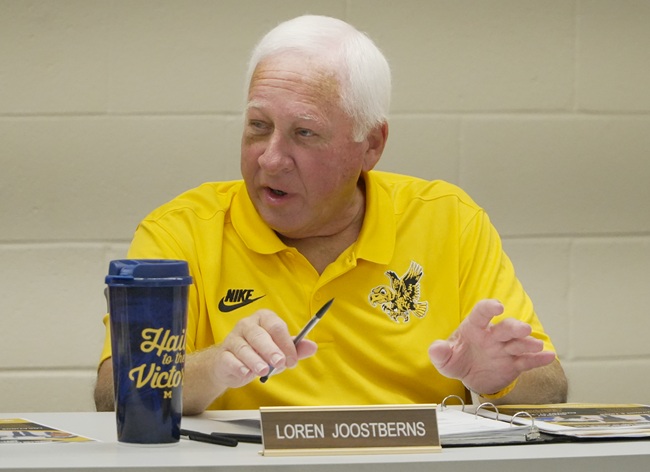 After graduating from Hamilton and then Hope College, Joostberns returned to the district as a teacher. He taught for 30 years, then continued his connection to the classroom as a substitute teacher for another nine. Today, he remains an active part of Hamilton Community Schools as Board of Education secretary, now in his 13th year of service.
Through it all, he has found joy in staying close to athletics. Since announcing his first football game in 1981, he’s become a fixture at sporting events year-round. His passion is not about statistics or wins and losses – it’s about making sure young athletes have the best possible experiences.
“I think one thing is, what can you do to contribute to kids having good experiences?” he said. “That’s one thing I always keep in the back of my mind. You want to do what you can to help kids have positive experiences, and if that contributes in a small way, then it’s worth it.”
Of course, Joostberns admits there’s a little fun in the job, too. “You’re in the center of the action. I’ve got the best seat in the house for football, and for basketball you’re at center court. You get to know the officials, get to know people from other schools, and it’s a good way to be involved.”
Memories from the press box
The Hamilton facilities Joostberns works in today look nothing like what he started with in the early 1980s. He chuckled as he recalled the first press box from which he worked.
“In football, if you would have seen what we had in Hamilton back in 1981 and 1982 compared to what we have now in terms of facilities, it’s incredible,” he said. “The press box was a little green building basically on stilts that swayed with heavy winds, and it held six people – two coaches from each team on either side and an announcer and timer in the middle. You were elbow to elbow and you felt in a precarious position because you didn’t know if the press box was going to stand up or not.”
 That humble start makes him especially proud to see how the district has grown its athletic facilities and opportunities for students.
While Joostberns has devoted his life to Hamilton, he also holds a special passion for the University of Michigan. He has been a season ticket holder for 51 years, attending countless games at “The Big House” in Ann Arbor. The dual loyalties complement one another: Hamilton football on Fridays and Michigan football on Saturdays.
But no matter how big the stage gets, his heart always comes back to Hamilton. “At Hamilton, we have always prided ourselves in trying our best to do the best we can for kids, to do things the right way,” Joostberns said. “That’s why I’ve stayed involved for so long.”
Lasting Legacy
Few communities can point to someone who has continuously served across so many different roles for more than four decades.
Joostberns’ contributions can’t be measured in titles or statistics, but rather in the memories he has helped shape – whether it’s an athlete hearing his name announced before a big play, a student remembering him as a teacher, or a fellow community member working alongside him on the school board. Numerous times a year, veteran opposing coaches greet Joostberns before the game to say hi because he is such a staple of the community and school district. His warm and friendly demeanor is appreciated by all, both on the home and opposing sidelines.
Hamilton’s athletic director and coaches often describe him as the kind of person every school hopes to have: reliable, passionate, and selfless. He doesn’t do it for recognition, but for the chance to leave things a little better than he found them.
For Joostberns, the motivation is simple: “It’s about helping kids, and being part of something bigger than yourself.”
And for Hamilton, the community is grateful that one of its own has been willing to give back for so many years. As recognition for his countless years of service in and out of the classroom, “Mr. Hamilton” was honored with the high school basketball court being renamed the Loren Joostberns Court in 2021.
From the rickety old press box of 1981 to the modern facilities of today, from chalkboards in the classroom to discussions in the boardroom, Joostberns has remained a steady, positive presence. His story is a reminder of how one person’s steady commitment over a lifetime can shape a school and community for generations.
Not all lessons or legacies are cemented in the classrooms or fields, but some are passed on from behind the mic and echoed over the airwaves for all to hear and cherish.
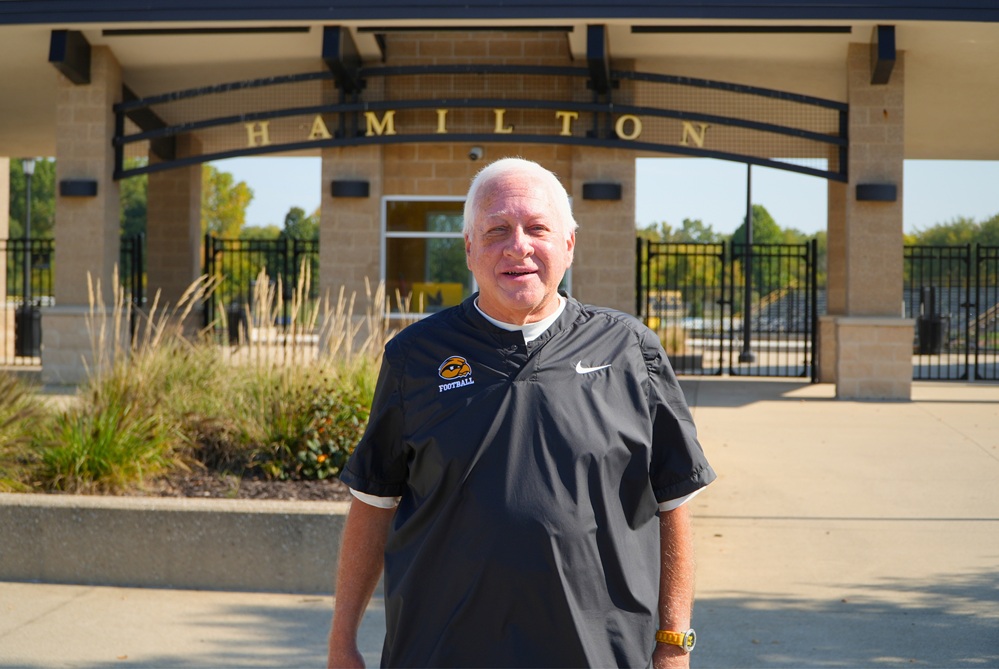
PHOTOS (Top) Hamilton’s Loren Joostberns poses for a photo in front of the high school stadium this fall. (Middle) Joostberns has served the district in several roles over the years, including as a member of the school board. (Below) Joostberns takes a moment for a photo while behind the microphone. (Photos courtesy of Hamilton Community Schools.)