

Be Proactive with Concussions
October 22, 2019

Most people have seen the headlines about concussions as a common sports injury, and it's natural that parents may be concerned for their young athlete.
A large misconception in sports is that previous concussions are to be blamed for ongoing headaches, blurred visions and memory loss, among other symptoms.
“It’s really important to think about concussions in concert with overall brain health,” says Jeffrey Kutcher, M.D., a sports neurologist who treats athletes at the Henry Ford Concussion and Sports Neurology Clinic. “Concussions can be concerning, but they shouldn’t be looked at in a vacuum. The best way to prevent brain injury begins before the injury occurs.”
One way to do that is to consult with your child’s doctor or a sports neurologist for an annual evaluation. A sports neurologist focuses on managing sports-related brain and nervous system injuries and conditions in athletes, such as concussions, post-concussion syndrome, peripheral nerve injuries, migraines, epilepsy, and more.
“Having an annual evaluation of your athlete’s brain function when they are healthy and uninjured can help diagnose and treat issues when they arise,” says Dr. Kutcher.
Results from the baseline test can be used as an important tool for comparison by a qualified healthcare professional later if an athlete has a suspected concussion.
Best Practices to Ensure Your Athlete Stays Safe
Dr. Kutcher shares these tips for parents to make sure you’re keeping your child’s brain health and safety – not just their athletic performance – at the forefront:
• Get a brain health baseline. A proper baseline test should include a personal and family neurological history, with a focus on any active issues. It is important to note any neurological conditions that may influence concussion recovery, such as ADHD, depression, anxiety, or migraine headaches.
• Teach your kid to listen to her or his body. With any sport, there is a calculated risk to play. Teaching kids to listen to and be honest about how their body is feeling is the best way to prevent and treat injuries.
• In the event of an injury, look for the signs. Within 24 hours after an injury, an athlete should be evaluated if they are experiencing:
· Headaches
· Fatigue
· Dizziness and nausea
· Changes in sleep habits
· Trouble with memory
· Confusion
· Irritability and anxiety
· Light sensitivity
• Brain injuries don’t just occur with a blow to the head. They can also occur from falls, car accidents, or even through whiplash. If your child is experiencing any symptoms, be sure to consult your physician.
• Brain health is more than just concussions. If your athlete is complaining of chronic headaches, migraines, dizziness, memory or mood issues, there may be an underlying issue.
“There is no magic number of concussions a brain can sustain. Each individual is different,” Dr. Kutcher explains. “The impact severity and recovery time can greatly affect an athlete’s brain. By getting a baseline before the injury, we can establish a goal to work towards in recovery.”
Want to learn more? Henry Ford Health System sports medicine experts are treating the whole athlete, in a whole new way. From nutrition to neurology, and from injury prevention to treatment of sports-related conditions, they can give your athlete a unique game plan.
Visit henryford.com/sports or call (313) 972-4216 for an appointment within 24 business hours.
Century of School Sports: 'The Mitten' Becomes Sought-After Symbol of MHSAA Greatness
By
Geoff Kimmerly
MHSAA.com senior editor
June 10, 2025
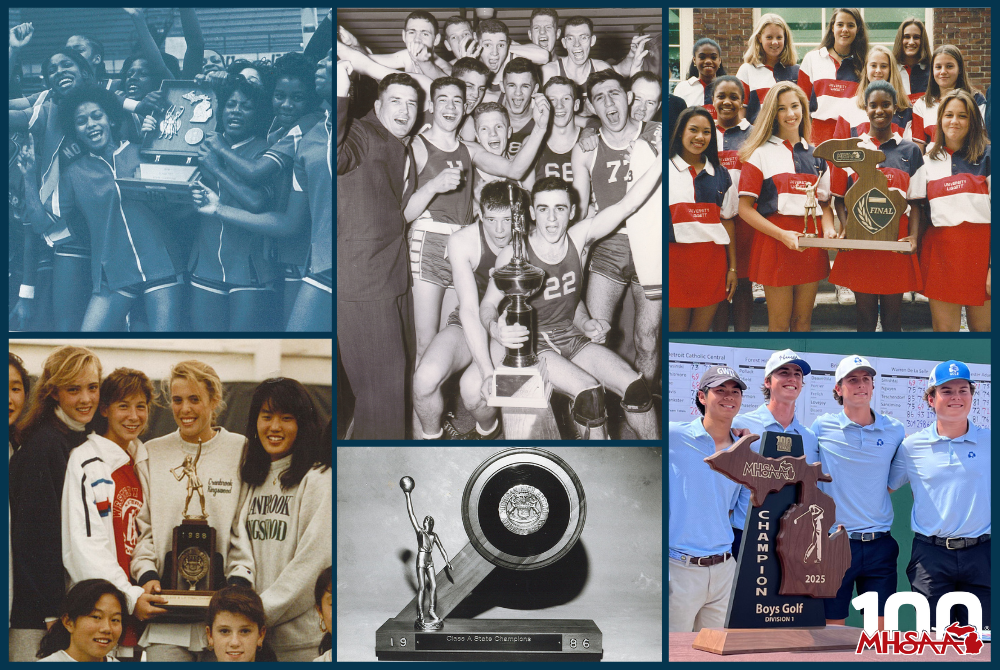
The MHSAA championship trophy – often referred to as “The Mitten” – has become perhaps one of the most iconic and enduring symbols of this organization over the last 25 years, most frequently greeting visitors strolling past a school’s trophy case or serving as the centerpiece of celebration photos over the final month of every sport season.
More than 2000 MHSAA trophies are presented to teams every school year, the great majority to District, Regional and Finals champions at the high school level.
There actually have been several versions of MHSAA trophies awarded over the last century – probably more than we can tell about, since our knowledge of the first 30-40 years especially is reliant on photos of winning teams holding their awards, and trophies that have been returned to us after a school has closed or those artifacts have made their ways into yard sales or second-hand stores.
 Our early trophies take on a few specific designs – there are traditional cups, later columns affixed to bases with inscriptions celebrating champions, or metal statuettes representing their respective sports. Later versions incorporated a combination of those features, for example a square or rectangular wooden plaque affixed to a base with a statuette (or two, or even three) decorating the trophy. The 1974-75 version was especially notable; celebrating the 50th year of the MHSAA, those trophies included a large county map of Michigan and the state seal.
During the mid-1980s, the MHSAA made another move to a unique design among its trophies – a circular award affixed to a base by a wooden arm at a 45-degree angle. Then came a return to a more traditional squared-off pedestal and statue before the 1989-90 move to a triangular plaque – which in theory could be hung up in a trophy case as something of a space-saver. But that idea didn’t seem to gain traction – which in part led to the creation of the inaugural version of “The Mitten” awarded today.
That first rendition made its debut during the 1992-93 school year. What started out as an artistic wooden representation of the state’s peninsulas evolved at the start of 2009-10 into the current more map-accurate version of the state’s land masses affixed to a black background. The only noticeable change since has been the addition this 100-anniversary year of a medal at the top celebrating that milestone.
How beloved has “The Mitten” become?
During the 2008-09 school year, our students let us know. With the MHSAA Trophy & Medal Committee deliberating on a possible two design – and two proposals that did not include the wooden state version in the mix – then-Executive Director Jack Roberts presented the possibilities to the MHSAA’s Student Advisory Council.
In resounding fashion, the Advisory Council said keep “The Mitten” – and it remains the symbol of achievement for thousands of MHSAA Tournament champs every school year.
Previous "Century of School Sports" Spotlights
June 3: MHSAA's Move to TV, Now Internet, 60 Years Old & Growing - Read
May 27: Upper Peninsula Helps Make Michigan's School Sports Story Unique - Read
May 20: From Nearly A to Z, Schools Repped by 221 Nicknames - Read
May 13: These Record-Setters were Nearly Impossible to Defeat - Read
May 6: 200+ Representatives Fill All-Time Council Roster - Read
April 29: MHSAA Programs Prioritize Health & Safety - Read
April 23: Patches Signify Registered Officials' Role in MHSAA Story - Read
April 16: Student Advisory Council Gives Voice to Athletes - Read
April 9: State's Storytellers Share Spring Memories - Read
April 2: Sharp Leadership Synonymous with MHSAA Success - Read
March 25: Athletic Directors Indispensable to Mission of School Sports - Read
March 18: 2025 Finals Begin Next Half-Century of Girls Hoops Championships - Read
March 11: Boys Basketball's Best 1st to Earn MHSAA Finals Titles - Read
March 5: Everything We Do Begins with Participation - Read
Feb. 25: Slogans & Logos Remain Unforgettable Parts of MHSAA History - Read
Feb. 19: MHSAA Tickets Continue to Provide Fan-Friendly Value - Read
Feb. 11: We Recognize Those Who Make Our Games Go - Read
Feb. 4: WISL Conference Continues to Inspire Aspiring Leaders - Read
Jan. 28: Michigan's National Impact Begins at NFHS' Start - Read
Jan. 21: Awards Celebrate Well-Rounded Educational Experience - Read
Jan. 14: Predecessors Laid Foundation for MHSAA's Formation - Read
Jan. 9: MHSAA Blazes Trail Into Cyberspace - Read
Dec. 31: State's Storytellers Share Winter Memories - Read
Dec. 17: MHSAA Over Time - Read
Dec. 10: On This Day, December 13, We Will Celebrate - Read
Dec. 3: MHSAA Work Guided by Representative Council - Read
Nov. 26: Finals Provide Future Pros Early Ford Field Glory - Read
Nov. 19: Connection at Heart of Coaches Advancement Program - Read
Nov. 12: Good Sports are Winners Then, Now & Always - Read
Nov. 5: MHSAA's Home Sweet Home - Read
Oct. 29: MHSAA Summits Draw Thousands to Promote Sportsmanship - Read
Oct. 23: Cross Country Finals Among MHSAA's Longest Running - Read
Oct. 15: State's Storytellers Share Fall Memories - Read
Oct. 8: Guided by 4 S's of Educational Athletics - Read
Oct. 1: Michigan Sends 10 to National Hall of Fame - Read
Sept. 25: MHSAA Record Books Filled with 1000s of Achievements - Read
Sept. 18: Why Does the MHSAA Have These Rules? - Read
Sept. 10: Special Medals, Patches to Commemorate Special Year - Read
Sept. 4: Fall to Finish with 50th Football Championships - Read
Aug. 28: Let the Celebration Begin - Read