

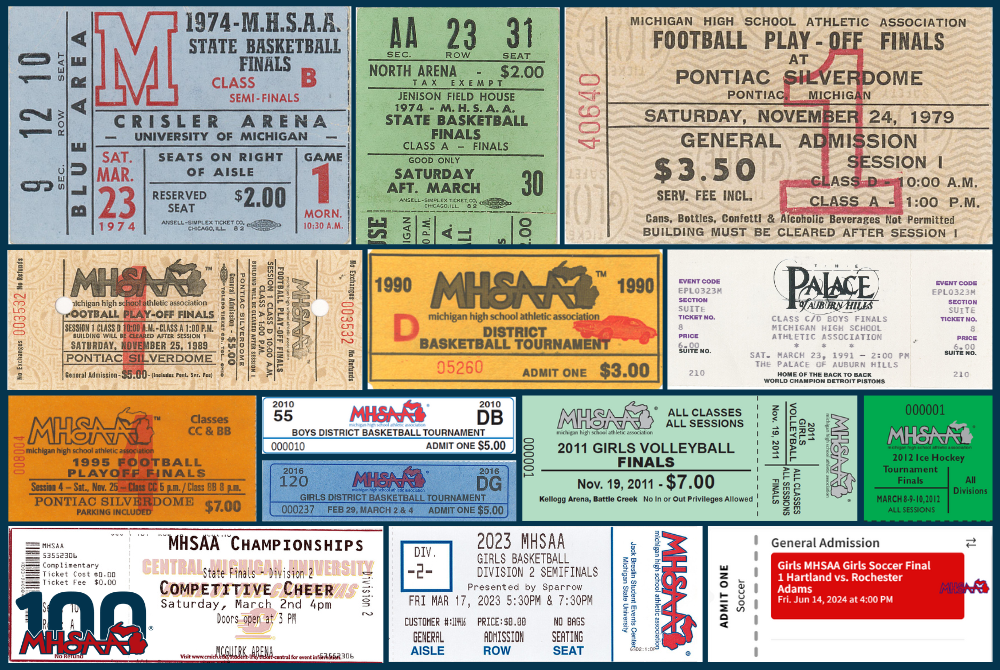
Century of School Sports: MHSAA Tickets Continue to Provide Fan-Friendly Value
By
Geoff Kimmerly
MHSAA.com senior editor
February 19, 2025
A buck went a lot farther a century ago, and a family of four wishing to watch the MHSAA Class A Boys Basketball Final in 1928 could have done so, at the minimum, for a grand total of $2 – or $6 if they were looking to splurge on the best seats.
Of course, relating the value of money 100 years ago to now is not apples to apples. But for Michigan school sports, a deal like that is meant to last forever.
The MHSAA has made it part of long-standing philosophy to keep ticket prices for its tournament events as low as possible, continuing to provide opportunities for entire families to attend together, and hoping to provide the best bargain as tickets to sporting events at other levels have climbed much more rapidly over the decades.
For the sake of comparison, consider tickets over the years for the Boys Basketball Tournament – the first event hosted by the newly-created MHSAA in 1925.
In 1928 (the first year for which cost of admission could be found), ticket prices for the MHSAA Boys Basketball Finals at the Olympia in Detroit were listed at 75 cents, $1 and $1.50, and a newspaper report after noted that in fact the cheapest seats were sold for 50 cents apiece instead. One ticket was good for all four games.
Less than 30 years later, $1.50 still got a fan two championship games – reserved seats for 1955 Boys Basketball Finals at Jenison Field House cost $1.50 per session, with Class C and B Finals in the afternoon and Class A and D in the evening. A decade after that, in 1965, tickets still cost $1.50 per session – although sessions were now split into the Class B game in the morning, Class D and C games in the afternoon, and a Class A session that night.
Sixty years later, prices have continued to rise incrementally – but again, while prioritizing keeping them as low as possible.
These days for boys basketball, District tickets cost $7, Regional tickets cost $9, Quarterfinals cost $10, and Semifinals and Finals tickets cost $12 per two-game session.
On its face, that’s quite a jump from the 1960s, much less the 1920s. But consider: Multiple inflation calculators say that $1.50 ticket for two games in 1955 would be worth more than $17 for two games now, meaning MHSAA Finals ticket prices have grown at a much slower rate.
Consider as well MHSAA ticket prices against Consumer Price Index data over the last 20 years. The U.S. Bureau of Labor Statistics reported in 2023 that admission costs to sporting events nationally had doubled over the previous two decades – literally going up 100 percent – yet price increases for the MHSAA Boys Basketball Tournament since 2005-06 have increased just 40 percent at the District level, where 60 percent of our boys basketball tickets are sold. Ticket prices for Regionals and Finals also have grown slower than that national rate.
And it remains tough to argue with what spectators get for their money at the MHSAA Tournament level.
For the 2024-25 school year, tickets for all District and Regional competitions – and some Quarterfinals and Semifinals – remain in the $7-$9 range. Finals tickets cost $10-$12, except for Individual Wrestling Finals ($18) and 11-Player Football Finals ($20) both at Ford Field – and one ticket for those is good to watch championships in five divisions in wrestling and four football championship games over one day, respectively.
In fact, the most recent change to ticketing has had nothing to do with the price – but instead, the move away from the paper tickets you see above. All tournament tickets are now digital, which keeps the MHSAA current with what’s done in college and pro sports and other forms of entertainment and assists in efficiency by taking cash out of the equation.
Previous "Century of School Sports" Spotlights
Feb. 11: We Recognize Those Who Make Our Games Go - Read
Feb. 4: WISL Conference Continues to Inspire Aspiring Leaders - Read
Jan. 28: Michigan's National Impact Begins at NFHS' Start - Read
Jan. 21: Awards Celebrate Well-Rounded Educational Experience - Read
Jan. 14: Predecessors Laid Foundation for MHSAA's Formation - Read
Jan. 9: MHSAA Blazes Trail Into Cyberspace - Read
Dec. 31: State's Storytellers Share Winter Memories - Read
Dec. 17: MHSAA Over Time - Read
Dec. 10: On This Day, December 13, We Will Celebrate - Read
Dec. 3: MHSAA Work Guided by Representative Council - Read
Nov. 26: Finals Provide Future Pros Early Ford Field Glory - Read
Nov. 19: Connection at Heart of Coaches Advancement Program - Read
Nov. 12: Good Sports are Winners Then, Now & Always - Read
Nov. 5: MHSAA's Home Sweet Home - Read
Oct. 29: MHSAA Summits Draw Thousands to Promote Sportsmanship - Read
Oct. 23: Cross Country Finals Among MHSAA's Longest Running - Read
Oct. 15: State's Storytellers Share Fall Memories - Read
Oct. 8: Guided by 4 S's of Educational Athletics - Read
Oct. 1: Michigan Sends 10 to National Hall of Fame - Read
Sept. 25: MHSAA Record Books Filled with 1000s of Achievements - Read
Sept. 18: Why Does the MHSAA Have These Rules? - Read
Sept. 10: Special Medals, Patches to Commemorate Special Year - Read
Sept. 4: Fall to Finish with 50th Football Championships - Read
Aug. 28: Let the Celebration Begin - Read

NFHS Voice: Regardless of Future Direction, Multiple Sports/Activities is Best Choice
By
Karissa Niehoff
NFHS Executive Director
May 7, 2021
The values of participating in high school activities – sports, speech and debate, music, theatre and other programs – are well-documented.
A majority of the 12 million-plus participants in education-based activities have higher grade-point averages, are more disciplined and self-confident. In addition, research indicates that participation in high school activities is often a predictor of later success – in college, a career and becoming a contributing member of society.
This past year, the importance of these activities was demonstrated further through the consequences that occurred when these programs suddenly were unavailable.
The social, emotional and mental health of students was affected. When sports and activities no longer were available, many students self-reported symptoms of depression and anxiety. With less physical activity and no involvement in these programs, there were state-reported higher incidences of youth suicide. The research is sobering, and the link between participation in activities and overall health has arguably never been so clear.
So, there is a hope that the expected return to full programming this fall will begin the healing process.
And, if the opportunity to play one sport or activity is a positive step, the chance for involvement in multiple sports or activities throughout the entire school year has untold benefits – for the majority of students who are involved in high school activities to compete with their friends for fun, as well as those who are hoping to play sports at higher levels.
For many students, the experience of playing on a high school team may be the most positive aspect of their lives, and the high school coach or director of a speech or music group may be the most positive role model they have.
So, the return of these activities in schools nationwide is crucial. These programs provide a welcoming place and a means for support, guidance and direction. And when one sport or activity season ends, students should be encouraged to become involved in another activity the next season. Students can also enjoy multiple activities concurrently, such as participating on a sports team while also belonging to a performing arts group.
In a recent article in High School Today magazine, counselors at a school in Delaware reported that the most successful students applying to college and for scholarships are those involved in multiple sports, band, debate and other activities.
In some cases, the opportunity to participate in activities is the chief motivator to attend classes, graduate from high school, obtain a job and begin a career. Playing multiple sports and/or being a part of multiple arts and activities keeps students engaged throughout the school year.
Playing multiple sports is also the best direction for the 3 to 5 percent of high school athletes who will play at the college level. Many parents believe for their son or daughter to earn a college scholarship, they have to specialize in one sport year-round. This is simply not true.
As opposed to playing one sport year-round, playing multiple sports often affords student-athletes a better chance of landing a college athletic scholarship or, for the most elite athletes, having their name called in the NFL or NBA draft.
Consider this year’s NFL draft. Of the 32 first-round draft picks, 27 played one additional sport other than football in high school, and 10 of the 32 played two other sports. Amazingly, one individual – Jaelan Phillips – played five sports (football, basketball, baseball, volleyball and track & field) at Redlands (California) High School.
The list of high-profile professional athletes who played multiple sports in high school rather than focusing on one sport year-round includes the likes of Patrick Mahomes, Tom Brady, Aaron Rodgers, Joe Mauer, Bo Jackson, Alex Rodriguez and John Elway among numerous others.
The advantages of playing multiple sports rather than specializing in one sport are numerous. Students who play multiple sports have a reduced risk of overuse injuries, are able to learn from multiple coaches, participate in cross-training which leads to better athleticism, have better mental development and teamwork skills, and have a reduced chance of burnout in sports.
A number of successful business men and women were highly involved in high school and college sports or performing arts as well. Meg Whitman, CEO of Hewlett-Packard, was the captain of her swimming team and also played lacrosse, tennis and basketball. Former Whole Foods CEO Walter Robb was the captain of the Stanford soccer team. Bank of America CEO Brian Moynihan played rugby at Brown University.
Whether the goal is to participate in high school sports and activities to have fun with their peers, or to achieve a college athletic scholarship, or to be a lifelong participant, the best route to achieving a successful, healthy balance in life is to participate in multiple sports and other activities.
Dr. Karissa L. Niehoff is in her third year as executive director of the National Federation of State High School Associations (NFHS) in Indianapolis, Indiana. She is the first female to head the national leadership organization for high school athletics and performing arts activities and the sixth full-time executive director of the NFHS, which celebrated its 100th year of service during the 2018-19 school year. She previously was executive director of the Connecticut Association of Schools-Connecticut Interscholastic Athletic Conference for seven years.