

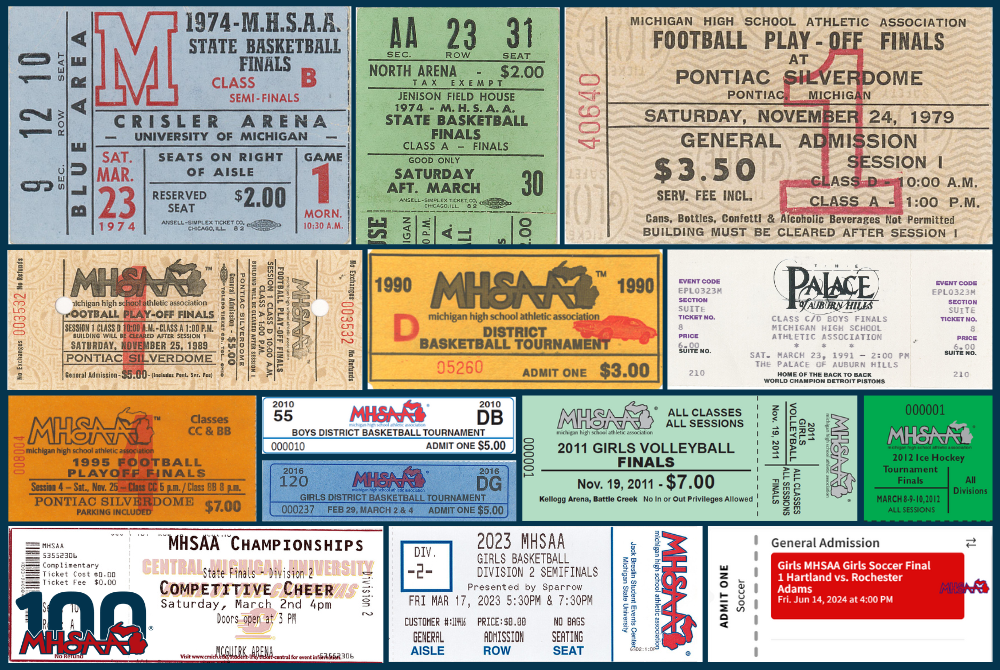
Century of School Sports: MHSAA Tickets Continue to Provide Fan-Friendly Value
By
Geoff Kimmerly
MHSAA.com senior editor
February 19, 2025
A buck went a lot farther a century ago, and a family of four wishing to watch the MHSAA Class A Boys Basketball Final in 1928 could have done so, at the minimum, for a grand total of $2 – or $6 if they were looking to splurge on the best seats.
Of course, relating the value of money 100 years ago to now is not apples to apples. But for Michigan school sports, a deal like that is meant to last forever.
The MHSAA has made it part of long-standing philosophy to keep ticket prices for its tournament events as low as possible, continuing to provide opportunities for entire families to attend together, and hoping to provide the best bargain as tickets to sporting events at other levels have climbed much more rapidly over the decades.
For the sake of comparison, consider tickets over the years for the Boys Basketball Tournament – the first event hosted by the newly-created MHSAA in 1925.
In 1928 (the first year for which cost of admission could be found), ticket prices for the MHSAA Boys Basketball Finals at the Olympia in Detroit were listed at 75 cents, $1 and $1.50, and a newspaper report after noted that in fact the cheapest seats were sold for 50 cents apiece instead. One ticket was good for all four games.
Less than 30 years later, $1.50 still got a fan two championship games – reserved seats for 1955 Boys Basketball Finals at Jenison Field House cost $1.50 per session, with Class C and B Finals in the afternoon and Class A and D in the evening. A decade after that, in 1965, tickets still cost $1.50 per session – although sessions were now split into the Class B game in the morning, Class D and C games in the afternoon, and a Class A session that night.
Sixty years later, prices have continued to rise incrementally – but again, while prioritizing keeping them as low as possible.
These days for boys basketball, District tickets cost $7, Regional tickets cost $9, Quarterfinals cost $10, and Semifinals and Finals tickets cost $12 per two-game session.
On its face, that’s quite a jump from the 1960s, much less the 1920s. But consider: Multiple inflation calculators say that $1.50 ticket for two games in 1955 would be worth more than $17 for two games now, meaning MHSAA Finals ticket prices have grown at a much slower rate.
Consider as well MHSAA ticket prices against Consumer Price Index data over the last 20 years. The U.S. Bureau of Labor Statistics reported in 2023 that admission costs to sporting events nationally had doubled over the previous two decades – literally going up 100 percent – yet price increases for the MHSAA Boys Basketball Tournament since 2005-06 have increased just 40 percent at the District level, where 60 percent of our boys basketball tickets are sold. Ticket prices for Regionals and Finals also have grown slower than that national rate.
And it remains tough to argue with what spectators get for their money at the MHSAA Tournament level.
For the 2024-25 school year, tickets for all District and Regional competitions – and some Quarterfinals and Semifinals – remain in the $7-$9 range. Finals tickets cost $10-$12, except for Individual Wrestling Finals ($18) and 11-Player Football Finals ($20) both at Ford Field – and one ticket for those is good to watch championships in five divisions in wrestling and four football championship games over one day, respectively.
In fact, the most recent change to ticketing has had nothing to do with the price – but instead, the move away from the paper tickets you see above. All tournament tickets are now digital, which keeps the MHSAA current with what’s done in college and pro sports and other forms of entertainment and assists in efficiency by taking cash out of the equation.
Previous "Century of School Sports" Spotlights
Feb. 11: We Recognize Those Who Make Our Games Go - Read
Feb. 4: WISL Conference Continues to Inspire Aspiring Leaders - Read
Jan. 28: Michigan's National Impact Begins at NFHS' Start - Read
Jan. 21: Awards Celebrate Well-Rounded Educational Experience - Read
Jan. 14: Predecessors Laid Foundation for MHSAA's Formation - Read
Jan. 9: MHSAA Blazes Trail Into Cyberspace - Read
Dec. 31: State's Storytellers Share Winter Memories - Read
Dec. 17: MHSAA Over Time - Read
Dec. 10: On This Day, December 13, We Will Celebrate - Read
Dec. 3: MHSAA Work Guided by Representative Council - Read
Nov. 26: Finals Provide Future Pros Early Ford Field Glory - Read
Nov. 19: Connection at Heart of Coaches Advancement Program - Read
Nov. 12: Good Sports are Winners Then, Now & Always - Read
Nov. 5: MHSAA's Home Sweet Home - Read
Oct. 29: MHSAA Summits Draw Thousands to Promote Sportsmanship - Read
Oct. 23: Cross Country Finals Among MHSAA's Longest Running - Read
Oct. 15: State's Storytellers Share Fall Memories - Read
Oct. 8: Guided by 4 S's of Educational Athletics - Read
Oct. 1: Michigan Sends 10 to National Hall of Fame - Read
Sept. 25: MHSAA Record Books Filled with 1000s of Achievements - Read
Sept. 18: Why Does the MHSAA Have These Rules? - Read
Sept. 10: Special Medals, Patches to Commemorate Special Year - Read
Sept. 4: Fall to Finish with 50th Football Championships - Read
Aug. 28: Let the Celebration Begin - Read

NFHS Voice: Football's Promising Results
September 9, 2020
By Karissa Niehoff
NFHS Executive Director
Normally at this time of year, the NFHS releases the latest figures from its annual High School Athletics Participation Survey. One of the most important and successful endeavors in the organization’s history, the NFHS has collected participation data through its 51 member state associations annually since 1971.
Before the 2018-19 school year, the number of participants in high school sports had increased for 29 consecutive years. Despite the first decline last year since 1988, we anticipated a quick turnaround in 2019-20 because of the continued strength of education-based high school athletics programs across the country.
There were encouraging reports last fall that football participation numbers were headed in a more positive direction. Interest in other fall sports continued to be at a high level, and winter sports were experiencing tremendous success. Then came the pandemic in mid-March, which shut down all high school sports competition.
Two-thirds of the states were unable to complete state basketball tournaments, and participants in the traditional spring sports of baseball, softball, track and field, and lacrosse – in most cases – were never able to take the field.
With spring sports unable to even get off the ground, state associations could not compile comprehensive surveys of sports participation for the 2019-20 school year. As a result, for the first time in the 50-year history of the survey, the NFHS is unable to release its annual summary of high school sports participation.
However, there is a silver lining to report. Though complete statistics are unavailable, numbers from a couple of sports last fall were obtained; and the optimism surrounding a positive trend in football participation came to fruition.
After annual declines of 23,311, 20,540 and 30,829 the past three years, participation by boys in high school 11-player football in 2019 dropped by only 2,489 – from 1,006,013 to 1,003,524. These numbers suggest to us that parents are appreciative of the risk minimization efforts that have been put in place. Every state has enacted rules that limit the amount of contact before the season and during practice, and every state has established concussion protocols and laws.
Participation in 11-player football reached an all-time high of 1,112,303 in 2008-09, and except for 2013-14, has declined every year since; however, this year’s decline is the smallest in 10 years.
The continued enthusiasm for football has been evident this fall – even amid the COVID-19 pandemic. State associations have worked with government, education and health leaders to do everything possible to offer the sport at some time during the 2020-21 season.
Some of the 34 states that are conducting football this fall have started play, and there is a special sense of gratitude on the part of students, coaches, officials and fans for the opportunity. While there may be pauses with some players and teams quarantined, and while 17 other states will not play until later in the school year, the excitement and anticipation of Friday Night Lights continues.
In addition to football, girls volleyball continued its tremendous growth last fall, increasing by 9,751 participants for a total of 462,559. In the past 10 years, the sport has added 60,000 participants and has passed basketball as the No. 2 sport for girls behind track and field.
Though a complete participation report for 2019-20 will not be available due to the loss of spring sports, totals on more fall and winter sports from 2019-20 will be formulated in the coming weeks. Judging from the early returns, it appears the past year’s participation numbers would have started the NFHS on a new streak of record participation if spring sports had not been cancelled.
Most likely, next year’s participation survey will be anything but ordinary as well. Regardless of the challenges in compiling participation statistics in 2020-21, the opportunity and desire to participate in all education-based activities remain.
Dr. Karissa L. Niehoff is starting her third year as executive director of the National Federation of State High School Associations (NFHS) in Indianapolis, Indiana. She is the first female to head the national leadership organization for high school athletics and performing arts activities and the sixth full-time executive director of the NFHS, which celebrated its 100th year of service during the 2018-19 school year. She previously was executive director of the Connecticut Association of Schools-Connecticut Interscholastic Athletic Conference for seven years.