

Century of School Sports: MHSAA Tickets Continue to Provide Fan-Friendly Value
By
Geoff Kimmerly
MHSAA.com senior editor
February 19, 2025
A buck went a lot farther a century ago, and a family of four wishing to watch the MHSAA Class A Boys Basketball Final in 1928 could have done so, at the minimum, for a grand total of $2 – or $6 if they were looking to splurge on the best seats.
Of course, relating the value of money 100 years ago to now is not apples to apples. But for Michigan school sports, a deal like that is meant to last forever.
The MHSAA has made it part of long-standing philosophy to keep ticket prices for its tournament events as low as possible, continuing to provide opportunities for entire families to attend together, and hoping to provide the best bargain as tickets to sporting events at other levels have climbed much more rapidly over the decades.
For the sake of comparison, consider tickets over the years for the Boys Basketball Tournament – the first event hosted by the newly-created MHSAA in 1925.
In 1928 (the first year for which cost of admission could be found), ticket prices for the MHSAA Boys Basketball Finals at the Olympia in Detroit were listed at 75 cents, $1 and $1.50, and a newspaper report after noted that in fact the cheapest seats were sold for 50 cents apiece instead. One ticket was good for all four games.
Less than 30 years later, $1.50 still got a fan two championship games – reserved seats for 1955 Boys Basketball Finals at Jenison Field House cost $1.50 per session, with Class C and B Finals in the afternoon and Class A and D in the evening. A decade after that, in 1965, tickets still cost $1.50 per session – although sessions were now split into the Class B game in the morning, Class D and C games in the afternoon, and a Class A session that night.
Sixty years later, prices have continued to rise incrementally – but again, while prioritizing keeping them as low as possible.
These days for boys basketball, District tickets cost $7, Regional tickets cost $9, Quarterfinals cost $10, and Semifinals and Finals tickets cost $12 per two-game session.
On its face, that’s quite a jump from the 1960s, much less the 1920s. But consider: Multiple inflation calculators say that $1.50 ticket for two games in 1955 would be worth more than $17 for two games now, meaning MHSAA Finals ticket prices have grown at a much slower rate.
Consider as well MHSAA ticket prices against Consumer Price Index data over the last 20 years. The U.S. Bureau of Labor Statistics reported in 2023 that admission costs to sporting events nationally had doubled over the previous two decades – literally going up 100 percent – yet price increases for the MHSAA Boys Basketball Tournament since 2005-06 have increased just 40 percent at the District level, where 60 percent of our boys basketball tickets are sold. Ticket prices for Regionals and Finals also have grown slower than that national rate.
And it remains tough to argue with what spectators get for their money at the MHSAA Tournament level.
For the 2024-25 school year, tickets for all District and Regional competitions – and some Quarterfinals and Semifinals – remain in the $7-$9 range. Finals tickets cost $10-$12, except for Individual Wrestling Finals ($18) and 11-Player Football Finals ($20) both at Ford Field – and one ticket for those is good to watch championships in five divisions in wrestling and four football championship games over one day, respectively.
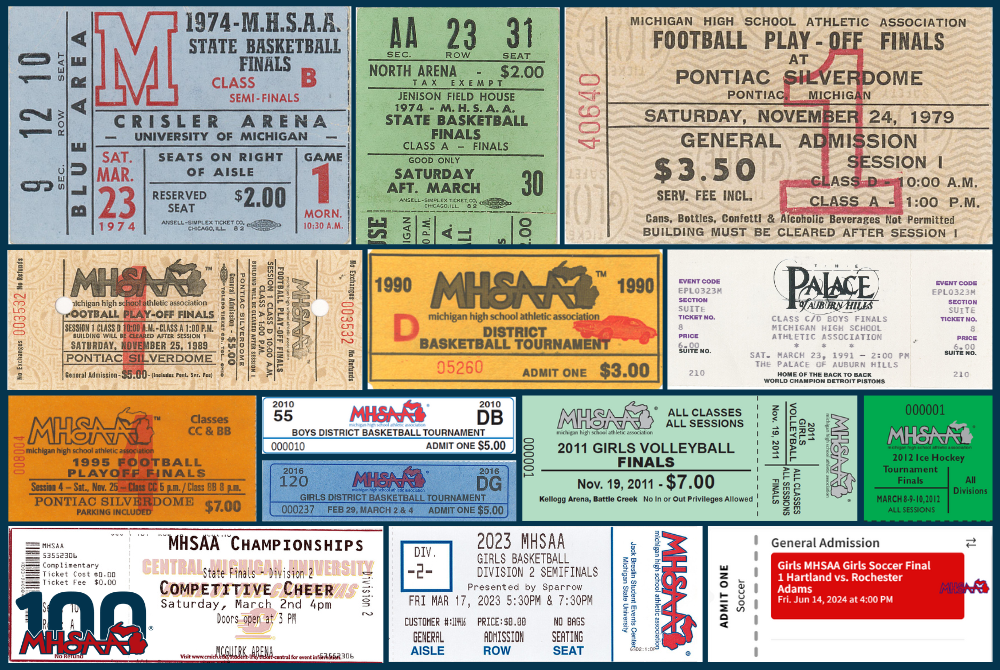
In fact, the most recent change to ticketing has had nothing to do with the price – but instead, the move away from the paper tickets you see above. All tournament tickets are now digital, which keeps the MHSAA current with what’s done in college and pro sports and other forms of entertainment and assists in efficiency by taking cash out of the equation.
Previous "Century of School Sports" Spotlights
Feb. 11: We Recognize Those Who Make Our Games Go - Read
Feb. 4: WISL Conference Continues to Inspire Aspiring Leaders - Read
Jan. 28: Michigan's National Impact Begins at NFHS' Start - Read
Jan. 21: Awards Celebrate Well-Rounded Educational Experience - Read
Jan. 14: Predecessors Laid Foundation for MHSAA's Formation - Read
Jan. 9: MHSAA Blazes Trail Into Cyberspace - Read
Dec. 31: State's Storytellers Share Winter Memories - Read
Dec. 17: MHSAA Over Time - Read
Dec. 10: On This Day, December 13, We Will Celebrate - Read
Dec. 3: MHSAA Work Guided by Representative Council - Read
Nov. 26: Finals Provide Future Pros Early Ford Field Glory - Read
Nov. 19: Connection at Heart of Coaches Advancement Program - Read
Nov. 12: Good Sports are Winners Then, Now & Always - Read
Nov. 5: MHSAA's Home Sweet Home - Read
Oct. 29: MHSAA Summits Draw Thousands to Promote Sportsmanship - Read
Oct. 23: Cross Country Finals Among MHSAA's Longest Running - Read
Oct. 15: State's Storytellers Share Fall Memories - Read
Oct. 8: Guided by 4 S's of Educational Athletics - Read
Oct. 1: Michigan Sends 10 to National Hall of Fame - Read
Sept. 25: MHSAA Record Books Filled with 1000s of Achievements - Read
Sept. 18: Why Does the MHSAA Have These Rules? - Read
Sept. 10: Special Medals, Patches to Commemorate Special Year - Read
Sept. 4: Fall to Finish with 50th Football Championships - Read
Aug. 28: Let the Celebration Begin - Read
Choose the Right Sports Medicine Expert
July 7, 2020

By Christina Eyers, Ed.D., AT, ATC
Henry Ford Health System
If you're an athlete, chances are you'll require specialized care from a health professional during your career.
Confused about the differences between athletic trainers, sports medicine physicians and exercise physiologists, among other experts? You're not alone!
Each of these professionals has different levels of training, expertise and certifications, but the care they provide often overlaps. That's one reason why they often work together.
Sports Professionals Defined
Caring for athletes isn't always clear-cut. In fact, most athletes require a full team of professionals working in concert to stay at the top of their game. Yet confusion remains about which professionals you need to see for training, injury prevention, and recovery and treatment after an injury.
Each type of professional has its own set of experience, training and certifications. Here’s how they measure up:
· Sports medicine doctor: Sports medicine physicians are typically trained in orthopedic surgery, primary care or emergency medicine. These professionals have medical degrees as well as specialized training in sports medicine, including the prevention and treatment of injury. In addition to caring for conditions ranging from concussion to head colds, sports medicine physicians also focus on helping people return to sports safely and effectively after illness or injury.
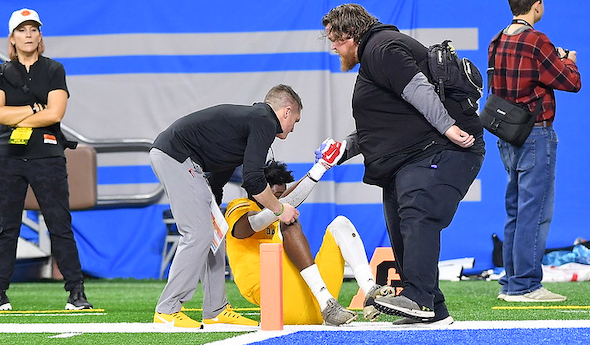
· Athletic trainer: Athletic trainers take care of athletes from prevention through rehabilitation. In collaboration with a physician, these professionals offer insights that help minimize risk and prevent injuries. They evaluate athletes and provide immediate care and treatment, sometimes even on the sidelines. They also provide rehabilitation and reconditioning after an injury or illness.
· Exercise physiologist: Exercise physiologists study the effect of exercise on the muscular, cardiovascular, and sympathetic and parasympathetic nervous systems. They examine functional capacity and strength due to endurance training or strength training. These professionals may also test athletes for VO2max (your oxygen volume while training) and body composition (the ratio of fatty mass to lean mass).
· Physical medicine and rehab physician: These professionals treat a variety of medical conditions that affect the brain, spinal cord, nerves, bones, joints, ligaments, muscles and tendons. They take the whole body into account to pinpoint problems and enhance performance without surgery.
· Physical therapist: Physical therapists diagnose and treat individuals of all ages with conditions that limit their ability to move and perform daily activities.
Other Specialized Professionals Who Care for Athletes
In addition to the health care professionals described above, athletes may meet with a host of experts, including:
· Nurses and medical assistants
· Occupational therapists
· Cardiologists
· Neurologists
· Behavioral health specialists
· Dietitians
· Complementary medical practitioners, such as acupuncturists and chiropractors
None of these individuals are "fitness professionals," a term nearly anyone can use to describe a range of professional activities. Rather, these sports medicine experts are part of a comprehensive team that includes at least one physician. They are each licensed by the state to provide specialized care to athletes.
Personal trainers, on the other hand, focus on helping people find their way around the gym, hold them accountable to achieve their goals and help new exercisers and seasoned fitness enthusiasts stick to a workout regimen.
If you're an athlete, you need a team of health professionals who can provide comprehensive care to reach your highest potential.
Christina Eyers, Ed.D., AT, ATC, is the Director of Athletic Training & Community Outreach with Henry Ford Sports Medicine.
Want to learn more? Henry Ford Health System sports medicine experts are treating the whole athlete, in a whole new way. From nutrition to neurology, and from injury prevention to treatment of sports-related conditions, they can give your athlete a unique game plan.
Visit henryford.com/sports or call (313) 972-4216 for an appointment within 24 business hours.