

Century of School Sports: MHSAA Work Guided by Representative Council
By
Geoff Kimmerly
MHSAA.com senior editor
December 3, 2024
One of the most common misconceptions about the MHSAA over its 100-year history is that all decisions regarding school sports in Michigan are made by the staff in the East Lansing office.
The MHSAA truly is an organization built upon its membership, with its Representative Council the legislative body that has produced the rules and tournament schedules currently in place to provide structure in athletics for more than 750 high schools and hundreds more middle schools across the state.
The Representative Council is the 19-member legislative body of the MHSAA. All but five members are elected by member schools. Four members are appointed by the Council to facilitate representation of females and minorities, and the 19th position is occupied by the Superintendent of Public Instruction or designee.
The Council considers all proposals brought before it from MHSAA sport and other appointed committees that meet throughout the year, and also makes decisions on a variety of eligibility rules, postseason tournament and operational issues. The Council regularly considers 30 committee proposals during its Spring meeting alone, along with a handful of others during Fall and Winter meetings which otherwise are primarily opportunities for discussion of topics that may come up for action at a later date.
Eight representatives are elected across four regions – two apiece from the Northern Lower Peninsula, Southeastern Michigan, Southwestern Michigan and the Upper Peninsula – and also based on school enrollment, with one representative from each of those regions from the larger Class A and B-sized schools and one representative from each region from the smaller Class C and D-sized schools. There are also two statewide at-large positions, two representing junior high/middle schools, and elected representatives from Detroit Public Schools and private and parochial schools.
All Representative Council members must be representatives of a member school, as faculty or board of education members. Every Council candidate must have superintendent or principal approval in writing and be qualified for the position for which that person is running.
Elections take place every fall after names of candidates are submitted and published to the MHSAA Website by April 15 the preceding spring. Ballots are mailed to schools in September and must be postmarked no later than two weeks after they were sent by the MHSAA office. A Board of Canvassers appointed annually counts the ballots, which must be signed by the principal and superintendent of that member school (except for private and parochial schools, which require signature by the principal only).
Council members are selected by majority vote.
Terms for elected Council representatives are two years long. Appointed members also serve two-year terms and may not serve longer than two successive terms.
The Council meets three times annually. Council officers – president, vice president and secretary-treasurer – are elected during the Fall meeting for the full Council.
Five members of the Council also convene monthly during the school year to form the MHSAA’s Executive Committee, which reviews appeals of Handbook regulations by member schools. Those five include the three elected officers.
Previous "Century of School Sports" Spotlights
Nov. 26: Finals Provide Future Pros Early Ford Field Glory - Read
Nov. 19: Connection at Heart of Coaches Advancement Program - Read
Nov. 12: Good Sports are Winners Then, Now & Always - Read
Nov. 5: MHSAA's Home Sweet Home - Read
Oct. 29: MHSAA Summits Draw Thousands to Promote Sportsmanship - Read
Oct. 23: Cross Country Finals Among MHSAA's Longest Running - Read
Oct. 15: State's Storytellers Share Fall Memories - Read
Oct. 8: Guided by 4 S's of Educational Athletics - Read
Oct. 1: Michigan Sends 10 to National Hall of Fame - Read
Sept. 25: MHSAA Record Books Filled with 1000s of Achievements - Read
Sept. 18: Why Does the MHSAA Have These Rules? - Read
Sept. 10: Special Medals, Patches to Commemorate Special Year - Read
Sept. 4: Fall to Finish with 50th Football Championships - Read
Aug. 28: Let the Celebration Begin - Read
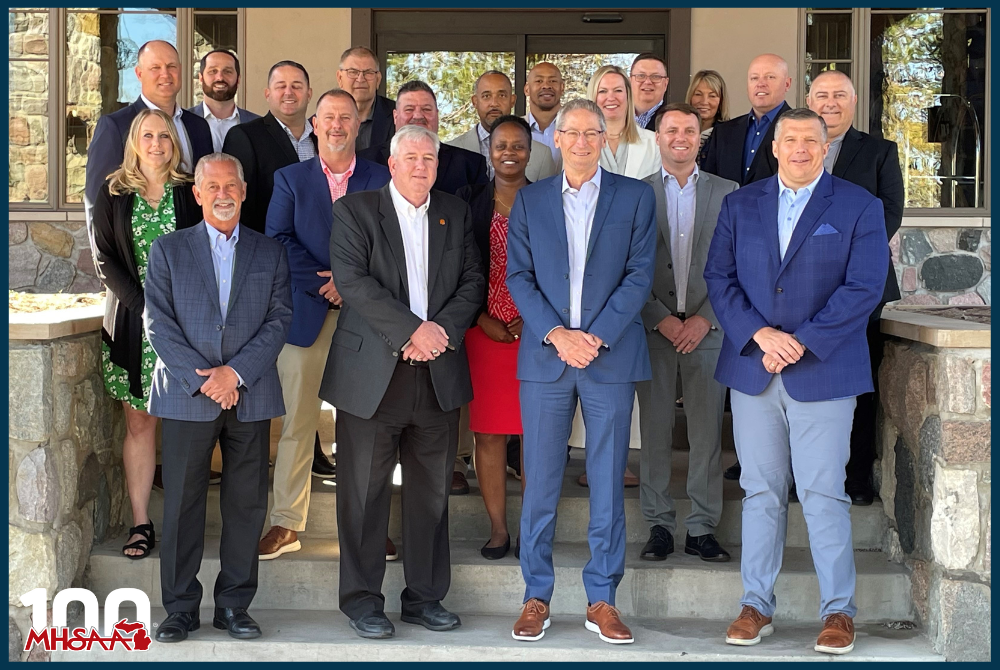
PHOTO The MHSAA Representative Council and Executive Director Mark Uyl (front row, far right) take a group photo during its Spring Meeting in May. (Photo by Jon Ross.)
NFHS Voice: Security Wake-Up Call
December 4, 2019
By Karissa Niehoff
NFHS Executive Director
Given the increase in school-related shootings since the Columbine massacre 20 years ago, perhaps it is not surprising that these acts of violence are no longer confined to regular school hours.
The tragic shooting – and eventual death of an innocent 10-year-old – at a New Jersey high school football game last month made headlines across the country and was a somber reminder that events occurring after school hours are subject to the same type of senseless violence.
This was not the first shooting at a high school sporting event this year – actually it was the 23rd according to the National Center for Spectator Sport Safety and Security (NCS4) – but the death of Micah Tennant and the eventual conclusion of the game five days later at the Philadelphia Eagles’ stadium drew nationwide coverage.
Camden High School and Pleasantville High School finished the playoff game at a nearly empty Lincoln Financial Field before a few hundred family members and friends as the stadium was closed to the public. Larry White, New Jersey State Interscholastic Athletic Association executive director, said the decision to finish the game was made by both schools “to provide closure and send a powerful message that acts of violence and those who perpetrate them will not win.”
High school sporting events traditionally have been safe gathering places for fans to attend and celebrate the accomplishments of high school student-athletes – particularly the sport of football. And we must do whatever is necessary to make sure these venues remain safe and secure.
Reports have been encouraging about attendance as state football playoffs have concluded in many states. In Indiana, about 20,000 people attended the Class 5A championship at Lucas Oil Stadium in Indianapolis on the day after Thanksgiving.
We want to ensure that our stadiums remain open for everyone to attend. The fans – students, parents, other family members, friends, community residents – are what make education-based athletics different from non-school sports.
More intense security plans have been in existence at college and professional sports venues for many years; it is essential that leaders in high school sports move after-school safety and security to the top of their priority lists.
In addition to school athletic events that typically start in early evening hours, security plans also should be in place for practices inside and outside the school building.
Many resources are available for high school athletic administrators to implement an after-school safety and security program, including the free online education course on the NFHS Learning Center at www.NFHSLearn.com. “Afterschool Security” provides practical strategies for developing and implementing a school safety team and an after-school activities supervision plan.
As was the case with increased security at airports after September 11, 2001, the results of heightened safety plans for after-school activities may be an inconvenience for some individuals. However, plans must be in place to ensure that high school stadiums and arenas remain open for the almost eight million participants in high school sports, as well as the estimated 350 million fans annually.
Dr. Karissa L. Niehoff is in her second year as executive director of the National Federation of State High School Associations (NFHS) in Indianapolis, Indiana. She is the first female to head the national leadership organization for high school athletics and performing arts activities and the sixth full-time executive director of the NFHS, which celebrated its 100th year of service during the 2018-19 school year. She previously was executive director of the Connecticut Association of Schools-Connecticut Interscholastic Athletic Conference for seven years.