

Century of School Sports: Michigan's National Impact Begins at NFHS' Start
By
Geoff Kimmerly
MHSAA.com senior editor
January 28, 2025
The beginning of the National Federation of State High School Associations (NFHS) predated the start of the MHSAA by about 4½ years. But Michigan played a leading role in creating the national organization for school-based sports and arts activities – and through its work with the NFHS continues to impact how school sports are played across the country.
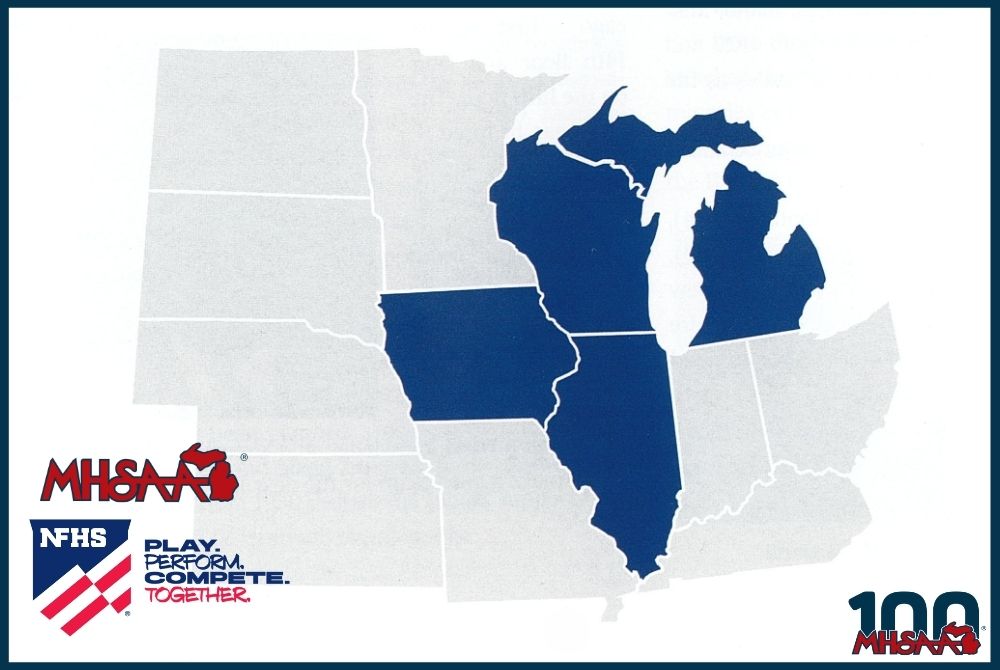
On May 14, 1920, representatives from the Illinois, Indiana, Iowa, Michigan and Wisconsin high school associations met to discuss common issues – especially national championships and eligibility rules in football, as returning World War I veterans were seeking to play on high school teams; and, according to meeting minutes, because “high school athletics were being handled in an unsatisfactory manner in contests under the auspices of colleges and universities.” At this time, Michigan school sports were governed by the MHSAA’s predecessor organization – the Michigan Interscholastic Athletic Association (MIAA) – and president A.W. Krauss, the principal at Grand Rapids South High School, represented our state.
Building on their desire to form common rules to govern athletics, those five states together formed the framework for the Mid-West Federation of State High School Associations, and the MIAA officially voted to join the organization March 31, 1921, becoming one of the four founding states (Indiana was absent when the Mid-West Federation constitution was adopted). Just about a year later, on March 1, 1922, with 11 states now present, the Mid-West Federation changed its name to the National Federation of State High School Athletic Associations – which became the current NFHS in 1970.
Representing the MIAA at the 1922 Federation meeting was Ann Arbor High School principal L.L. Forsythe – cited frequently for his outsized contributions during this “Century of School Sports” series – and he was elected as Federation vice president, a role in which he served for 15 years. Obviously his impact in that role was significant for the growing organization, which now includes associations from all 50 states and Washington, D.C.
Another Michigan school sports luminary, retired executive director John E. Jack Roberts, also had significant ties to the NFHS. He served on staff from 1973-80 and was heavily involved with the implementation of Title IX at the local and state levels. He also made immense contributions as the NFHS representative to the landmark Amateur Sports Act of 1978, and played a significant role in the NFHS rules-writing process as the organization started writing and publishing rules for a number of new sports during the 1970s. Roberts began his 32-year tenure leading the MHSAA in 1986.
The NFHS’s primary contribution to state associations remains today as writer of game rules for nearly all school sports, and those rules govern the majority of MHSAA-sponsored programs. (Competitive cheer is exclusive to Michigan, and golf, tennis and bowling are regulated by national governing organizations).
By agreeing to follow NFHS game rules, the MHSAA receives the opportunity to help make them, serving turns on rules-making committees with other representatives from the NFHS’s Section 4 – which also includes Wisconsin, Iowa, Illinois and Indiana. Michigan also sends a rotating representative to serve on the national record book committee.
Previous "Century of School Sports" Spotlights
Jan. 21: Awards Celebrate Well-Rounded Educational Experience - Read
Jan. 14: Predecessors Laid Foundation for MHSAA's Formation - Read
Jan. 9: MHSAA Blazes Trail Into Cyberspace - Read
Dec. 31: State's Storytellers Share Winter Memories - Read
Dec. 17: MHSAA Over Time - Read
Dec. 10: On This Day, December 13, We Will Celebrate - Read
Dec. 3: MHSAA Work Guided by Representative Council - Read
Nov. 26: Finals Provide Future Pros Early Ford Field Glory - Read
Nov. 19: Connection at Heart of Coaches Advancement Program - Read
Nov. 12: Good Sports are Winners Then, Now & Always - Read
Nov. 5: MHSAA's Home Sweet Home - Read
Oct. 29: MHSAA Summits Draw Thousands to Promote Sportsmanship - Read
Oct. 23: Cross Country Finals Among MHSAA's Longest Running - Read
Oct. 15: State's Storytellers Share Fall Memories - Read
Oct. 8: Guided by 4 S's of Educational Athletics - Read
Oct. 1: Michigan Sends 10 to National Hall of Fame - Read
Sept. 25: MHSAA Record Books Filled with 1000s of Achievements - Read
Sept. 18: Why Does the MHSAA Have These Rules? - Read
Sept. 10: Special Medals, Patches to Commemorate Special Year - Read
Sept. 4: Fall to Finish with 50th Football Championships - Read
Aug. 28: Let the Celebration Begin - Read
(Map graphic courtesy of NFHS.)
This Week in High School Sports: 10/9/25
By
Jon Ross
MHSAA Director of Broadcast Properties
October 9, 2025
This week's edition celebrates the first Finals champions of 2025-26, in Upper Peninsula girls tennis; awards Game Balls to high achievers in football and soccer, and introduces this fall's Sportsmanship Summit series.
 The 5-minute program each week includes feature stories from MHSAA.com or network affiliates, along with "Be the Referee," a 60-second look at the fine art of officiating.
"This Week in High School Sports" is powered by MI Student Aid, a division within the Department of Lifelong Education, Advancement, and Potential (MiLEAP).
Listen to this week's show by Clicking Here.
Previous 2025-26 editions
Oct. 2: 2026 MHSAA/Farm Bureau Insurance Scholar-Athlete Awards, Boys Soccer Tournament - Listen
Sept. 25: Saline's record-approaching performance, SAC sportsmanship statement - Listen
Sept. 18: Athletic director training, "Block Party" volleyball report - Listen
Sept. 11: Football coaching legend Al Fracassa, MHSAA Student Advisory Council - Listen
Sept. 4: MHSAA participation rising, Harbor Springs soccer's Henry Juneau - Listen
Aug. 28: Field hockey's first season, changes to Football Playoffs, Tennis Finals - Listen