

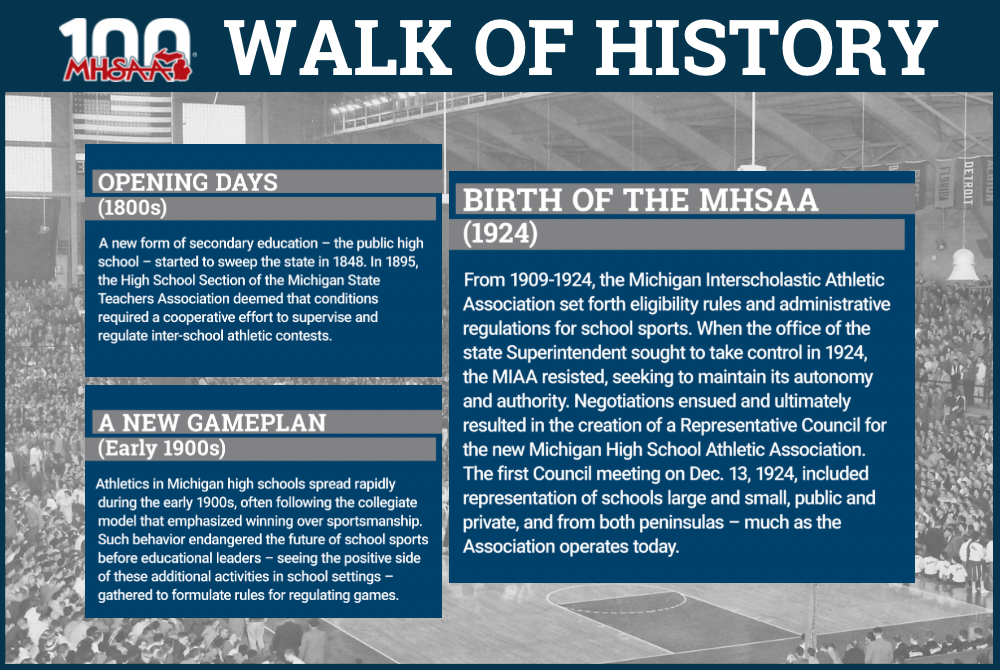
Century of School Sports: Predecessors Laid Foundation for MHSAA's Formation
By
Geoff Kimmerly
MHSAA.com senior editor
January 14, 2025
We have celebrated throughout this school year the 100th anniversary of the Michigan High School Athletic Association – our “Century of School Sports.” But the first high school sports in this state were being played more than a half-century before the MHSAA was established in December 1924 – and it’s important to recognize our predecessor organizations for their pioneering work.
To keep things very brief, it’s fair to say that high school athletics in Michigan followed the increase in number high schools across the state – especially public schools – as well as interest in sports predominantly at the college level.
In lieu of citing detail by detail, the following is based on research from “Athletics in Michigan High Schools – The First Hundred Years” by L.L. Forsythe, who served as the first president of the MHSAA Representative Council after playing a leading role in its creation as an officer of the previous Michigan Interscholastic Athletic Association. Newspaper reports of the day also contributed to what's summarized below.
It is also key to keep in mind a few things about the organizations that regulated high school athletics before the MHSAA, and to understand their relation to our work today:
- Schools at the start of organized athletics sought primarily to create competitive equity and a safe playing environment for their teams and athletes.
- Schools looked to the statewide organization to uphold and consider appeals for those rules regulating eligibility and fair play.
- Schools later asked for the statewide organization to take over sponsorship of the statewide championship events that began to crop up over the 30 years before the MHSAA formed.
According to Forsythe’s research, the first public high schools in Michigan opened during the middle of the 19th century – as of 1850, only 3-4 existed, but after the Civil War that number began to grow, and with it an interest in athletics as part of student life. Football and baseball were main draws, later to be joined by basketball and track & field – which would be among the MHSAA’s first championship offerings several years later.
The Beginning (1895-1909)
Forsythe notes that 1895 saw the first steps toward regulating high school athletics on a statewide basis. A few entities took on roles in an attempt to bring structure.
- The Michigan State Teachers Association, which in 1895 began to recruit schools to become part of an organization that would require eligible athletes to be enrolled students, succeeding academically with at least a “passing grade,” and participating in no more than five seasons or years of a sport. However, the MSTA did not have a program of activities, as those of the day were generally organized by universities.
- The University Athletic Association was formed by University of Michigan in 1898, and was the main organizer of invitational “state” championships in partnership with the MSTA.
- Another organization, the Michigan Inter-School Athletic Association, also pops up in 1895 as the host of what aspired to be an annual field day.
Michigan Interscholastic Athletic Association (1909-1924)
The Michigan Schoolmasters’ Club absorbed control of athletics from the MSTA in April 1909, forming the MIAA and immediately introducing a series of regulations including an age limit of 21 years old, an eligibility limit of four years, and a restriction on participation by athletes who had competed professionally.
The MIAA would continue to set other eligibility rules, charge dues ($1), and also write into bylaws that member schools could play only member schools. That latter detail was a big driver of growth – the revised MIAA constitution in 1921 added that regulation, and the association grow from 26 schools in 1920 to 130 in 1921, to 284 in 1922 to 305 schools in 1923.
On the event side, the MIAA conducted its first state track meet in 1912, then did so coordinating with Michigan State College. The 1921 basketball tournament saw the first mention of classes – Class B for schools with 250 or fewer students, and Class A for schools with more than 250.
It should also be noted that during the early 1920s, MIAA representatives helped form the organization (first of Midwest states) that would become the National Federation of State High School Associations (NFHS) – which continues to write game rules for nearly all MHSAA sports.
The MIAA continued operating into its annual meeting in December 1923, when leaders were presented with an unwelcome surprise announcement – the Michigan legislature, at the close of its recent session, had transferred supervision of interscholastic athletics to the state Superintendent of Public Instruction (to the superintendent's surprise as well, Forsythe noted).
The negotiations between schools and the state over the following year resulted in the dissolution of the MIAA on Dec. 5, 1924 – and the first meeting of the MHSAA eight days later.
Previous "Century of School Sports" Spotlights
Jan. 9: MHSAA Blazes Trail Into Cyberspace - Read
Dec. 31: State's Storytellers Share Winter Memories - Read
Dec. 17: MHSAA Over Time - Read
Dec. 10: On This Day, December 13, We Will Celebrate - Read
Dec. 3: MHSAA Work Guided by Representative Council - Read
Nov. 26: Finals Provide Future Pros Early Ford Field Glory - Read
Nov. 19: Connection at Heart of Coaches Advancement Program - Read
Nov. 12: Good Sports are Winners Then, Now & Always - Read
Nov. 5: MHSAA's Home Sweet Home - Read
Oct. 29: MHSAA Summits Draw Thousands to Promote Sportsmanship - Read
Oct. 23: Cross Country Finals Among MHSAA's Longest Running - Read
Oct. 15: State's Storytellers Share Fall Memories - Read
Oct. 8: Guided by 4 S's of Educational Athletics - Read
Oct. 1: Michigan Sends 10 to National Hall of Fame - Read
Sept. 25: MHSAA Record Books Filled with 1000s of Achievements - Read
Sept. 18: Why Does the MHSAA Have These Rules? - Read
Sept. 10: Special Medals, Patches to Commemorate Special Year - Read
Sept. 4: Fall to Finish with 50th Football Championships - Read
Aug. 28: Let the Celebration Begin - Read

This Week in High School Sports: 11/13/25
By
Jon Ross
MHSAA Director of Broadcast Properties
November 13, 2025
This week's edition highlights MHSAA.com's "Performance of the Week" feature and some of this school year's honorees, awards Game Balls to high achievers in girls swimming & diving, girls volleyball and football; and gives a glimpse of Shelby's football comeback this fall.
 The 5-minute program each week includes feature stories from MHSAA.com or network affiliates, along with "Be the Referee," a 60-second look at the fine art of officiating.
"This Week in High School Sports" is powered by MI Student Aid, a division within the Department of Lifelong Education, Advancement, and Potential (MiLEAP).
Listen to this week's show by Clicking Here.
Previous 2025-26 editions
Nov. 6: Lower Peninsula Cross Country Finals, Boys Soccer Finals review - Listen
Oct. 30: Mendon football's Owen Gorham, MHSAA Girls Volleyball Tournament primer - Listen
Oct. 23: Lower Peninsula Girls Golf Finals review, LP Boys Tennis Finals - Listen
Oct. 16: MHSAA Football Playoff selection, Field Hockey Finals week primer - Listen
Oct. 9: Upper Peninsula Girls Tennis Finals review, 2025 Sportsmanship Summits - Listen
Oct. 2: 2026 MHSAA/Farm Bureau Insurance Scholar-Athlete Awards, Boys Soccer Tournament - Listen
Sept. 25: Saline's record-approaching performance, SAC sportsmanship statement - Listen
Sept. 18: Athletic director training, "Block Party" volleyball report - Listen
Sept. 11: Football coaching legend Al Fracassa, MHSAA Student Advisory Council - Listen
Sept. 4: MHSAA participation rising, Harbor Springs soccer's Henry Juneau - Listen
Aug. 28: Field hockey's first season, changes to Football Playoffs, Tennis Finals - Listen