

Century of School Sports: WISL Conference Continues to Inspire Aspiring Leaders
By
Geoff Kimmerly
MHSAA.com senior editor
February 4, 2025
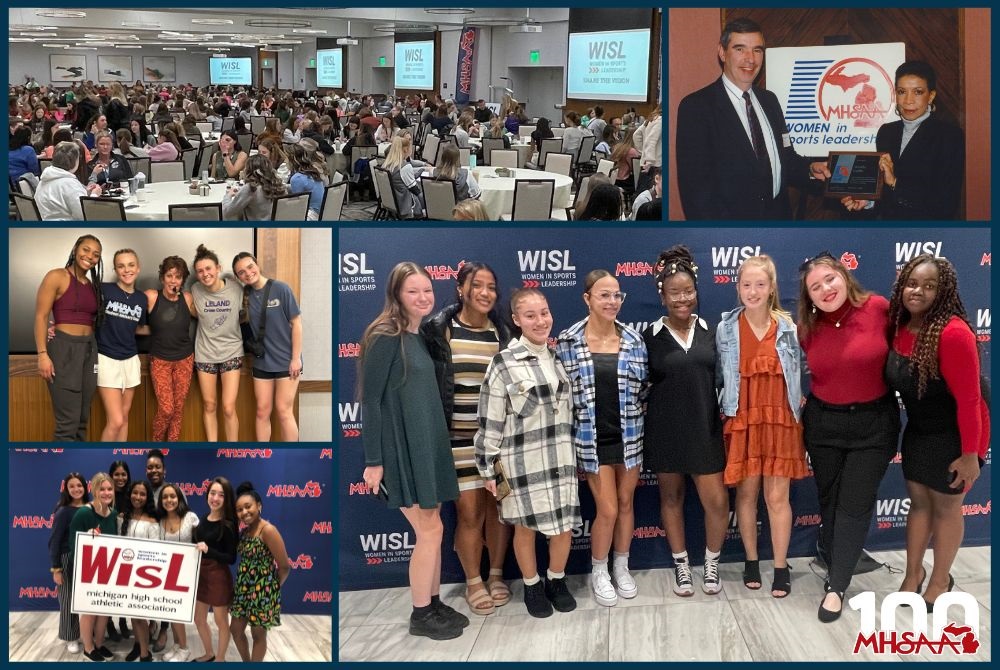
There has long been a mighty sense of pride at the MHSAA for its Women In Sports Leadership Conference – which remains the nation’s first, largest and longest-serving event promoting the roles of females in athletics.
The event has continued to grow tremendously since the first group of 130 administrators, coaches, high school and college students assembled in Lansing in 1989. It’s easy to argue as well that the WISL Conference has become even more impactful over its 26 editions, the most recent beginning a year ago today with the theme “Share the Vision.”
Nearly 800 participants – mostly female high school student-athletes – attended last year’s two-day event, where they were able to engage in several of 36 workshops and learn from a group of 45 speakers with expertise in a wide variety of sports-related fields. The WISL Conference has welcomed Olympians, leaders in Michigan government and Hall of Fame coaches at all levels of athletics among several who have put their voices to the goals of encouraging women and growing their presence at all levels of sport.
Attracting women back to coaching and officiating was the mission of the first WISL Conference – percentages of both had fallen dramatically since the dawn of Title IX nearly two decades prior had led to rapid growth in athletic competitive opportunities for females at various levels. The first WISL events were organized by MHSAA assistant director Suzanne Martin, under the leadership as well of then-executive director Jack Roberts, until Martin retired in December 2002. Fun fact: The first Michigan legislative resolution recognizing Feb. 5 as Girls and Women In Sports Day statewide (in addition to nationally) was presented during the 1990 WISL Conference.
Kathy Vruggink Westdorp took over the WISL program upon joining the MHSAA staff as assistant director during the 2003-04 school year after more than two decades as a teacher, coach and administrator in the Grand Rapids area. Under her leadership, WISL has continued to build and thrive – it’s currently an every-other-year event, generally hosted during the first weekend in February although the 25th WISL took place during October 2022 as part of the culmination of the MHSAA’s year-long celebration of “Title IX at 50.” Topics covered still include coaching and teaching and learning leadership, but also sports nutrition and performance, empowerment and goal-setting, and several more areas of interest.
In 1990, the MHSAA also awarded its first of now 38 Women In Sports Leadership Awards, recognizing pioneers who have elevated athletics in Michigan as pioneers, advocates, voices and leaders, particularly at the interscholastic level. The 39th Women In Sports Leadership Award winner will be announced later this month.
Previous "Century of School Sports" Spotlights
Jan. 28: Michigan's National Impact Begins at NFHS' Start - Read
Jan. 21: Awards Celebrate Well-Rounded Educational Experience - Read
Jan. 14: Predecessors Laid Foundation for MHSAA's Formation - Read
Jan. 9: MHSAA Blazes Trail Into Cyberspace - Read
Dec. 31: State's Storytellers Share Winter Memories - Read
Dec. 17: MHSAA Over Time - Read
Dec. 10: On This Day, December 13, We Will Celebrate - Read
Dec. 3: MHSAA Work Guided by Representative Council - Read
Nov. 26: Finals Provide Future Pros Early Ford Field Glory - Read
Nov. 19: Connection at Heart of Coaches Advancement Program - Read
Nov. 12: Good Sports are Winners Then, Now & Always - Read
Nov. 5: MHSAA's Home Sweet Home - Read
Oct. 29: MHSAA Summits Draw Thousands to Promote Sportsmanship - Read
Oct. 23: Cross Country Finals Among MHSAA's Longest Running - Read
Oct. 15: State's Storytellers Share Fall Memories - Read
Oct. 8: Guided by 4 S's of Educational Athletics - Read
Oct. 1: Michigan Sends 10 to National Hall of Fame - Read
Sept. 25: MHSAA Record Books Filled with 1000s of Achievements - Read
Sept. 18: Why Does the MHSAA Have These Rules? - Read
Sept. 10: Special Medals, Patches to Commemorate Special Year - Read
Sept. 4: Fall to Finish with 50th Football Championships - Read
Aug. 28: Let the Celebration Begin - Read
(MHSAA file photos.)
Let's Learn What This Time Can Teach Us
April 8, 2020
By Kevin Wolma
Hudsonville Athletic Director
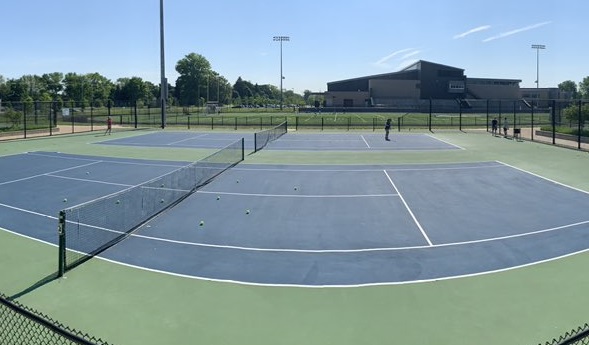
A simple service return that landed into the net last fall ended my son’s tennis career.
When you are a senior, there is an end date. Just like that it is over.
Seems like yesterday I was playing catch with him in the front yard. Seems like yesterday I was rebounding as he shot at our basketball hoop. Seems like yesterday I put a tennis racquet in his hands for the first time. The success and failures along with the laughter and frustration all came to an end.
Along the way people would warn me about how fast the time goes, but when you are living day to day, you don’t really believe them. Going into the final day of the season, I had those thoughts that this would be the last day I’d watch my son play a competitive tennis match, but it didn't really hit me until I watched that last ball go into the net.
However, I also realized that we were going to experience many final moments during his senior year and this was a natural part of the journey. What I didn't know on that day was that this was the very last time I would see him compete. The cancellation of spring sports season with the COVID-19 crisis took that opportunity away from him competing in track & field this spring.
We never know when things will be taken away from us.
Administrators, Athletes, Coaches, Officials, Trainers:
Do you have a message that will provide inspiration, motivation or comfort to Michigan’s high school sports community during this unprecedented time? We’d like to help share it. Submit your “viewpoint” – written or video – to [email protected] for consideration for publication on Second Half.
My daughter, also a senior, will also lose the opportunity to finish her tennis career at Hudsonville because of the COVID-19 shutdown. For the two of us, tennis was more than a sport – it was our connection. From the time she was 5 years old hitting foam balls in the gym to now, the tennis court became far more than a surface with a net and lines.
The tennis court was our place of solitude. We hit thousands and thousands of tennis balls over the years. But more importantly, the tennis court created a platform where lessons were shared, stories of success and failure were told, and a love for a sport was born. I dread the day the tennis court sits silent, because that means my daughter will move on to her next stage in life. That time could be now.
Sports is not the end-all, and it surely does not define a person. However, it is a mechanism to bring people together and to teach life lessons that are often taken for granted, until we realize it is over.
The purpose of this article is not to talk about the end as much as it is to emphasize the importance of those moments leading to the end. Don’t let those moments slip away. If your son or daughter asks you to go outside and play catch, please put down the computer or phone and do it. The email can wait. The phone call can wait. The game on TV can wait.
Admittedly, I have been occasionally guilty of this as well and now realize the importance of time and how unpredictable it can be. I have one more chance with my youngest daughter to make sure we don’t take those moments for granted. They are moments we will never get back, and again, we never know when those moments will be taken away.
As a high school athletic director, all I’ve wanted was more time. Sixty plus-hour work weeks while trying to navigate work and home schedules is often a challenge. Many of us live this life every day. We all would like more time.
However, over a 48-hour span during the month of March 2020, time was all I had. In those two days, after the Utah Jazz’ Rudy Gobert tested positive for COVID-19, both the NCAA and NBA shut down while schools and businesses began closing their doors indefinitely.
Now, time is all any of us have.
My hope is that we realize time is a gift and we must be willing to receive it when available. Take advantage of the time to regain a perspective of what is really important in our lives and act on that. This moment in time will end and for many of us, our lives will resume juggling personal, work, and sports schedules. Are we ready? Did we take this “time off” from the busyness of life and focus on how we can maximize every moment of every day?
For some of us, this gives us a chance to hit the restart button and maybe look at youth sports through a different lens. Maybe our interactions with our kids, coaches, and officials will be more positive. Maybe we worry less about the outcome and more about the process. Once we get back to the playing field, maybe we will look at participation in sports differently. Maybe we will understand that it is truly a gift, and every gift deserves a level of gratitude – gratitude toward the many people who allow this experience, and all its life lessons, to transpire.
Years from now, when we look back at the year of COVID-19, will we still value the essence of time and living in the moment? Will we still give gratitude to the gift of sports? Each one of us wants to look back at our kid’s experiences with athletics and have no regrets. No regrets with our actions. No regrets with our time. We have an opportunity as parents right now to pause, reflect, and make changes that could impact youth sports for generations to come.
We must seize this opportunity now because this part of life will be over before we know it. For some of us, maybe even more quickly than we expected.
Wolma has served as Hudsonville's athletic director since 2011 and previously coached boys varsity basketball and girls varsity golf among other teams. He also previously taught physical education and health. Photo courtesy of the Hudsonville High School tennis programs.