


Coaches Must Set the Example
October 15, 2012
By Scott Westfall
MSU Institute for the Study of Youth Sports
NOTE: This is part one of a two-part viewpoint explaining the importance of coaches and parents setting proper examples for young athletes in their treatment of game officials.
 In light of the recent uproar over NFL replacement officials, it seems that never before has it been so common and socially accepted to yell disgust at referees.
While this trend is prevalent in both professional and college football, it has unfortunately trickled down into the high school ranks. What is actually accomplished when a coach or fan yells at an official? Do people really believe that if they become irate, a ‘bad call’ will be erased? In all of my years watching, playing, and coaching athletics, not once have I seen a referee change his or her ruling because a coach or a fan yelled at him or her.
When adults lose control and scream at referees, who does this bad behavior really affect? Since youth learn their emotional control from adult leaders, I believe the true damage is done to the young minds that are witnessing their mentors lose their cool. After their display of anger, how can these same adults hope for kids to stay calm when things do not go their way in life? It is pure hypocrisy to expect otherwise.
Whether we like it or not, referees are the absolute authority in athletic contests; they control the game from start to finish, make the tough calls on the playing surface, and even decide who gets to stay and who is sent to the locker room. Yet, it is baffling how often their authority is disrespected.
It is the coach’s responsibility to establish his or her program as one that respects authority. Since players watch all of the moves their coaches make, it is imperative that coaches respect the officials – especially when the calls do not go their way. If a player sees his or her coach going berserk due to a ‘bad call,’ the same player will think it is OK to act like this down the road when upset or faced with adversity. Even more detrimental to these kids is hearing their coach preach a message but contradict it by not backing it up with actions.
Great high school coaches will use the playing surface as an extension of their classroom. In my years as a head coach, I tried my hardest to set a good example for my players and told them to never question, back-talk, or disrespect an official. However, I made the mistake of breaking my own rule on one occasion by questioning the referee’s judgment.
When I was a younger coach, I may have attributed my actions to the heat of the moment, or defended myself on the criteria that I was trying to stick up for my team. However, being a veteran leader who wanted to practice what I preached, I saw my mistake as a teaching moment.
The next practice, when we conducted team discipline conditioning, “Reminders” (usually reserved for players with unacceptable school behavior or poor grades), I asked my players what I had taught them about respecting authority and if I had broken my own rule. The players agreed that I had broken my rule and had not respected the referee.
I let them know that this rule applied to me as much as them. I then lined-up on the goal line and ran my own set of wind sprints as the players, assistant coaches, and managers watched in disbelief. Afterward, to even my surprise, several players thanked me for holding myself accountable.
One kid even had tears in his eyes, and said that after watching my self-imposed discipline, he wanted more than ever to be a man of his word and do the right thing.
Scott Westfall has spent the last 10 years as a teacher, coach, and athletic director in Fort Collins, Colo. He currently is working on his Doctorate at Michigan State University, with an emphasis in Sport Psychology and Athletic Administration, and assisting the MHSAA with its student leadership programs. Westfall is a former athlete who participated in football, wrestling, tennis and cross country at the high school level, and rugby at the collegiate level. He can be reached at [email protected].
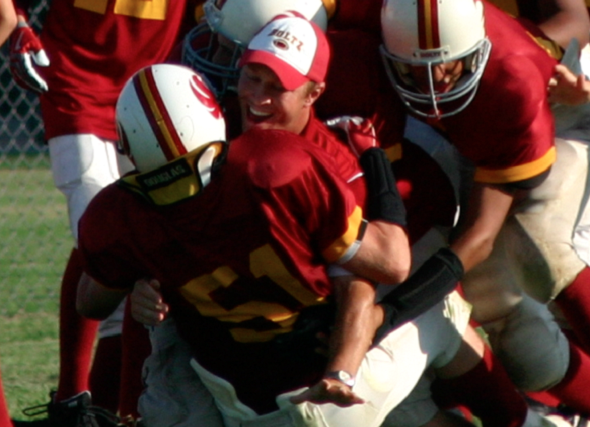
PHOTO: Scott Westfall celebrates with his football team while serving as a coach at Boltz Middle School in Fort Collins, Colo.

NFHS Voice: Leadership Continues at NADC
December 17, 2019
By Karissa Niehoff
NFHS Executive Director
In the history of high school sports, the early 1970s will always be remembered first and foremost for the passage of Title IX in 1972 – legislation that sparked the growth of girls sports in the United States.
A year earlier, however, the National Federation of State High School Associations made a decision that has impacted education-based athletics in an equally significant manner.
Recognizing the future growth of the high school athletic directors profession, the NFHS started the National Conference of High School Directors of Athletics in February 1971. A total of 355 athletics directors attended the first conference in St. Louis, followed by another 257 at the December 1971 gathering in Columbus, Ohio.
The national conference for high school athletic directors has been held annually in December since that time, and on Friday, December 13, at the Gaylord National Resort and Convention Center in National Harbor, Maryland, more than 2,100 athletic administrators were scheduled to convene for the 50th National Athletic Directors Conference (NADC).
The growth of the high school athletic administration profession as well as the NADC was additionally fueled in 1977 when the NFHS formed the National Interscholastic Athletic Administrators Association (NIAAA), a national professional organization for high school athletic directors. Membership in the NIAAA expanded rapidly and, in 2006, it became its own organization. Since that time, the NFHS – the national leader and advocate for high school athletics and performing arts – and the NIAAA have worked together annually to sponsor the NADC.
Without a doubt, athletic directors are the leaders of education-based athletics in our nation’s high schools. They have an endless list of responsibilities and set the tone for the overall success of a school’s athletics and/or activities program.
In recent releases of “The NFHS Voice,” we have noted the significant role that athletic directors play with regard to the educational direction of a school’s athletic program, as well as ensuring that security measures are in place for after-school events.
Unlike national conferences for some groups, professional development is among the main reasons that athletic directors attend this annual conference. They know that they are entrusted with key leadership roles and want to provide a safe and fun experience for student-athletes in their schools.
This year, 40 workshops were offered on key issues related to athletic directors' tasks, including coaching coaches, social media, effective communication, managing fan behavior, event management, generating new sources of revenue, creating positive parent culture and promoting multi-sport participation.
In addition, the NIAAA offered 52 Leadership Training classes, on topics from legal issues, to marketing and promotions, to managing fields and equipment, to working with students with disabilities.
Very simply, high school athletic directors are the key leaders in our nation’s education-based athletic programs. Local schools depend on these individuals to lead their athletics programs. Our member state high school associations depend on these men and women to help lead state events and initiatives. And the NFHS and NIAAA look to athletic administrators for leadership at the national level. We appreciate the tremendous service they provide our nation’s young people!
Dr. Karissa L. Niehoff is in her second year as executive director of the National Federation of State High School Associations (NFHS) in Indianapolis, Indiana. She is the first female to head the national leadership organization for high school athletics and performing arts activities and the sixth full-time executive director of the NFHS, which celebrated its 100th year of service during the 2018-19 school year. She previously was executive director of the Connecticut Association of Schools-Connecticut Interscholastic Athletic Conference for seven years.