


Coaches Must Set the Example
October 15, 2012
By Scott Westfall
MSU Institute for the Study of Youth Sports
NOTE: This is part one of a two-part viewpoint explaining the importance of coaches and parents setting proper examples for young athletes in their treatment of game officials.
 In light of the recent uproar over NFL replacement officials, it seems that never before has it been so common and socially accepted to yell disgust at referees.
While this trend is prevalent in both professional and college football, it has unfortunately trickled down into the high school ranks. What is actually accomplished when a coach or fan yells at an official? Do people really believe that if they become irate, a ‘bad call’ will be erased? In all of my years watching, playing, and coaching athletics, not once have I seen a referee change his or her ruling because a coach or a fan yelled at him or her.
When adults lose control and scream at referees, who does this bad behavior really affect? Since youth learn their emotional control from adult leaders, I believe the true damage is done to the young minds that are witnessing their mentors lose their cool. After their display of anger, how can these same adults hope for kids to stay calm when things do not go their way in life? It is pure hypocrisy to expect otherwise.
Whether we like it or not, referees are the absolute authority in athletic contests; they control the game from start to finish, make the tough calls on the playing surface, and even decide who gets to stay and who is sent to the locker room. Yet, it is baffling how often their authority is disrespected.
It is the coach’s responsibility to establish his or her program as one that respects authority. Since players watch all of the moves their coaches make, it is imperative that coaches respect the officials – especially when the calls do not go their way. If a player sees his or her coach going berserk due to a ‘bad call,’ the same player will think it is OK to act like this down the road when upset or faced with adversity. Even more detrimental to these kids is hearing their coach preach a message but contradict it by not backing it up with actions.
Great high school coaches will use the playing surface as an extension of their classroom. In my years as a head coach, I tried my hardest to set a good example for my players and told them to never question, back-talk, or disrespect an official. However, I made the mistake of breaking my own rule on one occasion by questioning the referee’s judgment.
When I was a younger coach, I may have attributed my actions to the heat of the moment, or defended myself on the criteria that I was trying to stick up for my team. However, being a veteran leader who wanted to practice what I preached, I saw my mistake as a teaching moment.
The next practice, when we conducted team discipline conditioning, “Reminders” (usually reserved for players with unacceptable school behavior or poor grades), I asked my players what I had taught them about respecting authority and if I had broken my own rule. The players agreed that I had broken my rule and had not respected the referee.
I let them know that this rule applied to me as much as them. I then lined-up on the goal line and ran my own set of wind sprints as the players, assistant coaches, and managers watched in disbelief. Afterward, to even my surprise, several players thanked me for holding myself accountable.
One kid even had tears in his eyes, and said that after watching my self-imposed discipline, he wanted more than ever to be a man of his word and do the right thing.
Scott Westfall has spent the last 10 years as a teacher, coach, and athletic director in Fort Collins, Colo. He currently is working on his Doctorate at Michigan State University, with an emphasis in Sport Psychology and Athletic Administration, and assisting the MHSAA with its student leadership programs. Westfall is a former athlete who participated in football, wrestling, tennis and cross country at the high school level, and rugby at the collegiate level. He can be reached at [email protected].
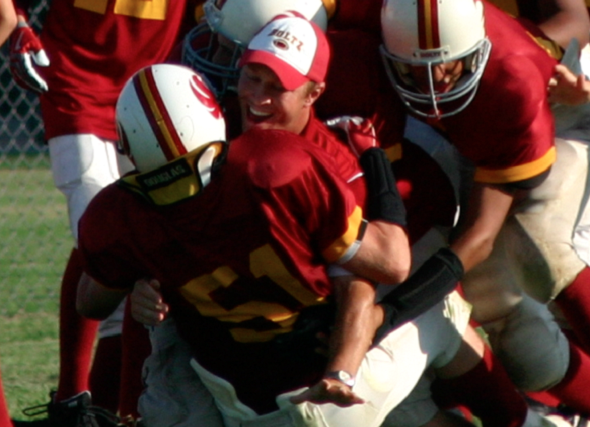
PHOTO: Scott Westfall celebrates with his football team while serving as a coach at Boltz Middle School in Fort Collins, Colo.
Century of School Sports: 200+ Representatives Fill All-Time Council Roster
By
Geoff Kimmerly
MHSAA.com senior editor
May 6, 2025
When Plymouth-Canton Community Schools superintendent Monica Merritt attended her first meeting as a member of the MHSAA’s Representative Council on March 21 in East Lansing, she became the 203rd voting member to serve on the association’s legislative body since the first Council convened Dec. 13, 1924.
We covered how the Council is comprised in our Dec. 3 installment – “MHSAA Work Guided by Representative Council.” Briefly, the Council is the 19-member legislative body of the MHSAA. All but five members are elected by member schools. Four members are appointed by the Council to facilitate representation of females and minorities, and the 19th position is occupied by the Superintendent of Public Instruction or designee.
During a typical school year, the Council meets three times, and convened for the third time for 2024-25 this past Sunday and Monday in Gaylord.
The first Representative Council included 11 members, from Ann Arbor, Battle Creek, Detroit, Eaton Rapids, Escanaba, Flint, Grand Rapids, Ishpeming, Otsego, Petoskey and Saginaw. While it’s difficult to say how many high schools specifically have been represented over the years – for example, Detroit Public Schools as a district has one representative, and there are multiple statewide positions – it’s accurate to say at least 130 communities (made of one or more schools) have sent at least one delegate over the last century.
Total, 54 Council members have served at least a decade, and 11 of those 54 have served at least 20 years: Detroit’s George Mead (1930-62) and Roy Allen (1976-96), Gwinn’s Leo P. McDonald (1930-52), Saginaw’s Roy J. McMurray (1932-50, 1952-57), Escanaba’s Dan Flynn (1988-2010), Grand Haven's Scott Grimes (2001-24), Deerfield, Beal City, Hartford and Cheboygan’s Paul Ellinger (1985-2007); Gaylord, Benzonia and Bear Lake’s Karen Leinaar (2000-2021); Clare, Maple City and Sanford Meridian’s William Newkirk (1988-2007), Trenton and Gibraltar Carlson’s Eric Federico (1986-94, 1996-2009) and current director of physical education and athletics for the Archdiocese of Detroit Vic Michaels, who has represented non-public schools on the Council since 2003.
A total of 17 Council members have served multiple terms but not entirely consecutively, with Petoskey’s Robert Doctor the only one with two breaks; he was on the Council from 1972-80, 1988-90 and 1994-95. As noted by his 32 years above, Mead was on the Council longest, representing Detroit Public Schools during his tenure as health and physical education director.
At least eight Council members have represented multiple schools, including current member Fred Smith, who has served a combined 15 years over two tenures while employed at Comstock, Buchanan, Benton Harbor and currently Bangor.
Michigan Department of Education representatives are not counted in the totals above as they are non-voting members – but they has provided an invaluable viewpoint during Council proceedings over the years. The current MDE representative on Council is Ross Fort, who serves as special assistant to the deputy superintendent.
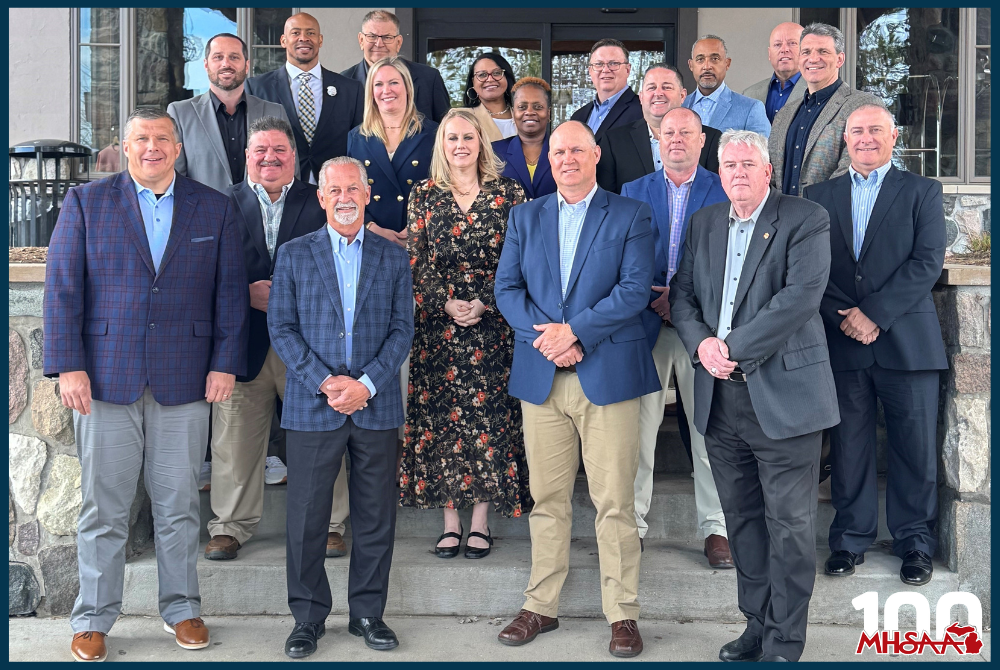
The photo above was taken Monday morning. Front row, from left, are MHSAA executive director Mark Uyl, Michaels (who also serves as Council secretary/treasurer), Midland athletic director and Council president Eric Albright, and Brighton athletic director and Council vice president John Thompson.
Second row, from left, are Gobles athletic director Chris Miller, Freeland Middle School principal Jennifer Thunberg, Kingsford athletic director Chris Hartman and Camden-Frontier superintendent Chris Adams.
Third row, from left: Boyne City High School principal Adam Stefanski, Harbor Springs athletic director Anna Novak, Wyoming Godfrey-Lee Public Schools superintendent Arnetta Thompson, Mt. Morris athletic director Jeff Kline and Fenton High School principal Mike Bakker.
Back row, from left: Westland John Glenn athletic director Jason Malloy, Smith, Merritt, Fort, Detroit Public Schools executive director of athletics Jay Alexander and Calumet assistant principal Sean Jacques. (Portage Northern athletic director Chris Riker is not pictured.)
Previous "Century of School Sports" Spotlights
April 29: MHSAA Programs Prioritize Health & Safety - Read
April 23: Patches Signify Registered Officials' Role in MHSAA Story - Read
April 16: Student Advisory Council Gives Voice to Athletes - Read
April 9: State's Storytellers Share Spring Memories - Read
April 2: Sharp Leadership Synonymous with MHSAA Success - Read
March 25: Athletic Directors Indispensable to Mission of School Sports - Read
March 18: 2025 Finals Begin Next Half-Century of Girls Hoops Championships - Read
March 11: Boys Basketball's Best 1st to Earn MHSAA Finals Titles - Read
March 5: Everything We Do Begins with Participation - Read
Feb. 25: Slogans & Logos Remain Unforgettable Parts of MHSAA History - Read
Feb. 19: MHSAA Tickets Continue to Provide Fan-Friendly Value - Read
Feb. 11: We Recognize Those Who Make Our Games Go - Read
Feb. 4: WISL Conference Continues to Inspire Aspiring Leaders - Read
Jan. 28: Michigan's National Impact Begins at NFHS' Start - Read
Jan. 21: Awards Celebrate Well-Rounded Educational Experience - Read
Jan. 14: Predecessors Laid Foundation for MHSAA's Formation - Read
Jan. 9: MHSAA Blazes Trail Into Cyberspace - Read
Dec. 31: State's Storytellers Share Winter Memories - Read
Dec. 17: MHSAA Over Time - Read
Dec. 10: On This Day, December 13, We Will Celebrate - Read
Dec. 3: MHSAA Work Guided by Representative Council - Read
Nov. 26: Finals Provide Future Pros Early Ford Field Glory - Read
Nov. 19: Connection at Heart of Coaches Advancement Program - Read
Nov. 12: Good Sports are Winners Then, Now & Always - Read
Nov. 5: MHSAA's Home Sweet Home - Read
Oct. 29: MHSAA Summits Draw Thousands to Promote Sportsmanship - Read
Oct. 23: Cross Country Finals Among MHSAA's Longest Running - Read
Oct. 15: State's Storytellers Share Fall Memories - Read
Oct. 8: Guided by 4 S's of Educational Athletics - Read
Oct. 1: Michigan Sends 10 to National Hall of Fame - Read
Sept. 25: MHSAA Record Books Filled with 1000s of Achievements - Read
Sept. 18: Why Does the MHSAA Have These Rules? - Read
Sept. 10: Special Medals, Patches to Commemorate Special Year - Read
Sept. 4: Fall to Finish with 50th Football Championships - Read
Aug. 28: Let the Celebration Begin - Read