


Leadership: A Skill that can be Taught
January 30, 2013
 By Jed Blanton
MSU Institute for the Study of Youth Sports
At the MHSAA and the ISYS, in the milieu of work we conduct centered on understanding and developing leadership in young athletes, there is one definition that seems to govern our approach and serve as a foundation for the research questions and training clinics that follow it.
Penned by Peter Northouse, that definition states “leadership is a process, whereby an individual influences a group of individuals to achieve a common goal.”
Choosing to frame ‘leadership’ as a process, rather than as some personality characteristic destined only for those naturally-born leaders, allows the concept of leadership to be utilized and taught as a skill, or set of skills. If a coach can agree with the philosophy that leadership can be learned, we can begin to design a series of strategies to enhance leadership in our young athletes.
First, I’m going to discuss what most coaches already know about teaching skills. Teaching skills is essentially an effort of behavior modification. A coach sometimes is able to choose athletes who already possess a certain level of competency within the skills necessary for their sport; sometimes coaches must work with whoever shows up on the first day of practice.
In either case, coaches tend to conduct a subconscious assessment of skills that must be learned (that they must teach), whether complex strategies or mere fundamentals. When teaching athletic skills to young people, coaches must break down the multitude of steps involved.
Think about a lay-up in basketball or the high jump in track & field. Either skill itself is actually a combination of several skills, and the ability to pay attention to very specific cues in the environment. Coaches teach the approach, the proper hand/arm placement, the essential cues to focus on, and the follow-through. Coaches can devote segments or entire practices to particular skills – breaking down all the steps, creating drills to practice the steps, and offering the full practice of the skill in a competition-like environment.
During this episode of developing a skill in our athletes, to get them to perform in a very specific way, our interactions often mirror what behavioral psychology has known for decades: People respond to reinforcements and punishments. Coaches positively reinforce their athletes with compliments, clapping hands, and congratulations. Our words and actions shape how the individual learning the skill makes adjustments to receive more praise.
These shifts of their body and miniscule changes in their actions to get to the desired behavior of their instructor are “learning.” Similarly, coaches often threaten punishment of extra sprints or difficult drills to give athletes a clue as to what behaviors they should avoid. Often, something as simple as a disapproving glance can be reinforcing enough to change whatever behavior the athlete shouldn’t be practicing. The simple “good job” or the threat of sprints essentially shapes how our athletes behave athletically.
This same approach can work toward leadership development.
What would it look like for a coach to reinforce and punish athletes toward leadership development in the same vein they develop athletic skills? If coaches could determine what three or four behaviors they’d like their athlete leaders to showcase, and then positively reinforce those skills with compliments and thanks, and potentially punish athletes with disapproving glances or even lectures after practice, leadership can be learned like any other athletic skill.
Phil Jackson, the multiple championship-winning NBA coach, has been quoted saying he would try to give two compliments for every criticism with his professional teams. The Positive Coaching Alliance – a national nonprofit organization that strives to educate coaches on ways to enhance the youth sport experience – suggests a ratio of five positive comments to every negative criticism. Research has consistently shown that people respond better and more rapidly to positive reinforcement than to punishment.
All too often, coaches wait for leaders to emerge, rather than teach the leadership they desire. Imagine if coaches waited for players to figure out the offensive plays and strategies instead of teaching players where to move, how to move, and why they are moving there. Adopting a similar approach with your athlete has the potential to expedite the behaviors you’d most ideally want them to possess. Using tactics of positive reinforcement can help these young players to become excellent leaders in a shorter period of time than merely hoping someone steps up.
I’ll leave you with a simple list of suggestions of how coaches can teach leadership, just like they teach any other necessary athletic skill.
- Develop goals with your athletes regarding leadership. What kinds of things do your athletes value or feel would help the team? How can they practice leading their teammates in that way?
- Develop your own goals toward teaching leadership. What would it look like if a coach made it a goal to compliment three players on specific leadership behaviors each practice? Think about the ultimate team captain for your team, and develop strategies to teach your players how to be that captain.
- Break down leadership skills into smaller and easier to practice chunks, just like an athletic skill. Then create an environment where the athletes can practice these skills. By organizing your team into smaller groups, or even partners, you can assign leadership roles within each group. Asking certain players to lead various parts of practice (stretches, lay-ups, circuit training), you are giving them a sense of ownership over their athletic experiences and responsibility over their teammates.
- Positively reinforce the desired behaviors. How would it make a player feel if their coach pulled them aside and thanked them for their specific leadership behavior after a practice or game? A “job well done” or an approving thank you can go a long way in making a young athlete feel they are developing into the leader you desire them to be.
Blanton is a doctoral candidate at Michigan State University in the department of Kinesiology, specializing in the PsychoSocial Aspects of Sport and Physical Activity, and a research assistant for MSU's Institute for the Study of Youth Sports. He has served as a facilitator at MHSAA Captains Clinics the last three years and currently is assisting the association with its student leadership programs.
Century of School Sports: These Record-Setters Were Nearly Impossible to Defeat
By
Geoff Kimmerly
MHSAA.com senior editor
May 13, 2025
Most days, across Michigan high school sports and athletics at every level, a rare big-time upset is going to grab a bigger headline over yet another win by a usual favorite that comes out on top all the time.
But today, we’re going to celebrate teams that have made winning something of a daily routine over long stretches during the MHSAA’s 100-year run.
For the majority of head-to-head team sports, the MHSAA tracks winning streaks and lists the longest in their respective record books. And while all making those lists are impressive, the longest seem almost inconceivable.
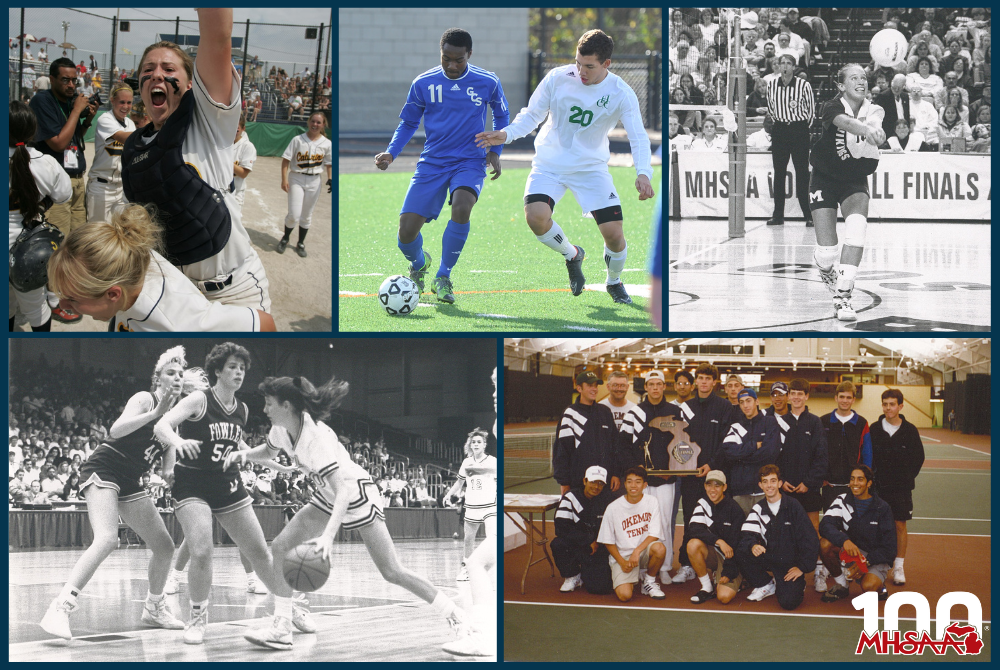
Let’s start with the 192-match winning streak by Marysville from Dec. 10, 1996, through Jan. 15. 2000, the longest by number of victories. That incredible run made up most of the first half of an also incredible eight-straight Class B Finals championship seasons for the Vikings. Three others volleyball teams have won at least 92 straight matches, but none more than 98.
Traverse City Central girls tennis’ 107-dual match winning streak from 1989-2000 is the longest by length of time, and the only other to reach triple digits for total wins – with a seven-year, 71-match run by the Okemos boys tennis team from 1990-97 also reaching toward nearly a decade of similar success.
Several more have approached the 100-consecutive-win milestone. Hudsonville Unity Christian girls soccer won 86 straight games from 2005-08, and actually was 97-0-1 over those four seasons. The Allen Park Cabrini softball team won 80 straight games during the 2006-08 seasons, the Powers North Central boys basketball team won 84 straight games between 2014-17, and Orchard Lake St. Mary’s baseball team became our latest winning streak record-setter with 84 straight victories from May 1, 2021 through May 3, 2023.
Okemos is the one of only two schools with two record winning streaks, having also won 64 straight girls lacrosse games from March 21, 2009, through May 3, 2011. The other is North Central, which also won 41 straight 8-player football games between Sept. 18, 2020, and Sept. 15 2023, with many of the same athletes who played on the record-setting boys basketball team.
Also from the Upper Peninsula, Carney-Nadeau’s girls basketball teams of 1989-91 held on to their record of 78 consecutive wins despite a 76-victory pursuit by Pittsford from 2015-18. Bloomfield Hills Brother Rice won the first 13 Division 1 boys lacrosse championships, and the early years of that run included a 29-game winning streak during the 2008 and 2009 seasons.
The record holders in boys soccer and 11-player football require a little bit of explanation. While Genesee Christian owns the boys soccer winning streak record of 33 from 2015 and beginning of the 2016 season, Detroit Country Day easily outpaces the rest for longest unbeaten streak in that sport having gone 69-0-10 between 1991-94.
Hudson football also remains legendary for its record streaks of 72 straight wins (including playoffs) from 1968-1975 and 81 straight during the regular season from 1968-1977 – although that playoff era streak included only one playoff win, as the Tigers won their Semifinal in 1975 but fell to Ishpeming in the inaugural Class C title game. The longest football playoff streak built entirely during the playoff era belongs to Ithaca, which won 69 straight games beginning with its opener in 2010 and ending in the 2014 Division 6 championship game as the Yellowjackets pursued what would have been a fifth-straight title in that division.
The lack of winning streak lists in wrestling and ice hockey are a noticeable gaps in this collection. Those lists hopefully will be constructed in the future.
Previous "Century of School Sports" Spotlights
May 6: 200+ Representatives Fill All-Time Council Roster - Read
April 29: MHSAA Programs Prioritize Health & Safety - Read
April 23: Patches Signify Registered Officials' Role in MHSAA Story - Read
April 16: Student Advisory Council Gives Voice to Athletes - Read
April 9: State's Storytellers Share Spring Memories - Read
April 2: Sharp Leadership Synonymous with MHSAA Success - Read
March 25: Athletic Directors Indispensable to Mission of School Sports - Read
March 18: 2025 Finals Begin Next Half-Century of Girls Hoops Championships - Read
March 11: Boys Basketball's Best 1st to Earn MHSAA Finals Titles - Read
March 5: Everything We Do Begins with Participation - Read
Feb. 25: Slogans & Logos Remain Unforgettable Parts of MHSAA History - Read
Feb. 19: MHSAA Tickets Continue to Provide Fan-Friendly Value - Read
Feb. 11: We Recognize Those Who Make Our Games Go - Read
Feb. 4: WISL Conference Continues to Inspire Aspiring Leaders - Read
Jan. 28: Michigan's National Impact Begins at NFHS' Start - Read
Jan. 21: Awards Celebrate Well-Rounded Educational Experience - Read
Jan. 14: Predecessors Laid Foundation for MHSAA's Formation - Read
Jan. 9: MHSAA Blazes Trail Into Cyberspace - Read
Dec. 31: State's Storytellers Share Winter Memories - Read
Dec. 17: MHSAA Over Time - Read
Dec. 10: On This Day, December 13, We Will Celebrate - Read
Dec. 3: MHSAA Work Guided by Representative Council - Read
Nov. 26: Finals Provide Future Pros Early Ford Field Glory - Read
Nov. 19: Connection at Heart of Coaches Advancement Program - Read
Nov. 12: Good Sports are Winners Then, Now & Always - Read
Nov. 5: MHSAA's Home Sweet Home - Read
Oct. 29: MHSAA Summits Draw Thousands to Promote Sportsmanship - Read
Oct. 23: Cross Country Finals Among MHSAA's Longest Running - Read
Oct. 15: State's Storytellers Share Fall Memories - Read
Oct. 8: Guided by 4 S's of Educational Athletics - Read
Oct. 1: Michigan Sends 10 to National Hall of Fame - Read
Sept. 25: MHSAA Record Books Filled with 1000s of Achievements - Read
Sept. 18: Why Does the MHSAA Have These Rules? - Read
Sept. 10: Special Medals, Patches to Commemorate Special Year - Read
Sept. 4: Fall to Finish with 50th Football Championships - Read
Aug. 28: Let the Celebration Begin - Read
PHOTOS Clockwise from top left: Allen Park Cabrini catcher Amanda Chidester celebrates her team's 2007 softball championship. (2) Genesee Christian's Caleb DuPree (11) controls possession as Kalamazoo Hackett Catholic Prep's Kawika Singson pursues during their 2015 championship match. (3) Shaleene Glombowski sets for Marysville during the 1998 Class B Final. (4) The 1995 Okemos boys tennis team takes a photo after clinching another Finals championship. (5) Carney-Nadeau's Jill Wetthuhn drives against Fowler during the 1990 Class D Final.