

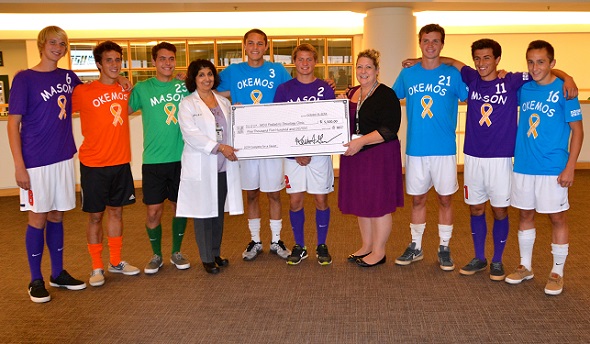
Mason, Okemos Score for a Cure
By
Geoff Kimmerly
MHSAA.com senior editor
November 11, 2014
Three weeks remain in the MHSAA’s 2014 fall season, and we’ve collected a few notes to pass along as we wind down the final three sports before moving inside (except for skiing) for the winter.
 Below are an update on a fundraising game we previewed earlier, plus recognition for perfection at our Girls Golf Finals and another high honor for one of the top players in MHSAA volleyball history.
Score for a cure
We wrote in September about an upcoming soccer game between Lansing-area powers that would raise money for pediatric cancer research. The “Compete for a Cause” game between Okemos and Mason on Sept. 13 was the third of what has become an annual event started by Mason’s team and coaching staff.
Attendance for this season’s game was nearly double the year before, and funds raised increased more than 500 percent.
The final tally: Roughly 1,400 fans attended the game, which raised $11,000 that was split between the CureSearch for Children’s Cancer national foundation and the Michigan State University Pediatric Oncology Clinic.
The first “Compete” game in 2012 raised $1,000, and the 2013 game drew 800 fans and raised about $2,000. This fall, Okemos was ranked No. 1 in Division 1 and Mason No. 7 in Division 2 when the game was played; it ended in a 1-1 tie. Both went on to postseason success – Okemos advanced to a Regional Final, and Mason fell to eventual Division 2 champion East Lansing in overtime in their Semifinal.
Only one shot needed
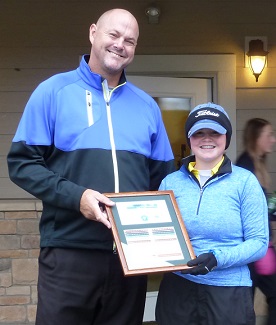 It’s a rarity – most of the time. But for the second straight season, a player at the MHSAA Lower Peninsula Girls Golf Finals sunk a hole-in-one.
Grosse Pointe South’s Lucy Buzolitz aced the par-3 No. 12 at Bedford Valley in Battle Creek, dropping the shot from 97 yards out during the first round of Division 1 play. Buzolitz was one of two individual qualifiers from her team and shot a 92-97-189 for the two-day tournament.
At the 2013 Division 2 Final, Fenton then-sophomore Madison Shegos aced the par-3 18th hole at Michigan State University’s Forest Akers East.
Sportswoman of the Year
Former Leland and Penn State University volleyball standout and current U.S. national team setter Alisha Glass was a finalist for 2014 Team Sportswoman of the Year at the 35th Salute to Women in Sports gala in October in New York City.
The event, put on by the Women’s Sports Foundation, annually recognizes a Sportswoman of the Year for both individual and team sports based on nominations by sport governing bodies and the public. Glass was one of 10 candidates this year for the team award after being named USA Volleyball Indoor Female Athlete of the Year in 2013. She also was named International Federation of Volleyball’s best setter at the 2014 World Championship in Italy after helping the United States to the title.
Olympic gold medal-winning ice dancer Meryl Davis received the Sportswoman of the Year team award, while the individual award when to gymnastics all-around world champion Simone Biles.
PHOTOS: (Top) Members of the Mason and Okemos boys soccer teams present a check for $5,500 to the MSU Pediatric Oncology Clinic and Dr. Renuka Gera last month. (Middle) Lucy Buzolitz receives a plaque recognizing her hole-in-one at the Division 2 Golf Final from Bedford Valley head pro Dean Kolstad.
Concussion Care: Signs & Symptoms to Watch
October 27, 2020

Henry Ford Health System
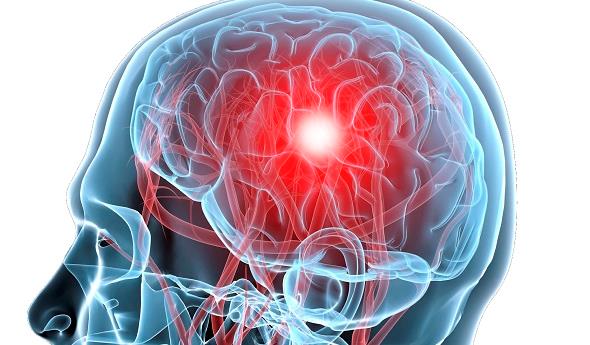
When you experience a blow to the head, knowing whether you've suffered a concussion isn't always clear cut.
Head injuries have a range of physical, psychological and intellectual effects — and only a small number of people lose consciousness.
"It's critical for parents, coaches, players and trainers to recognize the potential signs and symptoms of a concussion," says Jeffrey Kutcher, M.D., a sports neurologist who treats athletes at the Henry Ford Kutcher Clinic for Concussion and Sports Neurology. "The basic rule is that a concussion can affect any aspect of brain function."
Signs of Concussion
The Latin root of the word "concussion" means "to shake violently" — which makes sense. Concussions happen when there's a combination of movement and impact. So, any injury that involves a hit to the head — a fall, collision or hard hit by a heavy object — could cause one. So could a hit to the body that causes the head to move quickly.
"But every brain injury is different," Dr. Kutcher says. "Some symptoms show up right away while others develop gradually over days."
Here are common concussion symptoms to watch for — both immediately following a head injury and in the hours and days after:
Physical Concussion Symptoms
- Changes in sleep patterns
- Difficulty with balance
- Dizziness or lightheadedness
- Fatigue
- Headache
- Light sensitivity
- Nausea
- Numbness or tingling
- Sensitivity to sound
- Visual problems
- Vomiting
Emotional Concussion Symptoms
- Anxiety
- Depression
- Irritability
- Mood swings
Cognitive Concussion Symptoms
- Confusion
- Difficulty concentrating
- Feeling "slow" or "foggy"
- Memory problems
Diagnosing Concussion: Getting It Right
One reason concussions are frequently misdiagnosed is because they're assessed on the field or courtside during game play or practice. Coaches, trainers and parents often make lightning fast decisions about whether symptoms, such as headache, nausea and light sensitivity, are signs of concussion.
"Unfortunately, it’s more complicated than completing a concussion checklist. Everyone — and every concussion — is different. So, observers shouldn’t be diagnosing a head injury on the spot, but rather making a triage decision for safety. They should leave the diagnosis to the medical professionals," Dr. Kutcher says. In fact, those in-the-moment assessments are wrong about half of the time.
People should focus instead on getting immediate, emergency care for anyone who displays the following signs and symptoms right after a hit:
- Difficulty walking
- Weakness on one or both sides
- Not waking up
- Repeated vomiting
- Persistent confusion
- Seizures
- Unconsciousness
No matter how hard (or lightly) you think you've been hit, it's important to take head injury symptoms seriously. Even a seemingly minor blow could have a major impact. A complete evaluation by a medical professional will not only determine whether you have a concussion, it can also identify more serious, or even life-threatening, concerns.
"In every case, medical professionals are better equipped to assess the extent of the damage if you have a comprehensive baseline evaluation on file," Dr. Kutcher says. This thorough evaluation with a sports neurologist, including a complete family and neurological history, can act as a critical point of reference when trainers and medical professionals are trying to diagnose or manage a concussion.
Dr. Jeffrey Kutcher is a sports neurologist and the medical director of the Henry Ford Kutcher Clinic for Concussion and Sports Neurology.
Want to learn more? Henry Ford Health System sports medicine experts are treating the whole athlete, in a whole new way. From nutrition to neurology, and from injury prevention to treatment of sports-related conditions, they can give your athlete a unique game plan.
Visit henryford.com/sports or call (313) 972-4216 for an appointment within 24 business hours.