

Mason, Okemos Score for a Cure
By
Geoff Kimmerly
MHSAA.com senior editor
November 11, 2014
Three weeks remain in the MHSAA’s 2014 fall season, and we’ve collected a few notes to pass along as we wind down the final three sports before moving inside (except for skiing) for the winter.
 Below are an update on a fundraising game we previewed earlier, plus recognition for perfection at our Girls Golf Finals and another high honor for one of the top players in MHSAA volleyball history.
Score for a cure
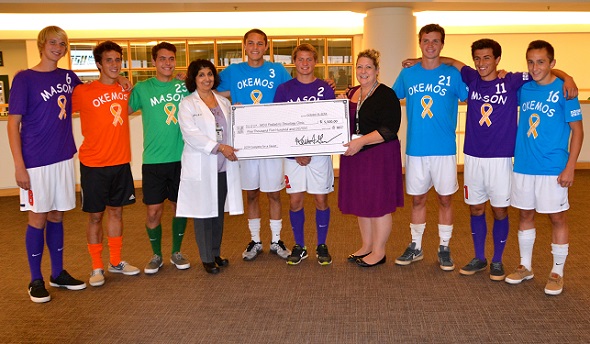
We wrote in September about an upcoming soccer game between Lansing-area powers that would raise money for pediatric cancer research. The “Compete for a Cause” game between Okemos and Mason on Sept. 13 was the third of what has become an annual event started by Mason’s team and coaching staff.
Attendance for this season’s game was nearly double the year before, and funds raised increased more than 500 percent.
The final tally: Roughly 1,400 fans attended the game, which raised $11,000 that was split between the CureSearch for Children’s Cancer national foundation and the Michigan State University Pediatric Oncology Clinic.
The first “Compete” game in 2012 raised $1,000, and the 2013 game drew 800 fans and raised about $2,000. This fall, Okemos was ranked No. 1 in Division 1 and Mason No. 7 in Division 2 when the game was played; it ended in a 1-1 tie. Both went on to postseason success – Okemos advanced to a Regional Final, and Mason fell to eventual Division 2 champion East Lansing in overtime in their Semifinal.
Only one shot needed
 It’s a rarity – most of the time. But for the second straight season, a player at the MHSAA Lower Peninsula Girls Golf Finals sunk a hole-in-one.
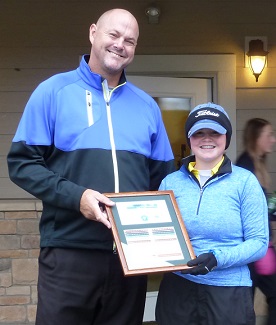
Grosse Pointe South’s Lucy Buzolitz aced the par-3 No. 12 at Bedford Valley in Battle Creek, dropping the shot from 97 yards out during the first round of Division 1 play. Buzolitz was one of two individual qualifiers from her team and shot a 92-97-189 for the two-day tournament.
At the 2013 Division 2 Final, Fenton then-sophomore Madison Shegos aced the par-3 18th hole at Michigan State University’s Forest Akers East.
Sportswoman of the Year
Former Leland and Penn State University volleyball standout and current U.S. national team setter Alisha Glass was a finalist for 2014 Team Sportswoman of the Year at the 35th Salute to Women in Sports gala in October in New York City.
The event, put on by the Women’s Sports Foundation, annually recognizes a Sportswoman of the Year for both individual and team sports based on nominations by sport governing bodies and the public. Glass was one of 10 candidates this year for the team award after being named USA Volleyball Indoor Female Athlete of the Year in 2013. She also was named International Federation of Volleyball’s best setter at the 2014 World Championship in Italy after helping the United States to the title.
Olympic gold medal-winning ice dancer Meryl Davis received the Sportswoman of the Year team award, while the individual award when to gymnastics all-around world champion Simone Biles.
PHOTOS: (Top) Members of the Mason and Okemos boys soccer teams present a check for $5,500 to the MSU Pediatric Oncology Clinic and Dr. Renuka Gera last month. (Middle) Lucy Buzolitz receives a plaque recognizing her hole-in-one at the Division 2 Golf Final from Bedford Valley head pro Dean Kolstad.

NFHS Voice: Planning with Patience
May 30, 2020
By Karissa Niehoff
NFHS Executive Director
For several weeks, Americans have been awaiting answers to several questions. When will restaurants restart dine-in services? When will hair salons and gyms be open? When will people be able to congregate for worship services? And, of course, when will education-based sports and performing arts programs return?
And the answer to the all-important last question is the same as the first three – it varies from state to state.
If there was ever any doubt about the popularity and interest in high school sports and performing arts – and how much these programs have been missed during the past three months – it was erased last week as the NFHS released its Guidance for Opening Up High School Athletics and Activities document.
The response was non-stop through the mainstream media as well as our social media platforms as the first nationwide discussion about the return of high school sports and other activities was in full swing.
Since that disappointing week in mid-March when it seemed like all of life came to a halt, millions of people – from high school students, coaches, parents, administrators, officials and fans – have been looking forward to the return of school-based sports and other activity programs. And the guidance document offered some hope that soon the light at the end of tunnel will not be the oncoming train we have felt for many weeks.
Now, state high school associations are developing timetables and protocols for return of activities in their states. And those guidelines will be different from state to state. This is not a one-size-fits-all plan. Depending on the specific circumstances of a state with respect to the containment of the virus, its progression through the various phases of returning to activities could be much different than another state.
As the guidance document developed by the NFHS Sports Medicine Advisory Committee noted, our hope is that students can return to school-based athletics and activities in any and all situations where it can be done smartly. When it comes to education-based sports and performing arts within our nation’s schools, nothing is more important than the health and safety of the participants AND the individuals conducting those programs.
Some individuals have expressed concern that our guidance document is too cautious, noting that some non-school youth programs have already restarted in some areas.
In one state this past week, a non-school sports program was allowed to restart because the “data shows children are less affected by the coronavirus.” While the preponderance of evidence shows that to be true, plans in education-based activities will include also protection for adults who coach, officiate and administer those events, which may be seen as a more conservative approach.
Within high school sports, the drive of coaches and dreams of parents cannot run ahead of player safety. Last week, a successful high school football coach with three previous state titles was suspended for allegedly holding practices. And there have been reports of parents considering moving to another state with fewer COVID-19 cases to enhance the chance of their son playing football and earning a college scholarship.
The NFHS, through its Sports Medicine Advisory Committee, took action in developing its Guidance for Opening Up High School Athletics and Activities document. The various state high school associations are taking action in the coming weeks in developing plans for a return to activities at the state level.
Now, we would ask parents and other fans to take action – and that action is patience. The urge to return to normal is understandable, but the path back to where we were three months ago will take time, and that “time” will not happen at the expense of the safety and well-being of everyone involved in high school sports and performing arts programs.
Dr. Karissa L. Niehoff is in her second year as executive director of the National Federation of State High School Associations (NFHS) in Indianapolis, Indiana. She is the first female to head the national leadership organization for high school athletics and performing arts activities and the sixth full-time executive director of the NFHS, which celebrated its 100th year of service during the 2018-19 school year. She previously was executive director of the Connecticut Association of Schools-Connecticut Interscholastic Athletic Conference for seven years.