

Mason, Okemos Score for a Cure
By
Geoff Kimmerly
MHSAA.com senior editor
November 11, 2014
Three weeks remain in the MHSAA’s 2014 fall season, and we’ve collected a few notes to pass along as we wind down the final three sports before moving inside (except for skiing) for the winter.
 Below are an update on a fundraising game we previewed earlier, plus recognition for perfection at our Girls Golf Finals and another high honor for one of the top players in MHSAA volleyball history.
Score for a cure
We wrote in September about an upcoming soccer game between Lansing-area powers that would raise money for pediatric cancer research. The “Compete for a Cause” game between Okemos and Mason on Sept. 13 was the third of what has become an annual event started by Mason’s team and coaching staff.
Attendance for this season’s game was nearly double the year before, and funds raised increased more than 500 percent.
The final tally: Roughly 1,400 fans attended the game, which raised $11,000 that was split between the CureSearch for Children’s Cancer national foundation and the Michigan State University Pediatric Oncology Clinic.
The first “Compete” game in 2012 raised $1,000, and the 2013 game drew 800 fans and raised about $2,000. This fall, Okemos was ranked No. 1 in Division 1 and Mason No. 7 in Division 2 when the game was played; it ended in a 1-1 tie. Both went on to postseason success – Okemos advanced to a Regional Final, and Mason fell to eventual Division 2 champion East Lansing in overtime in their Semifinal.
Only one shot needed
 It’s a rarity – most of the time. But for the second straight season, a player at the MHSAA Lower Peninsula Girls Golf Finals sunk a hole-in-one.
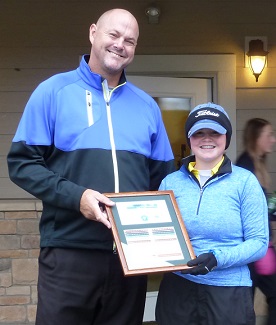
Grosse Pointe South’s Lucy Buzolitz aced the par-3 No. 12 at Bedford Valley in Battle Creek, dropping the shot from 97 yards out during the first round of Division 1 play. Buzolitz was one of two individual qualifiers from her team and shot a 92-97-189 for the two-day tournament.
At the 2013 Division 2 Final, Fenton then-sophomore Madison Shegos aced the par-3 18th hole at Michigan State University’s Forest Akers East.
Sportswoman of the Year
Former Leland and Penn State University volleyball standout and current U.S. national team setter Alisha Glass was a finalist for 2014 Team Sportswoman of the Year at the 35th Salute to Women in Sports gala in October in New York City.
The event, put on by the Women’s Sports Foundation, annually recognizes a Sportswoman of the Year for both individual and team sports based on nominations by sport governing bodies and the public. Glass was one of 10 candidates this year for the team award after being named USA Volleyball Indoor Female Athlete of the Year in 2013. She also was named International Federation of Volleyball’s best setter at the 2014 World Championship in Italy after helping the United States to the title.
Olympic gold medal-winning ice dancer Meryl Davis received the Sportswoman of the Year team award, while the individual award when to gymnastics all-around world champion Simone Biles.
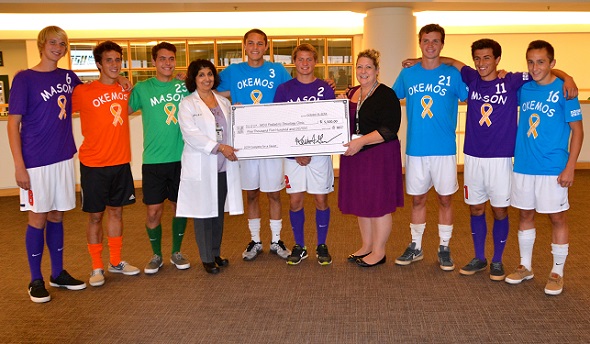
PHOTOS: (Top) Members of the Mason and Okemos boys soccer teams present a check for $5,500 to the MSU Pediatric Oncology Clinic and Dr. Renuka Gera last month. (Middle) Lucy Buzolitz receives a plaque recognizing her hole-in-one at the Division 2 Golf Final from Bedford Valley head pro Dean Kolstad.
Minding Our Business: Focus on Mental Health
December 30, 2019
By Mark Uyl
MHSAA Executive Director
For as long as I can remember, rules have played an important role in my life.
My father officiated high school and youth sports. So my brother and I did the same, and were fortunate enough to earn the right to work contests at the collegiate level. Today, my sons are officiating high school and youth sports.
I was hired by the MHSAA as an assistant director in large part due to my officiating background. Rules and regulations remain the backbone of athletics specifically, and society in general, as I learned more acutely when I entered the working world as a teacher and coach, then school administrator.
What also became abundantly clear to me within that framework was that it is our responsibility to provide our students not only the opportunity for competition, but also for our games and practices to take place under the safest conditions possible. From preseason physicals to equipment inventory and facility maintenance, a premium was placed on the well-being of participants and spectators.
Throughout my time at the MHSAA, various initiatives continued to target the growing list of health and safety concerns. My predecessor, Jack Roberts, often pointed to the “4 Hs” of the MHSAA’s health and safety campaign: Health Histories (Physicals), Heat and Hydration, Heads, and Hearts. Those pillars still hold the bulk of the content and resources on the Health & Safety resource pages of MHSAA.com. A few years ago, an extensive section promoting multi-sport participation was developed as an increasing amount of overuse injuries among single-sport athletes was being reported.
This fall, another section has been added as a sub-category to “Heads.” While attending an NCAA meeting in the summer of 2017, the topic of concussions came up, which I assumed to be the No. 1 issue concerning health and safety of student-athletes. It was quickly pointed out that student mental health – not concussions – had become the top health concern among our young people. That knocked me back.
Medical personnel have determined that depression, anxiety and other issues related to mental health are the No. 1 concern among adolescent-age children. There’s a real opportunity to provide some leadership and guidance in this area.
We need to offer resources on the subject, and also be prepared to provide guidance for our membership. The MHSAA has developed a Mental Health Speakers Bureau (please visit our Health & Safety page online). The first statewide Student Mental Health Summit scheduled for Lansing in October provided an opportunity for school principals, counselors, student leadership advisers and student leaders to convene on the topic.
The gathering was quickly sold out, indicating not only the growing nature of concern for this issue, but once again displaying the willingness of our educational leaders to recognize and react to another challenge.
This week, Second Half will publish the latest benchmarks report on the MHSAA’s mental health initiatives and those being undertaken by other states as well.