

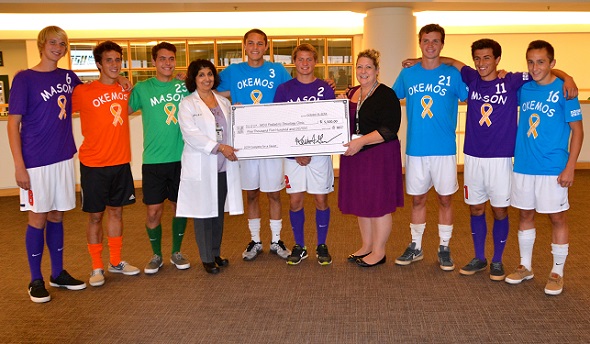
Mason, Okemos Score for a Cure
By
Geoff Kimmerly
MHSAA.com senior editor
November 11, 2014
Three weeks remain in the MHSAA’s 2014 fall season, and we’ve collected a few notes to pass along as we wind down the final three sports before moving inside (except for skiing) for the winter.
 Below are an update on a fundraising game we previewed earlier, plus recognition for perfection at our Girls Golf Finals and another high honor for one of the top players in MHSAA volleyball history.
Score for a cure
We wrote in September about an upcoming soccer game between Lansing-area powers that would raise money for pediatric cancer research. The “Compete for a Cause” game between Okemos and Mason on Sept. 13 was the third of what has become an annual event started by Mason’s team and coaching staff.
Attendance for this season’s game was nearly double the year before, and funds raised increased more than 500 percent.
The final tally: Roughly 1,400 fans attended the game, which raised $11,000 that was split between the CureSearch for Children’s Cancer national foundation and the Michigan State University Pediatric Oncology Clinic.
The first “Compete” game in 2012 raised $1,000, and the 2013 game drew 800 fans and raised about $2,000. This fall, Okemos was ranked No. 1 in Division 1 and Mason No. 7 in Division 2 when the game was played; it ended in a 1-1 tie. Both went on to postseason success – Okemos advanced to a Regional Final, and Mason fell to eventual Division 2 champion East Lansing in overtime in their Semifinal.
Only one shot needed
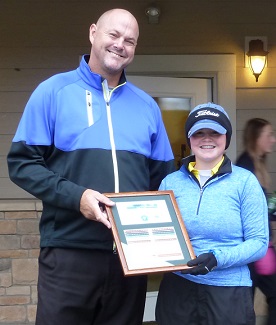 It’s a rarity – most of the time. But for the second straight season, a player at the MHSAA Lower Peninsula Girls Golf Finals sunk a hole-in-one.
Grosse Pointe South’s Lucy Buzolitz aced the par-3 No. 12 at Bedford Valley in Battle Creek, dropping the shot from 97 yards out during the first round of Division 1 play. Buzolitz was one of two individual qualifiers from her team and shot a 92-97-189 for the two-day tournament.
At the 2013 Division 2 Final, Fenton then-sophomore Madison Shegos aced the par-3 18th hole at Michigan State University’s Forest Akers East.
Sportswoman of the Year
Former Leland and Penn State University volleyball standout and current U.S. national team setter Alisha Glass was a finalist for 2014 Team Sportswoman of the Year at the 35th Salute to Women in Sports gala in October in New York City.
The event, put on by the Women’s Sports Foundation, annually recognizes a Sportswoman of the Year for both individual and team sports based on nominations by sport governing bodies and the public. Glass was one of 10 candidates this year for the team award after being named USA Volleyball Indoor Female Athlete of the Year in 2013. She also was named International Federation of Volleyball’s best setter at the 2014 World Championship in Italy after helping the United States to the title.
Olympic gold medal-winning ice dancer Meryl Davis received the Sportswoman of the Year team award, while the individual award when to gymnastics all-around world champion Simone Biles.
PHOTOS: (Top) Members of the Mason and Okemos boys soccer teams present a check for $5,500 to the MSU Pediatric Oncology Clinic and Dr. Renuka Gera last month. (Middle) Lucy Buzolitz receives a plaque recognizing her hole-in-one at the Division 2 Golf Final from Bedford Valley head pro Dean Kolstad.
This Week in High School Sports: 12/4/18
December 4, 2018
This week's show features new officials filling a need in Michigan's southeastern region, awards game balls to Marquette's boys basketball team and Hudson's girls and boys bowling teams, discusses the extended basketball sideline coaching box in "Be The Referee" and closes with thoughts from a pair of notable college coaches on what they're seeking when recruiting the high school ranks.
The 5-minute program, powered by MI Student Aid, leads off each week with feature stories from around the state from the MHSAA’s Second Half or network affiliates. "Be The Referee," a 60-second look at the fine art of officiating, comes in the middle of the show and is followed by a closing MHSAA "Perspective."
Listen to this week's show by Clicking Here.
Past editions
November 27: Defensive performances from 11-Player Football Finals, notable experiences at Ford Field - Listen
November 20: 8-player football champions Morrice and Rapid River, power of giving thanks - Listen
November 13: Port Huron Northern football, broadcasting one of the busiest championship weekends of the MHSAA school year - Listen
November 6: Three-time cross country champs, MIS as LP XC Finals home - Listen
October 30: Calumet football, changes to the MHSAA Transfer Rule - Listen
October 23: Jackson High football, "Football Week in Michigan" - Listen
October 16: Selection Sunday football primer, past playoff expansion - Listen
October 9: Pickford football, teams that finished undefeated, untied and unscored upon on the gridiron - Listen
October 2: Grand Rapids official Dolly Konwinski, "You’ve Got To Be Kidding Me" on a federal court case made by the parents of a kid who didn’t make the cut - Listen
September 25: Bronson volleyball's Kiera Lasky, the real blue-chip participants in high school sports - Listen
September 18: Hanover-Horton runner Judy Rector, countering a growing shortage of high school game officials - Listen
September 11: Alpena soccer coach Tim Storch, balancing interests of all high school athletes - Listen
September 4: Radio stations celebrating 77 years of high school sports broadcasts, and radio's importance in educational athletics - Listen
August 28: Forest Hills Central football's Tate Hallock, keeping perspective amid changing times - Listen
August 21: Lansing Everett football coach Mike Smith, MHSAA executive director transition - Listen