


More States Begin Mental Health Efforts
January 2, 2020
Editor’s Note: This is part of a series on NFHS News addressing the challenges of mental health issues in high school athletics. This article explores one statewide approach to this important subject.
Suicide is a serious public health problem. It is the second-leading cause of death of high school-aged individuals in the United States. (National Vital Statistics Report 2016 Data Published by the CDC July 2018)
In Oregon, the suicide rate is higher than the national average, and a recent survey of 11th-graders found that within the past year, 18 percent seriously considered suicide and 7 percent attempted suicide. (Youth Suicide Annual Report 2017 & Oregon Healthy Teens Survey 2017)
More concerning is the fact that the rate of completed suicides in youth has been increasing since 2011. Not only does suicide lead to a life lost much too early, it leaves a devastating impact on those left behind.
Fortunately, suicides are preventable. The Oregon Youth Suicide Intervention and Prevention Plan was created calling for “Zero Suicide ... through collective action among health and behavioral health systems, schools, communities, parents and other systems that touch the lives of youth.” (Youth Suicide Annual Report 2017) For numerous reasons, schools are being used as the primary means of dissemination and implementation of suicide prevention interventions.
One group of school personnel that had not been traditionally considered in school-based efforts are school activities personnel: coaches, athletic trainers and athletic administrators. These individuals spend a great deal of time with students, developing relationships that may go beyond what a student typically has with a teacher.
 Coaches, athletic trainers and athletic administrators are in the ideal position to recognize behavioral warning signs or be the point person for students to go to if they have concerns about a peer. This is vital as youth considering suicide often talk about suicide and exhibit behaviors and/or moods associated with increased suicide risk. Additionally, activities personnel are school leaders who are often known and trusted by parents, thus creating more opportunities for dialogue on suicide prevention.
Realizing the impact youth suicide has on school communities and the prevention opportunities that exist, the leadership of the Oregon School Activities Association (OSAA), the Oregon Athletic Coaches Association, the Oregon Athletic Directors Association and the Oregon Athletic Trainers’ Society partnered to promote the role of high school activities personnel in preventing youth suicide. While these groups had multiple means of reaching out to the intended audience, the leadership realized help was needed from experts for a statewide education campaign to be successful. The Suicide Intervention Coordinator for the Oregon Health Authority (the state agency charged with overseeing Oregon’s health-related programs) was contacted and agreed to assist in developing a statewide educational campaign geared to activities personnel.
The Campaign
It was determined that a series of articles geared specifically to activities personnel would be written by the Oregon Health Authority and then disseminated by the OSAA throughout the academic year.
The articles typically contained two pages of practical information and tips. The campaign was not designed to replace a formal suicide gatekeeper training; rather, it served to promote awareness of the role activities personnel play in countering the rising problem. The articles and additional resources were also posted to the OSAA website.
The OSAA Foundation provided funding for a poster that was provided to schools to be placed in locker rooms, team rooms, athletic training rooms and other areas where students congregate. The primary goal of the poster was to provide students with contact information for crisis lines.
Toward the end of the campaign, workshops were presented by a representative from the American Foundation for Suicide Prevention at the Oregon Athletic Directors Association’s annual statewide conference. The goal was to provide information on programs and policies that athletic administrators could implement at their schools.
While the campaign only spanned the 2017-18 academic year, the leadership of the stakeholder groups believed there was still more that could be done. In 2018-19, a campaign on anti-hazing and anti-bullying (which is a risk factor for suicide) was implemented using a similar approach as the suicide prevention campaign.
In addition, the groups coordinated a high school coaches’ symposium that included breakout sessions on suicide prevention, hazing prevention and character education.
Lessons Learned
Individuals who work with students involved with high school activity programs realize the power and opportunities which exist for positive character development. The focus of this campaign was to highlight a significant and growing public health problem – youth suicide. The goal of the campaign was to increase awareness and provide appropriate resources – not to create experts in suicide prevention.
The collaborative nature of this campaign strengthened the relationships between the different groups working together with a specific purpose. The groups have now partnered on several additional campaigns – the aforementioned anti-hazing/anti-bullying campaign and promoting the development of Emergency Action Plans.
The campaign also allowed the groups to work closely with state public health officials. While the OSAA had previously partnered with state public health officials regarding air quality policies and a guidance document for medical providers on pre-participation physical exams, this campaign provided several new and distinct advantages.
State public health officials were able to see the positive impact of participation in high school activity programs beyond just the activity itself – namely the positive mentorship relationships that may develop. They were also impressed by the large audience the campaign reached and the feedback provided (due to the expansive network of activities administrators, coaches and athletic trainers that the OSAA reaches). Ideally, this will spur additional collaborations in the future.
A major challenge for schools and school personnel is the competing demands for time and resources for the many worthy interventions and activities. Unfortunately, it is impossible to commit to all interventions and activities that may benefit students. While there was a monetary cost for the posters to be distributed to schools, development of the actual campaign articles and presentations were done by individuals as part of their job related to suicide prevention, so the campaign was relatively inexpensive. Since it was distributed throughout the year, it did not require a large time commitment from activities personnel and the monthly articles kept the issue front and center.
Conclusion
The statewide Youth Suicide Awareness Campaign is just one example of how the unique role of school activities personnel can be leveraged and how stakeholder organizations and state public health agencies can maximize their impact and reach through collaboration. While we will continue to review suicide incidence in Oregon during the coming years, the campaign is seen as a success at this point. It has strengthened relationships between the involved entities, and it promoted the role of coaches, athletic trainers and athletic administrators as mentors and trusted individuals to make an impact that extends beyond wins and losses.
— Sam Johnson, Rob Younger, Peter Weber, NFHS News, March 12, 2019
Colorado Institutes Mental Health Requirement
In a major step aimed at improving mental health of students across Colorado high schools, the CHSAA Board of Directors approved as a requirement that all coaches take a course on student mental health.
It is among the major topics facing high school students today. According to the U.S. Department of Health & Human Services, 31 percent of high school students reported symptoms of depression in 2017, and 17 percent reported they seriously considered attempting suicide.
 So, starting this fall, all coaches must take a course “Student Mental Health and Suicide Prevention” on the NFHS Learning Center, or a district-led mental health training. The NFHS Learn course is free.
In order to be a registered coach, this requirement must be satisfied. Unregistered coaches are not permitted to coach, per CHSAA bylaws. Other required courses or training are based around concussion, first aid, mandatory reporting, and the CHSAA coaches course.
“CHSAA’s vision is to deconstruct the stereotypes around mental health and help start the conversations that need to happen around our kids,” said CHSAA commissioner Rhonda Blanford-Green. “The mental and physical well-being of our student participants is our priority.”
The decision was made with the full support of the Sports Medicine Advisory Committee (SMAC), which discussed the topic at length during its meeting last school year.
“The committee was focused on finding great tools that we can give to our schools and coaches to help provide awareness around mental health, which is among the most important issues our students face,” said Jenn Roberts-Uhlig, the CHSAA staff liaison to SMAC. “We believe it is important for coaches to not be afraid to look for the signs and symptoms of a student who is struggling with their mental health, and this training will provide valuable instruction in how to do that.”
— Ryan Casey/CHSAA, June 27, 2019
Century of School Sports: 'The Mitten' Becomes Sought-After Symbol of MHSAA Greatness
By
Geoff Kimmerly
MHSAA.com senior editor
June 10, 2025
The MHSAA championship trophy – often referred to as “The Mitten” – has become perhaps one of the most iconic and enduring symbols of this organization over the last 25 years, most frequently greeting visitors strolling past a school’s trophy case or serving as the centerpiece of celebration photos over the final month of every sport season.
More than 2000 MHSAA trophies are presented to teams every school year, the great majority to District, Regional and Finals champions at the high school level.
There actually have been several versions of MHSAA trophies awarded over the last century – probably more than we can tell about, since our knowledge of the first 30-40 years especially is reliant on photos of winning teams holding their awards, and trophies that have been returned to us after a school has closed or those artifacts have made their ways into yard sales or second-hand stores.
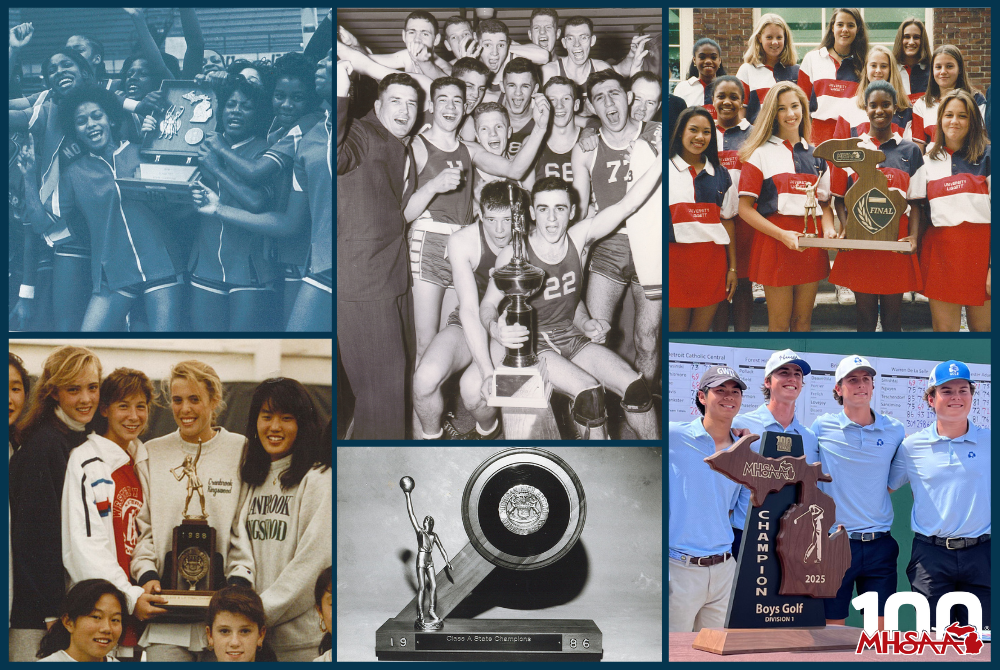
 Our early trophies take on a few specific designs – there are traditional cups, later columns affixed to bases with inscriptions celebrating champions, or metal statuettes representing their respective sports. Later versions incorporated a combination of those features, for example a square or rectangular wooden plaque affixed to a base with a statuette (or two, or even three) decorating the trophy. The 1974-75 version was especially notable; celebrating the 50th year of the MHSAA, those trophies included a large county map of Michigan and the state seal.
During the mid-1980s, the MHSAA made another move to a unique design among its trophies – a circular award affixed to a base by a wooden arm at a 45-degree angle. Then came a return to a more traditional squared-off pedestal and statue before the 1989-90 move to a triangular plaque – which in theory could be hung up in a trophy case as something of a space-saver. But that idea didn’t seem to gain traction – which in part led to the creation of the inaugural version of “The Mitten” awarded today.
That first rendition made its debut during the 1992-93 school year. What started out as an artistic wooden representation of the state’s peninsulas evolved at the start of 2009-10 into the current more map-accurate version of the state’s land masses affixed to a black background. The only noticeable change since has been the addition this 100-anniversary year of a medal at the top celebrating that milestone.
How beloved has “The Mitten” become?
During the 2008-09 school year, our students let us know. With the MHSAA Trophy & Medal Committee deliberating on a possible two design – and two proposals that did not include the wooden state version in the mix – then-Executive Director Jack Roberts presented the possibilities to the MHSAA’s Student Advisory Council.
In resounding fashion, the Advisory Council said keep “The Mitten” – and it remains the symbol of achievement for thousands of MHSAA Tournament champs every school year.
Previous "Century of School Sports" Spotlights
June 3: MHSAA's Move to TV, Now Internet, 60 Years Old & Growing - Read
May 27: Upper Peninsula Helps Make Michigan's School Sports Story Unique - Read
May 20: From Nearly A to Z, Schools Repped by 221 Nicknames - Read
May 13: These Record-Setters were Nearly Impossible to Defeat - Read
May 6: 200+ Representatives Fill All-Time Council Roster - Read
April 29: MHSAA Programs Prioritize Health & Safety - Read
April 23: Patches Signify Registered Officials' Role in MHSAA Story - Read
April 16: Student Advisory Council Gives Voice to Athletes - Read
April 9: State's Storytellers Share Spring Memories - Read
April 2: Sharp Leadership Synonymous with MHSAA Success - Read
March 25: Athletic Directors Indispensable to Mission of School Sports - Read
March 18: 2025 Finals Begin Next Half-Century of Girls Hoops Championships - Read
March 11: Boys Basketball's Best 1st to Earn MHSAA Finals Titles - Read
March 5: Everything We Do Begins with Participation - Read
Feb. 25: Slogans & Logos Remain Unforgettable Parts of MHSAA History - Read
Feb. 19: MHSAA Tickets Continue to Provide Fan-Friendly Value - Read
Feb. 11: We Recognize Those Who Make Our Games Go - Read
Feb. 4: WISL Conference Continues to Inspire Aspiring Leaders - Read
Jan. 28: Michigan's National Impact Begins at NFHS' Start - Read
Jan. 21: Awards Celebrate Well-Rounded Educational Experience - Read
Jan. 14: Predecessors Laid Foundation for MHSAA's Formation - Read
Jan. 9: MHSAA Blazes Trail Into Cyberspace - Read
Dec. 31: State's Storytellers Share Winter Memories - Read
Dec. 17: MHSAA Over Time - Read
Dec. 10: On This Day, December 13, We Will Celebrate - Read
Dec. 3: MHSAA Work Guided by Representative Council - Read
Nov. 26: Finals Provide Future Pros Early Ford Field Glory - Read
Nov. 19: Connection at Heart of Coaches Advancement Program - Read
Nov. 12: Good Sports are Winners Then, Now & Always - Read
Nov. 5: MHSAA's Home Sweet Home - Read
Oct. 29: MHSAA Summits Draw Thousands to Promote Sportsmanship - Read
Oct. 23: Cross Country Finals Among MHSAA's Longest Running - Read
Oct. 15: State's Storytellers Share Fall Memories - Read
Oct. 8: Guided by 4 S's of Educational Athletics - Read
Oct. 1: Michigan Sends 10 to National Hall of Fame - Read
Sept. 25: MHSAA Record Books Filled with 1000s of Achievements - Read
Sept. 18: Why Does the MHSAA Have These Rules? - Read
Sept. 10: Special Medals, Patches to Commemorate Special Year - Read
Sept. 4: Fall to Finish with 50th Football Championships - Read
Aug. 28: Let the Celebration Begin - Read