


NFHS Voice: Coaches, ADs Keys to Success
December 3, 2019
By Karissa Niehoff
NFHS Executive Director
This fall, one school canceled the remainder of its football season after reports of hazing surfaced. There have been several incidents of high school student-athletes using racial slurs against members of the opposing teams. As we have noted previously, there have also been multiple reports of parents verbally and – in some cases – physically abusing officials, along with several cases of coaches allegedly running up scores. And then there was the bizarre case of a suspended player appearing in a game disguised as another player.
On the positive side, there was a cross country runner who stopped at the one-mile mark of a race to assist a competing runner who had collapsed and was unresponsive. He didn’t finish the race, but he saved the life of the competing runner.
After the completion of a recent football game, one player on the winning team found his friend on the other team who had just lost his mother to cancer to comfort and pray with him. There have also been cases of schools helping other schools that were hit with tragedies, such as the fires in California.
And earlier this year a high school golfer who, after signing her scorecard, noticed on the app that her partner had entered an incorrect score for her on one hole. She could have kept quiet and retained her top-10 finish, and most likely no one would have noticed. Instead, she reported the error and was disqualified. She later was honored by her school for doing the right thing.
Fortunately, there are far more good acts of sportsmanship that happen in high school athletics and activity programs; however, the unsportsmanlike displays tend to make more headlines and sometimes overshadow the great things that are occurring.
The key individuals in schools who are responsible for making education the central theme of the athletic program are the athletic directors and coaches. If coaches are more committed to helping student-athletes become responsible citizens than helping them perfect an athletic skill, and if athletic directors are committed to an education-based philosophy, the likelihood of unsportsmanlike incidents such as those mentioned above is minimal.
What’s the measure of success for a high school coach – winning 80 percent of the games, bringing home multiple state championships, being named coach of the year several times? As long as success on the fields or courts is done in accordance with an education-based philosophy, this would be an award-winning biographical sketch.
The win-loss record aside, however, how about also considering the consistent teaching of values, character and lifelong lessons that would place his or her teams in consideration for sportsmanship awards and his or her student-athletes on the paths to successful lives after high school?
The NFHS has several free online education courses to assist coaches and athletic directors in leading an effective education-based program. “Engaging Effectively with Parents,” “Sportsmanship” and “Bullying, Hazing and Inappropriate Behaviors” are among the many courses at www.NFHSLearn.com. In addition, “Fundamentals of Coaching” is the core course that every interscholastic coach should complete.
When a school district is looking to hire a high school athletic director or coach, we would suggest finding someone more committed to an education-based philosophy than hardware in the trophy case.
Dr. Karissa L. Niehoff is in her second year as executive director of the National Federation of State High School Associations (NFHS) in Indianapolis, Indiana. She is the first female to head the national leadership organization for high school athletics and performing arts activities and the sixth full-time executive director of the NFHS, which celebrated its 100th year of service during the 2018-19 school year. She previously was executive director of the Connecticut Association of Schools-Connecticut Interscholastic Athletic Conference for seven years.
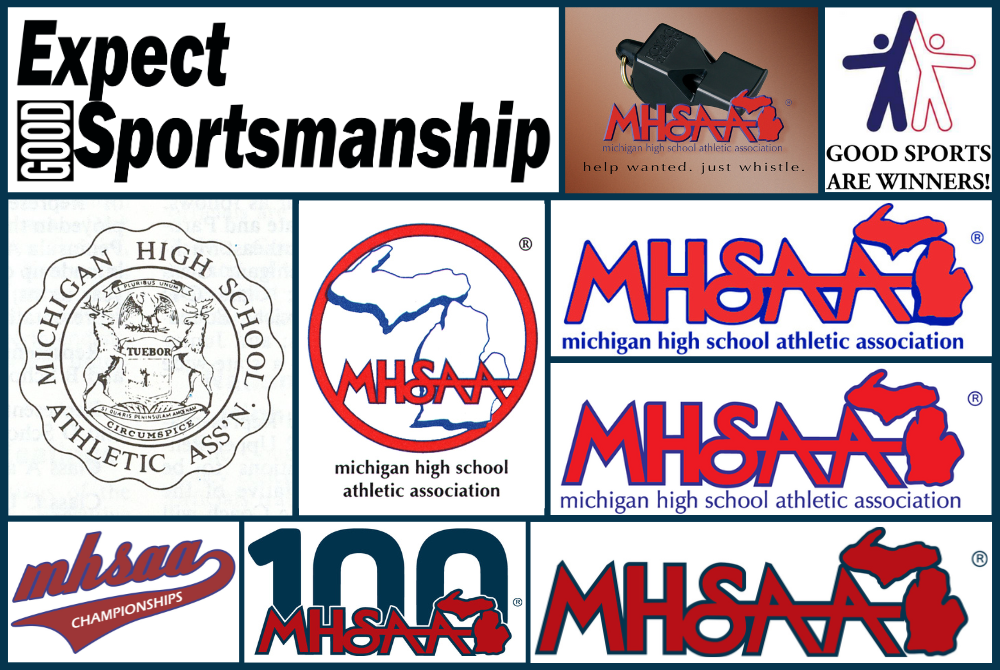
Century of School Sports: Slogans & Logos Remain Unforgettable Parts of MHSAA History
By
Geoff Kimmerly
MHSAA.com senior editor
February 25, 2025
Logos and slogans are meant to stick in your mind – and the MHSAA has created several that have become synonymous with the story of school sports.
When was the first time you saw the MHSAA logo? For me, it was on a ticket to watch my school at the 1993 Girls Basketball Semifinals at Kellogg Arena.
And I thought “Good Sports Are Winners” was just something everybody said about all things sportsmanship. I had no idea it headlined as the first of now several memorable MHSAA statements meant to do precisely what it did inside my teenage head – bury itself in our minds so we would hopefully recall the importance of being a good sport whenever we heard it.
The MHSAA’s “Century of School Sports” have really included only about a half-century of this type of messaging and branding. But no matter if you’ve spent your time with us as an athlete, coach, administrator, official, fan or a combination of those roles, some of what follows should jog your memory – and hopefully stir up plenty of good ones as well.
- Good Sports Are Winners!
Jack Roberts was hired as the MHSAA’s fourth full-time executive director in 1986. His first hire was John Johnson as one of, if not the first-of-a-kind communications director at a high school athletic association in the nation. One of their first undertakings was a campaign to improve sportsmanship – and “Good Sports Are Winners!” became their first and perhaps still most recognizable phrase.
- Sportsmanship Begins At Home
- We Need You To Be A Good Sport!
Sportsmanship is an idea that never graduates, but it also needs to be reintroduced frequently as generations of families make their ways through middle school to high school graduation. These were two more messages meant to encourage appropriate behavior at sporting events.
- Help Wanted: Just Whistle
- You Can Be A Referee
Recruiting and retaining game officials also is an annual drive, and these became part of the slogan-sphere over the last 15 years as those efforts increased due to decreasing numbers. “Be the Referee” became a weekly segment of the “This Week in High School Sports” five-minute show that airs on radio stations all over the state during the fall and winter seasons, and they always end with the call out “You Can Be A Referee” to enlist those who might be interested.
- We Are The MHSAA
This carried a certain boldness when read over the microphone at tournament events, and summed up neatly what being part of the MHSAA was all about. Paraphrasing: “We are … Coaches … administrators … and officials. … We are your school. We promote and protect the privilege of interscholastic competition. We make rules and follow them as a condition of membership. … We Are The MHSAA.”
- Promoting The Value – And Values – Of Educational Athletics
This sums up the MHSAA’s work and remains perhaps the favorite of all slogans used to describe it. We believe educational athletics have value – to participants, to their communities, and to society as a whole because of the adults they help produce. We also believe that educational athletics are reliant on specific values – sportsmanship, scholarship, safety and scope.
Those are the messages you’ve likely heard. But producing an identifiable image with the MHSAA and its work has been just as important – and below are explanations behind some of the familiar logos you see at the top of this page.
- First Logo: A Traditional Emblem (Last Used in 1987-88)
The first MHSAA logo featured the seal from the state flag, with “Michigan High School Athletic Association” surrounding it. It appeared on medals and official documents through the 1987-88 school year.
- The Round Logo: A Recognizable Symbol
In 1988, the MHSAA introduced a circular logo featuring Michigan’s Upper and Lower Peninsulas within a red border, with "MHSAA" prominently displayed.
- The Championship Logo: A Mark of Excellence
During the early 2000s, the MHSAA introduced a “championship” logo initially for tournament merchandise. Over time, it became the standard for all championship-related materials.
- The Modern MHSAA Logo: Evolving with Time
Debuting in 1987 – and designed by a pair of Sterling Heights Stevenson students as part of a contest – the modern logo introduced the bold "MHSAA" lettering with an interwoven "S" designed to convey motion and energy. Over time, its contours softened while maintaining its distinctive look. Initially, "Michigan High School Athletic Association" appeared beneath it, but in recent years, the text was removed for a cleaner, more streamlined design.
- The Centennial Celebration Logo
To mark its 100th anniversary, the MHSAA introduced a centennial logo, honoring its history. This commemorative design reflects a century of commitment to student-athletes and school communities.
Previous "Century of School Sports" Spotlights
Feb. 19: MHSAA Tickets Continue to Provide Fan-Friendly Value - Read
Feb. 11: We Recognize Those Who Make Our Games Go - Read
Feb. 4: WISL Conference Continues to Inspire Aspiring Leaders - Read
Jan. 28: Michigan's National Impact Begins at NFHS' Start - Read
Jan. 21: Awards Celebrate Well-Rounded Educational Experience - Read
Jan. 14: Predecessors Laid Foundation for MHSAA's Formation - Read
Jan. 9: MHSAA Blazes Trail Into Cyberspace - Read
Dec. 31: State's Storytellers Share Winter Memories - Read
Dec. 17: MHSAA Over Time - Read
Dec. 10: On This Day, December 13, We Will Celebrate - Read
Dec. 3: MHSAA Work Guided by Representative Council - Read
Nov. 26: Finals Provide Future Pros Early Ford Field Glory - Read
Nov. 19: Connection at Heart of Coaches Advancement Program - Read
Nov. 12: Good Sports are Winners Then, Now & Always - Read
Nov. 5: MHSAA's Home Sweet Home - Read
Oct. 29: MHSAA Summits Draw Thousands to Promote Sportsmanship - Read
Oct. 23: Cross Country Finals Among MHSAA's Longest Running - Read
Oct. 15: State's Storytellers Share Fall Memories - Read
Oct. 8: Guided by 4 S's of Educational Athletics - Read
Oct. 1: Michigan Sends 10 to National Hall of Fame - Read
Sept. 25: MHSAA Record Books Filled with 1000s of Achievements - Read
Sept. 18: Why Does the MHSAA Have These Rules? - Read
Sept. 10: Special Medals, Patches to Commemorate Special Year - Read
Sept. 4: Fall to Finish with 50th Football Championships - Read
Aug. 28: Let the Celebration Begin - Read