


NFHS Voice: 'Commit' is Verb, not Noun
January 13, 2020
By Karissa Niehoff
NFHS Executive Director
When is “commit” not a verb? According to Webster’s never – that is, unless the reference is to where the high school’s star quarterback is headed to college.
Even in game stories, the “top” players on high school teams are often referred to as a “(name of college) commit.” It seems innocent enough, but the continual focus on a player’s advancement to the next level is concerning given the current – and future – landscape of college sports.
With the NCAA’s recent decision to allow athletes to earn compensation for their name, image and likeness, high school sports governed by the NFHS and its member state associations will be the last bastion of pure amateur competition in the nation. And it must remain that way.
The focus on the individual rather than the team that often grabs the headlines in college basketball and football cannot become a part of high school sports. In college basketball, there is constant discussion about who the “one and done” players will be. At the end of the season in college football, the talk is about which juniors are turning pro and which players are sitting out bowl games to guard against injury.
Although we recognize that this decision by the NCAA was perhaps inevitable as a result of the earlier “Fair Pay to Play Act” by California Governor Gavin Newsom, we are concerned that it will further erode the concept of amateurism in the United States.
While only about one percent of high school boys basketball players and about 2.8 percent of high school 11-player football players will play at the NCAA Division I level, the perks offered to attend certain colleges will be enhanced and recruiting battles could escalate. Current issues with parents pushing their kids into specialization in the fight for scholarships could intensify as they consider the “best offer” from colleges.
This weakening of the amateur concept at the college level must not affect the team-based concept in education-based high school sports. The age-old plan of colleges relying on high schools for their players will continue; however, high school coaches and administrators must guard against an individual’s pursuit of a college scholarship overriding the team’s goals.
As the new model develops at the college level, the education-based nature of high school sports must be preserved. These programs cannot become a training ground or feeder program for college sports.
Instead, the focus should be on the millions of high school student-athletes who commit (an action verb) to being a part of a team and gain untold benefits throughout their high school days. Some of these individuals will play sports at the college level and move on to their chosen careers; others will take those values of teamwork, discipline and self-confidence from the playing field directly into their future careers.
There is nothing more sacred and fundamental to the past – and future – history of high school sports in the United States than the concept of amateurism. It is up to the NFHS and its member state associations to ensure that education remains the tenet of high school sports.
Dr. Karissa L. Niehoff is in her second year as executive director of the National Federation of State High School Associations (NFHS) in Indianapolis, Indiana. She is the first female to head the national leadership organization for high school athletics and performing arts activities and the sixth full-time executive director of the NFHS, which celebrated its 100th year of service during the 2018-19 school year. She previously was executive director of the Connecticut Association of Schools-Connecticut Interscholastic Athletic Conference for seven years.
Flashback 100: One Last Look Back as We Turn Focus Toward Future
July 10, 2025
We hope you’ve enjoyed this school year's retrospective on some of the most iconic athletes and personalities who began their journeys in MHSAA sports. While we’ve done our best to highlight a diverse range of individuals across various sports and professions, a single year simply isn’t enough to capture every standout story.
Michigan high schools have produced an incredible array of talent — and the following, in addition to those we've wrote about over the last 10 monrths, are just another glimpse of that legacy:
- Kirk Gibson (Waterford Kettering) – The 1988 National League MVP also played a pivotal role in the Detroit Tigers’ 1984 World Series championship and starred in football as well at Michigan State.
- Jake Long (Lapeer East) – Selected as the NFL’s No. 1 overall draft pick in 2008, he's among a distinguished list of Michigan high school alums to go early in the draft, including Braylon Edwards (Harper Woods Bishop Gallagher, No. 3 in 2005), Carl Banks (Flint Beecher, No. 3 in 1984), Jerome Bettis (Detroit Mackenzie, No. 10 in 1993), and Tyrone Wheatley (Dearborn Heights Robichaud, No. 17 in 1995).
- Jeff Daniels (Chelsea) – Before becoming a renowned actor with credits like The Newsroom, Escanaba in da Moonlight, and Dumb and Dumber, Daniels was a high school baseball player.
- Lisa Byington (Portage Northern) – A trailblazing broadcaster, she serves as the play-by-play voice for the Milwaukee Bucks and regularly appears on CBS during NCAA Basketball Tournaments.
- Kristin Haynie (Mason) – She was first athlete to play in both the NCAA Women’s Division I Basketball Championship and the WNBA Finals in the same calendar year.
- Jalen Rose, Voshon Lenard, and Howard Eisley – This trio of NBA professionals once shared the court at Detroit Southwestern, making it one of the most talent-rich high school teams in state history.
- Jim Abbott (Flint Central) – Born without a right hand, Abbott defied the odds to pitch for 10 seasons in Major League Baseball.
- Earl Morrall (Muskegon) – He was named NFL MVP in 1968 and enjoyed a long and successful pro football career.
- Charlie Gehringer (Fowlerville) and Hal Newhouser (Detroit Wilbur Wright) – Both legends of Major League Baseball, each captured MVP honors during their Hall of Fame careers.
- Kate Markgraf (Detroit Country Day) – A champion at every level of soccer, she earned titles in high school and college, an Olympic Gold Medal, and a FIFA World Cup victory.
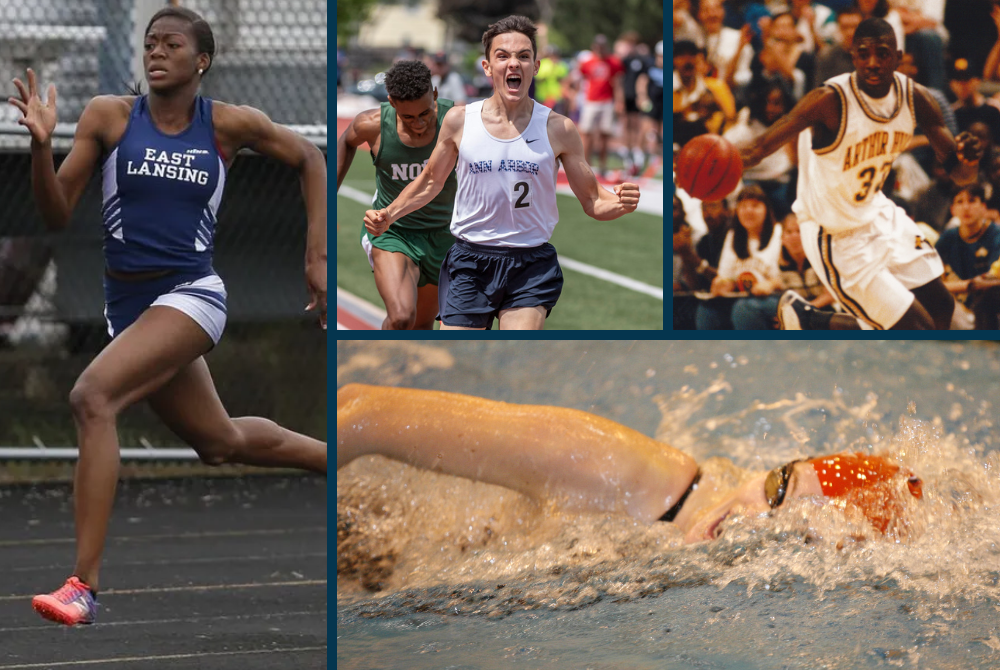
- Allison Schmitt (Canton) – One of the most decorated American swimmers of all time, Schmitt has earned 10 Olympic medals.
- Jason Richardson (Saginaw Arthur Hill) and Charles Rogers (Saginaw) – Both were drafted among the top five in their respective college sports (Richardson to the NBA in 2001, Rogers to the NFL in 2003) and faced off against each other as part of one of the state's most historic basketball rivalries.
- Staying with the city of Saginaw, Draymond Green (Saginaw) won a basketball championship in high school (2007) and then four in the NBA (2015, 2017, 2018, 2022) after being drafted in the second round of the 2012 draft by the Golden State Warriors.
And the legacy continues. Olympic gold medal dreams are alive in track & field standouts like Taylor Manson (East Lansing), Hobbs Kessler (Ann Arbor Skyline), and Grant Fisher (Grand Blanc), who are already well-accomplished on the worldwide stage.
So, who’s next?
Who will be the next MHSAA athlete selected on draft night? Hoisting an MVP trophy? Standing atop the podium as a champion?
We don’t know yet — but as we close the book on the first 100 years of MHSAA history, we can’t wait to see what the next century will bring.
Previous "Flashback 100" Features
June 23: Hutchinson's Dominance Starts as Multi-Sport Divine Child Standout - Read
June 10: Wagner's Dream of Going on Tour Realized - with Greta Van Fleet - Read
May 23: Tarpley's Legendary Run Began as Portage Central's Miss Soccer - Read
May 16: Scane’s Record-Setting Lacrosse Run Began at Cranbrook Kingswood - Read
May 8: Duckett's High School Domination Extended to Shot Put Circle - Read
May 6: MHSAA Titles Just Start for NCAA Champion, Olympian Stark - Read
May 1: Legendary Actor Played Multiple Sports Roles at Country Day - Read
April 23: Legacy Program Provided Start for Pioneering NBA Official Schroeder - Read
April 11: Rice's Championship-Winning Ways Started at Flint Northwestern - Read
March 28: Youngquist's Times Still Among MHSAA's Fastest - Read
March 18: After 40 Years, Coles' Shot Remains Among Century's Most Famous - Read
March 7: Walled Lake Northern's Hellebuyck Reigns as NHL's Elite Netminder - Read
Feb. 27: Zeerip's Mat Stats Remain Rarely-Challenged Chart Toppers - Read
Feb. 21: Before TV Stardom, Kerwin Excelled as All-State Skier - Read
Feb. 14: Detroit Central Star Voted into Pro Football Hall of Fame - Read
Feb. 6: Multi-Sport Star Look Becomes Super Bowl Officiating Legend - Read
Jan. 31: Johnson Family Put Magical Stamp on Michigan High School Hoops - Read
Jan. 24: Future Hall of Famers Face Off First in MHSAA Class A Final - Read
Jan. 17: First-Ever WNBA Draft Pick Rocked at Salem, Won Titles at Tennessee - Read
Jan. 10: Despite Launching Before 3-Point Line, Smith Still Tops Scoring List - Read
Jan. 3: Edison's Jackson Earns Place Among State's All-Time Elite - Read
Dec. 20: Future Olympian Piper Leads Grosse Pointe North to Historic Heights - Read
Dec. 13: The Other Mr. Forsythe in Michigan School Sports - Read
Dec. 6: Coleman's Legendary Heroics Carry Harrison Through Repeat - Read
Nov. 29: Harbaugh Brothers' Football Roots Planted in Part at Pioneer - Read
Nov. 22: 8-Player Football Finals Right at Home at Superior Dome - Read
Nov. 15: Leland Career Helps Set Stage for Glass' International Stardom - Read
Nov. 8: Future Baseball Pro Led Escanaba's Legendary Football Title Run - Read
Nov. 1: Michigan High School Baseball Trio Provide World Series Voices - Read
Oct. 25: Before Leading Free World, Ford Starred for Champion GR South - Read
Oct. 18: Mercy Links Legend Becomes World Golf Hall of Famer - Read
Oct. 11: Fisher Races to Finals Stardom on Way to U.S. Olympic First - Read
Oct. 4: Lalas Leaves High School Legacies on Ice & Pitch - Read
Sept. 27: Tamer's History-Making Run Starts in Dexter, Continues to Paris - Read
Sept. 20: Todd Martin’s Road to Greatness Starts at East Lansing - Read
Sept. 13: James Earl Jones, Dickson High Hoops to Hollywood Legend - Read
Sept. 6: Pioneers' Unstoppable Streak Stretches 9 Seasons - Read
Aug. 30: Detroit dePorres Rushes to 1995 Class CC Football Championship - Read
PHOTOS Clockwise from left: Taylor Manson sprints for East Lansing, Hobbs Kessler wins a race for Ann Arbor Pioneer, Jason Richardson plays in a Class A Basketball Final for Saginaw Arthur Hill and Allison Schmitt swims a championship race for Canton. (Manson photo courtesy of the Lansing State Journal; Kessler photo by RunMichigan.com. Others are MHSAA file photos.)