

NFHS Voice: Football's Promising Results
September 9, 2020
By Karissa Niehoff
NFHS Executive Director
Normally at this time of year, the NFHS releases the latest figures from its annual High School Athletics Participation Survey. One of the most important and successful endeavors in the organization’s history, the NFHS has collected participation data through its 51 member state associations annually since 1971.
Before the 2018-19 school year, the number of participants in high school sports had increased for 29 consecutive years. Despite the first decline last year since 1988, we anticipated a quick turnaround in 2019-20 because of the continued strength of education-based high school athletics programs across the country.
There were encouraging reports last fall that football participation numbers were headed in a more positive direction. Interest in other fall sports continued to be at a high level, and winter sports were experiencing tremendous success. Then came the pandemic in mid-March, which shut down all high school sports competition.
Two-thirds of the states were unable to complete state basketball tournaments, and participants in the traditional spring sports of baseball, softball, track and field, and lacrosse – in most cases – were never able to take the field.
With spring sports unable to even get off the ground, state associations could not compile comprehensive surveys of sports participation for the 2019-20 school year. As a result, for the first time in the 50-year history of the survey, the NFHS is unable to release its annual summary of high school sports participation.
However, there is a silver lining to report. Though complete statistics are unavailable, numbers from a couple of sports last fall were obtained; and the optimism surrounding a positive trend in football participation came to fruition.
After annual declines of 23,311, 20,540 and 30,829 the past three years, participation by boys in high school 11-player football in 2019 dropped by only 2,489 – from 1,006,013 to 1,003,524. These numbers suggest to us that parents are appreciative of the risk minimization efforts that have been put in place. Every state has enacted rules that limit the amount of contact before the season and during practice, and every state has established concussion protocols and laws.
Participation in 11-player football reached an all-time high of 1,112,303 in 2008-09, and except for 2013-14, has declined every year since; however, this year’s decline is the smallest in 10 years.
The continued enthusiasm for football has been evident this fall – even amid the COVID-19 pandemic. State associations have worked with government, education and health leaders to do everything possible to offer the sport at some time during the 2020-21 season.
Some of the 34 states that are conducting football this fall have started play, and there is a special sense of gratitude on the part of students, coaches, officials and fans for the opportunity. While there may be pauses with some players and teams quarantined, and while 17 other states will not play until later in the school year, the excitement and anticipation of Friday Night Lights continues.
In addition to football, girls volleyball continued its tremendous growth last fall, increasing by 9,751 participants for a total of 462,559. In the past 10 years, the sport has added 60,000 participants and has passed basketball as the No. 2 sport for girls behind track and field.
Though a complete participation report for 2019-20 will not be available due to the loss of spring sports, totals on more fall and winter sports from 2019-20 will be formulated in the coming weeks. Judging from the early returns, it appears the past year’s participation numbers would have started the NFHS on a new streak of record participation if spring sports had not been cancelled.
Most likely, next year’s participation survey will be anything but ordinary as well. Regardless of the challenges in compiling participation statistics in 2020-21, the opportunity and desire to participate in all education-based activities remain.
Dr. Karissa L. Niehoff is starting her third year as executive director of the National Federation of State High School Associations (NFHS) in Indianapolis, Indiana. She is the first female to head the national leadership organization for high school athletics and performing arts activities and the sixth full-time executive director of the NFHS, which celebrated its 100th year of service during the 2018-19 school year. She previously was executive director of the Connecticut Association of Schools-Connecticut Interscholastic Athletic Conference for seven years.
Century of School Sports: All-Time 'Parade of Champions'
By
Geoff Kimmerly
MHSAA.com senior editor
June 25, 2025
As we do every June, we will complete 2024-25 this week by publishing our “Parade of Champions” – a listing of every team to win an MHSAA Finals championship trophy this school year.
Recognizing about 130 champions annually – give or take a few if there were shared titles along the way during that past fall, winter and spring – it’s always an impressive list. So we’re plenty stoked – maybe even 100 times more – to present as our second-to-last “Century of School Sports” feature a few findings from our work-in-progress all-time “Parade of Champions.”
Eventually, the data we’ve collected will be provided on the MHSAA website as a searchable data base – there’s more work to come, and I’ll explain some of that below. But for today, here are some of the first facts that jump off the pages from this massive collection.
Starting with the biggest: Since its first titles were awarded to finish the Winter 1924-25 season, the MHSAA has recognized 6,876 teams for winning Finals championships.
Five schools have won at least 100 Finals titles, and 17 schools have won 50 or more. Marquette leads the list with 295, followed by East Grand Rapids (145), Escanaba (134), Ann Arbor Pioneer (122) and Detroit Country Day (107).
For several reasons, it’s difficult to compare championship totals among Upper Peninsula and Lower Peninsula schools as apples to apples – chiefly, schools in both peninsulas compete against each other in postseason competition in only 16 of 28 MHSAA-sponsored sports, and a handful of those 16 have little or no representation from the U.P. despite being statewide tournaments.
That said, here’s a look at some expanded school Finals title rankings, but by peninsula, going deeper on Lower Peninsula schools ranked because the majority of Michigan’s high schools are below Mackinac Bridge:
Lower Peninsula: 1. East Grand Rapids (145), 2. Ann Arbor Pioneer (122), 3. Detroit Country Day (107), 4. Bloomfield Hills Cranbrook Kingswood 88, 5. Detroit Catholic Central (74), 6. Bloomfield Hills Brother Rice (69), 7. Grosse Pointe Woods University Liggett (64), 8. Jackson Lumen Christi (55), 9. Petoskey (46), 10. Traverse City Central (45).
11. Okemos (44), 12. Detroit St. Martin dePorres (41), 13. East Lansing (39), 14. Rockford (37), T-15. Ann Arbor Greenhills (35), T-15. Birmingham Seaholm (35), 17. Flint Powers Catholic (33), T-18. Bloomfield Hills Marian (32), T-18. Kalamazoo Central (32), 20. Grand Rapids Forest Hills Northern (31).
Upper Peninsula: 1. Marquette (295), 2. Escanaba (134), 3. Iron Mountain (78), 4. Menominee (66), 5. Ishpeming Westwood (65), T-6. Ishpeming (64), T-6. Pickford (64), T-8. Negaunee (50), T-8. Ontonagon (50), 10. Houghton (49).
A few more interesting notes:
• Note Detroit dePorres at No. 12 among Lower Peninsula schools; dePorres closed in 2005. Flint Northern ranks 21st among Lower Peninsula schools with 30 championships despite closing in 2013. The former Ypsilanti High School, which consolidated with Willow Run in 2013 to form Ypsilanti Community, also is high on the list with 24 titles.
• Larger schools generally play more sports, and hence have more opportunities to win Finals titles. But Lower Peninsula small schools fell just outside those listed above, including Battle Creek St. Philip and Fowler – both with 29 championships – and Flint Beecher, Kalamazoo Hackett Catholic Prep and Pewamo-Westphalia with 26 apiece.
• We don’t have an easy way – yet – to figure out which schools have won at least once in the most sports. But among the top five, East Grand Rapids and Marquette both have won titles in 18 sports, Country Day has won in 17, Ann Arbor Pioneer in 15 and Escanaba in 13. Pioneer’s 15 include boys gymnastics, which was sponsored by the MHSAA from 1925-31 and 1961-81.
• Detroit Catholic Central has the most championships among all-boys schools, among 11 sports. Bloomfield Hills Marian ranks highest among all-girls schools, with its titles covering seven sports.
As noted, this remains a work in progress, as we’re continuing to research several school closings, consolidations or other name changes over the last 100 years and how those might affect our championship totals. We also need to continue figuring in how to list championships won by cooperative programs and if those are credited to primary schools or as standalone programs.
In the meantime, we’ll continue to update the data with championships won each season, including in our new sports of girls field hockey and boys volleyball debuting in 2025-26. Once the data is fully edited and complete, we’ll add this substantial source to our growing collection of historical information available for all to enjoy.
Previous "Century of School Sports" Spotlights
June 17: Top Performers Tell Us What High School Sports Mean to Them - Read
June 10: 'The Mitten' Becomes Sought-After Symbol of MHSAA Greatness - Read
June 3: MHSAA's Move to TV, Now Internet, 60 Years Old & Growing - Read
May 27: Upper Peninsula Helps Make Michigan's School Sports Story Unique - Read
May 20: From Nearly A to Z, Schools Repped by 221 Nicknames - Read
May 13: These Record-Setters were Nearly Impossible to Defeat - Read
May 6: 200+ Representatives Fill All-Time Council Roster - Read
April 29: MHSAA Programs Prioritize Health & Safety - Read
April 23: Patches Signify Registered Officials' Role in MHSAA Story - Read
April 16: Student Advisory Council Gives Voice to Athletes - Read
April 9: State's Storytellers Share Spring Memories - Read
April 2: Sharp Leadership Synonymous with MHSAA Success - Read
March 25: Athletic Directors Indispensable to Mission of School Sports - Read
March 18: 2025 Finals Begin Next Half-Century of Girls Hoops Championships - Read
March 11: Boys Basketball's Best 1st to Earn MHSAA Finals Titles - Read
March 5: Everything We Do Begins with Participation - Read
Feb. 25: Slogans & Logos Remain Unforgettable Parts of MHSAA History - Read
Feb. 19: MHSAA Tickets Continue to Provide Fan-Friendly Value - Read
Feb. 11: We Recognize Those Who Make Our Games Go - Read
Feb. 4: WISL Conference Continues to Inspire Aspiring Leaders - Read
Jan. 28: Michigan's National Impact Begins at NFHS' Start - Read
Jan. 21: Awards Celebrate Well-Rounded Educational Experience - Read
Jan. 14: Predecessors Laid Foundation for MHSAA's Formation - Read
Jan. 9: MHSAA Blazes Trail Into Cyberspace - Read
Dec. 31: State's Storytellers Share Winter Memories - Read
Dec. 17: MHSAA Over Time - Read
Dec. 10: On This Day, December 13, We Will Celebrate - Read
Dec. 3: MHSAA Work Guided by Representative Council - Read
Nov. 26: Finals Provide Future Pros Early Ford Field Glory - Read
Nov. 19: Connection at Heart of Coaches Advancement Program - Read
Nov. 12: Good Sports are Winners Then, Now & Always - Read
Nov. 5: MHSAA's Home Sweet Home - Read
Oct. 29: MHSAA Summits Draw Thousands to Promote Sportsmanship - Read
Oct. 23: Cross Country Finals Among MHSAA's Longest Running - Read
Oct. 15: State's Storytellers Share Fall Memories - Read
Oct. 8: Guided by 4 S's of Educational Athletics - Read
Oct. 1: Michigan Sends 10 to National Hall of Fame - Read
Sept. 25: MHSAA Record Books Filled with 1000s of Achievements - Read
Sept. 18: Why Does the MHSAA Have These Rules? - Read
Sept. 10: Special Medals, Patches to Commemorate Special Year - Read
Sept. 4: Fall to Finish with 50th Football Championships - Read
Aug. 28: Let the Celebration Begin - Read
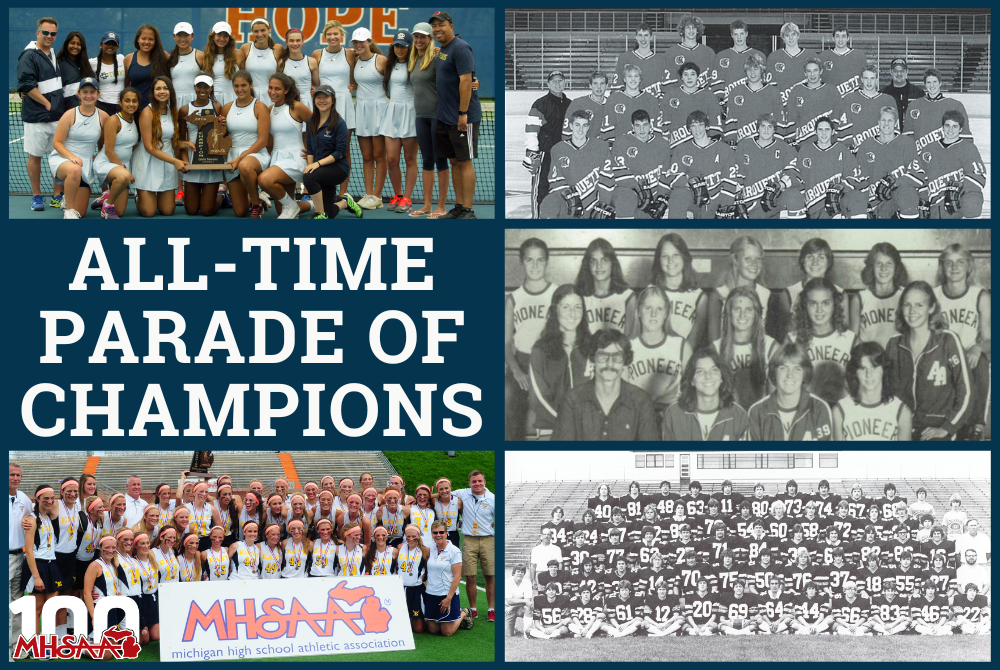
PHOTOS These are all past MHSAA Finals champions, clockwise from top left: The 2016 Detroit Country Day girls tennis team, 2004 Marquette ice hockey team, 1978 Ann Arbor Pioneer girls cross country team, 1981 Escanaba football team and 2013 East Grand Rapids girls lacrosse team.