

NFHS Voice: Madness to Maddening
March 23, 2020
By Karissa Niehoff
NFHS Executive Director
March Madness took on another meaning for everyone in the sports world during the week of March 9 – a week like none other in the history of organized sports with the acceleration of the coronavirus (COVID-19) in the United States.
The Madness was not the bouncing of basketballs in arenas around the country. Instead it was organization after organization trying to determine the viability of continuing to operate – particularly after the suspension of the NBA season and the cancellation of the NCAA Division I Men’s and Women’s Basketball Championships.
And NFHS-member state high school associations were among those organizations faced with making decisions because the heightened state of the coronavirus pandemic occurred in the middle of state high school basketball tournaments across the country. While 13 states had completed their tournaments, the remainder were faced with tough decisions throughout the week.
By the end of that week, another four states were able to complete their girls and boys basketball tournaments – although all of these states had to impose extreme limits on the number of fans in attendance.
About two-thirds of our member state associations had to shut down their tournaments. At this point, 19 state associations have cancelled their state basketball tournaments, while 15 others have postponed or suspended their events, although the hope of completing them seems to fade with each passing day.
In addition to basketball, some states were in the midst of conducting ice hockey, gymnastics and swimming championships. While most of those sports championships, along with wrestling, were completed, some states were forced to suspend or cancel these as well.
Because of varying information from state health leaders, the Centers for Disease Control and Prevention (CDC) and state governors, some states were able to continue playing longer than others. Each state’s high school basketball tournament is one of the anticipated events of the year – particularly for residents in towns with schools playing for a state title.
From start to finish of state basketball tournaments in the 50 states plus the District of Columbia, more than one million fans trek to gymnasiums to watch these events. This year, however, many of these fans, along with about half of the 950,000 boys and girls who play high school basketball, were not able to experience March Madness.
And if this wasn’t enough, spring sports seasons and championships are at risk – mainly because schools are closed in many states, which means the discontinuation of school activity programs. The NCAA has cancelled all spring sports championships; and while state associations haven’t cancelled spring championships yet, athletics and activities programs are on hold for a set period of time – or indefinitely in some states.
While the loss of college and professional sports has an enormous impact on everyday life, considering that events surrounding the coronavirus affect some 19,500 high schools and 12 million participants in high school sports and performing arts activities, the impact on high school sports is perhaps even larger.
We support our 51 member state association leaders as they continue to work through these challenges. The loss of state basketball championships in many states is a sizeable financial challenge ahead as they work to continue to make state-level athletics and activities programs available.
On many occasions, we have written about the value of high school sports and activities. This month, we have witnessed the disappointment of thousands and thousands of players and fans who were not able to experience a state championship – many of whom were “going to state” for the first time.
High school sports is different from every other level of sport as these programs are a vital part of communities across our nation. Two weeks ago, when the doors were closed in many gymnasiums, it was confirmation of the desire and need for education-based high school sports and activities in the United States.
During this time of imposed social distancing, it is a time to step back and be thankful for these programs in our nation’s schools.
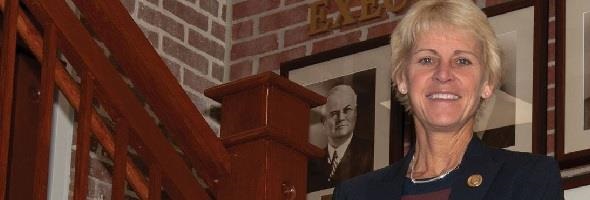
Dr. Karissa L. Niehoff is in her second year as executive director of the National Federation of State High School Associations (NFHS) in Indianapolis, Indiana. She is the first female to head the national leadership organization for high school athletics and performing arts activities and the sixth full-time executive director of the NFHS, which celebrated its 100th year of service during the 2018-19 school year. She previously was executive director of the Connecticut Association of Schools-Connecticut Interscholastic Athletic Conference for seven years.
Perspective: Fans at the Fore
December 11, 2014
In this week's edition of MHSAA Perspective, John Johnson talks about the Battle of the Fans IV, a program designed to recognize the best student cheering sections in the state.
Now in its 10th season, the radio commentary MHSAA Perspective – presented by the Michigan Army National Guard – airs on over 80 radio stations and audio outlets across the state, generally during the local broadcasts of high school games. The program runs for 30 weeks through the end of the winter sports season.
This week's Perspective: Fans At The Fore - Listen
Past editions
Dec. 1 - Life is Bigger than Football - Listen
Nov. 24 - Kudos - Listen
Nov. 17 - Something to Play For - Listen
Nov. 10 - Paper Playoff - Listen
Nov. 3 - Dumb & Really Dumb - Listen
Oct. 27 - The Middle - Listen
Oct. 20 - Football Playoff Primer - Listen
Oct. 13 - Value ... and Values - Listen
Oct. 6 - It's a Game - Not a War - Listen
Sept. 29 - Record Holders - Listen
Sept. 15 - Remembering 9/14 - Listen
Sept. 8 - Exposing Specialization - Listen
Sept. 1 - Enhancing The Fan Experience - Listen
Aug. 25 - Safety Trumps Everything - Listen