

Recent Stars Build on HS Sports Foundation
By
Pam Shebest
Special for MHSAA.com
January 23, 2018
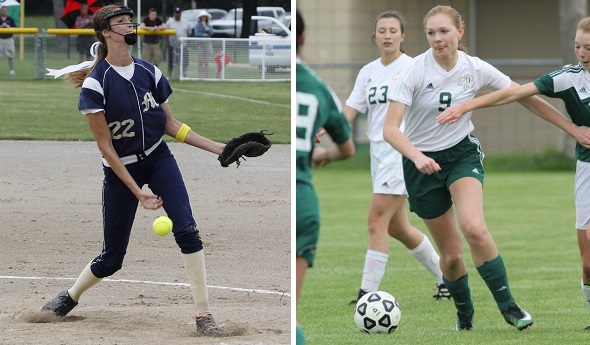
Mattawan’s Allie Havers experienced high school sports in part as a stepping stone to a scholarship and eventual national championship at the University of Nebraska.
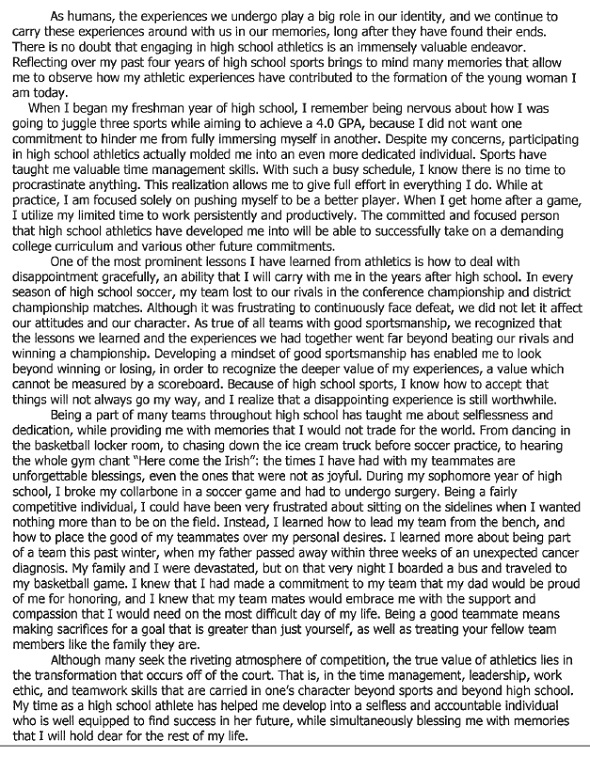
 Hackett Catholic Prep’s Hope Baldwin earned two national awards and several scholarships for an essay on the role of high school sports in shaping her future.
But for both Kalamazoo-area athletes, high school sports had a much deeper impact than just national recognition.
Baldwin, who is not playing varsity sports as a freshman at University of Notre Dame, was an MHSAA Scholar-Athlete Award winner, received the National Interscholastic Athletic Administrators Association National Scholar Athlete of the Year award in Phoenix in December and will travel to Atlanta in April for the Coach Wooden Citizenship Trophy.
She wrote the essay while a senior at Hackett and, looking back, she said, “When I wrote that essay, I think it was probably March of my senior year. Now, being in college and not being involved in those athletics any more has given me the opportunity to appreciate them even more.
 “Reading my speech and being able to look back on how I was writing from that perspective still in high school, I was like, ‘Oh my gosh.’ I knew it was important then, but now not having it any more I realize even more what a benefit high school sports are.”
The lasting impression for both athletes is not a specific game or highlight, but “mostly I miss my teammates and coaches,” Baldwin said.
“In each season, coming in every day to practice with the same people really made unique bonds because we were all working toward the same goals.”
Havers, who was first-team all-state in three sports at Mattawan, said looking back, it’s the people who made the deepest impression.
“I remember the people, the coaches, my teammates and the seniors who were on the team my senior year,” she said. “I look back, and it was a pretty cool experience. I’m really humbled.
“I didn’t do it by myself. I had help from my parents, siblings, coaches and teammates.”
Words of wisdom
Baldwin was stunned when her essay won for the state of Michigan and then for her NIAAA section (Michigan, Wisconsin, Iowa, Illinois, Indiana).
She then was chosen as the female national award winner, earning a $2,500 scholarship in addition to a plaque.
Among points she emphasized were the following:
- “Sports have taught me valuable time management skills.”
- “I learned … how to deal with disappointment gracefully, an ability I will carry with me in the years after high school.”
- “Developing a mindset of good sportsmanship has enabled me to look beyond winning or losing. … I realize a disappointing experience is still worthwhile.”
- “I broke my collarbone in a soccer game and had to undergo surgery. … I learned how to lead my team from the bench.”
She added that although most enjoy the thrill of competition, “the true value of athletics lies in the transformation off the court. That is, in the time management, leadership, work ethic and teamwork skills that are carried in one’s character beyond sports and beyond high school.”
Baldwin, who is majoring in neuroscience and behavior with a pre-med concentration, said she chose Notre Dame for academics rather than attending a smaller school where she might have played sports.
While she played four years of volleyball, basketball and soccer at Hackett, that drive for competition has not completely left her.
“I’ve been doing some intramural sports, which is really fun,” she said. “Sand volleyball, basketball and our dorm had a flag football team. We actually ended up making it to the championship and we got to play in the Notre Dame football stadium, so that was really cool.”
Succeeding, switching, succeeding again
Havers had no doubt she would be playing college sports after an outstanding career in basketball, volleyball and softball at Mattawan, graduating in 2013.
She earned a basketball scholarship to University of Michigan but when the coach left, she de-committed and eventually ended up with the Cornhuskers.
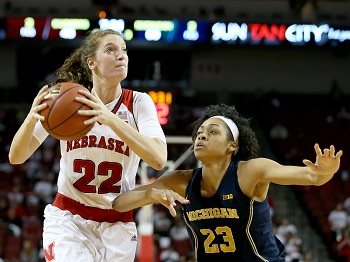 The transition from high school to college hoops was an eye-opener.
“I had to catch up to the game,” Havers said. “In college, the girls are a lot bigger, a lot stronger, a lot faster and more physical. I knew the girls at post, my position, were a lot stronger than me.
“I came in at (6-foot-4) 140 pounds, and most others in the post position were 180 to 200 pounds.”
Her practice schedule was also different.
In high school, the team practiced about two hours a day.
But in college, “We practice four hours and on the court just about every day,” Havers said. “You have school work, lifting, meetings, tutors. You will definitely come out with great organization skills.”
After playing four years of basketball at Nebraska and graduating with a degree in psychology, Havers knew she did not want to give up competition in a college atmosphere.
“I had a fifth year of eligibility left but not in basketball, so I went out for the volleyball team,” said Havers, who is working toward a master’s degree in journalism and mass communications. “I knew if I didn’t try, I would regret it. Nebraska is a volleyball dynasty.”
She was faced with a situation unfamiliar to her.
“I played every basketball game, but I played just two volleyball games,” she said. “It was a lot different. I was used to playing a lot in basketball and all through high school, too.”
“No athlete likes sitting the bench, but you learn your role and you go with it. I feel really blessed for the opportunity and knew I had to work hard for a spot.”
The payoff was the NCAA National Championship when Nebraska defeated Florida in the four-set final Dec. 16.
Even though her college eligibility is gone, Havers, who hopes coach once she graduates, is still playing sports at the intramural level.
“Beach volleyball is a college sport at Nebraska,” she said. “It’s a three-month season with an indoor court.”
Havers' advice for high school athletes is: “Go in with an open mind, go in with heart and leave nothing on the table. Go to practice earlier and stay later.
“Coaches promise you anything, but that’s not always the way it goes. You have to go with the flow.”
 Pam Shebest served as a sportswriter at the Kalamazoo Gazette from 1985-2009 after 11 years part-time with the Gazette while teaching French and English at White Pigeon High School. She can be reached at [email protected] with story ideas for Calhoun, Kalamazoo and Van Buren counties.
PHOTOS: (Top) Mattawan’s Allie Havers, left, and Kalamazoo Hackett’s Hope Baldwin enjoyed outstanding high school athletic careers. (Middle) Baldwin, top, and Havers. (Below) Havers went on to play both basketball and then volleyball at Nebraska. (Basketball photo courtesy of Nebraska’s athletic department; soccer photo courtesy of Hackett’s girls soccer program.)
ESSAY: See the full text of Baldwin’s essay below that contributed to her selection as an NIAAA Scholar Athlete winner for 2017.
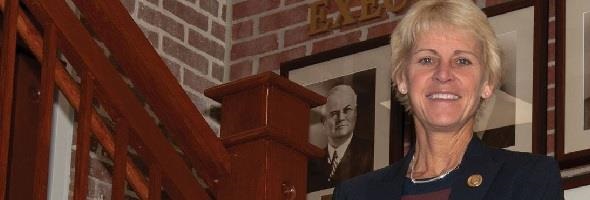
NFHS Voice: Football's Promising Results
September 9, 2020
By Karissa Niehoff
NFHS Executive Director
Normally at this time of year, the NFHS releases the latest figures from its annual High School Athletics Participation Survey. One of the most important and successful endeavors in the organization’s history, the NFHS has collected participation data through its 51 member state associations annually since 1971.
Before the 2018-19 school year, the number of participants in high school sports had increased for 29 consecutive years. Despite the first decline last year since 1988, we anticipated a quick turnaround in 2019-20 because of the continued strength of education-based high school athletics programs across the country.
There were encouraging reports last fall that football participation numbers were headed in a more positive direction. Interest in other fall sports continued to be at a high level, and winter sports were experiencing tremendous success. Then came the pandemic in mid-March, which shut down all high school sports competition.
Two-thirds of the states were unable to complete state basketball tournaments, and participants in the traditional spring sports of baseball, softball, track and field, and lacrosse – in most cases – were never able to take the field.
With spring sports unable to even get off the ground, state associations could not compile comprehensive surveys of sports participation for the 2019-20 school year. As a result, for the first time in the 50-year history of the survey, the NFHS is unable to release its annual summary of high school sports participation.
However, there is a silver lining to report. Though complete statistics are unavailable, numbers from a couple of sports last fall were obtained; and the optimism surrounding a positive trend in football participation came to fruition.
After annual declines of 23,311, 20,540 and 30,829 the past three years, participation by boys in high school 11-player football in 2019 dropped by only 2,489 – from 1,006,013 to 1,003,524. These numbers suggest to us that parents are appreciative of the risk minimization efforts that have been put in place. Every state has enacted rules that limit the amount of contact before the season and during practice, and every state has established concussion protocols and laws.
Participation in 11-player football reached an all-time high of 1,112,303 in 2008-09, and except for 2013-14, has declined every year since; however, this year’s decline is the smallest in 10 years.
The continued enthusiasm for football has been evident this fall – even amid the COVID-19 pandemic. State associations have worked with government, education and health leaders to do everything possible to offer the sport at some time during the 2020-21 season.
Some of the 34 states that are conducting football this fall have started play, and there is a special sense of gratitude on the part of students, coaches, officials and fans for the opportunity. While there may be pauses with some players and teams quarantined, and while 17 other states will not play until later in the school year, the excitement and anticipation of Friday Night Lights continues.
In addition to football, girls volleyball continued its tremendous growth last fall, increasing by 9,751 participants for a total of 462,559. In the past 10 years, the sport has added 60,000 participants and has passed basketball as the No. 2 sport for girls behind track and field.
Though a complete participation report for 2019-20 will not be available due to the loss of spring sports, totals on more fall and winter sports from 2019-20 will be formulated in the coming weeks. Judging from the early returns, it appears the past year’s participation numbers would have started the NFHS on a new streak of record participation if spring sports had not been cancelled.
Most likely, next year’s participation survey will be anything but ordinary as well. Regardless of the challenges in compiling participation statistics in 2020-21, the opportunity and desire to participate in all education-based activities remain.
Dr. Karissa L. Niehoff is starting her third year as executive director of the National Federation of State High School Associations (NFHS) in Indianapolis, Indiana. She is the first female to head the national leadership organization for high school athletics and performing arts activities and the sixth full-time executive director of the NFHS, which celebrated its 100th year of service during the 2018-19 school year. She previously was executive director of the Connecticut Association of Schools-Connecticut Interscholastic Athletic Conference for seven years.